In summary:
- Discovering Toronto’s best free views requires looking beyond the famous skyline and focusing on architectural details and unique perspectives.
- Timing is more critical than location; capturing landmarks during blue hour, after rainfall, or on weekdays avoids crowds and creates dramatic lighting.
- Create a walking tour connecting Beaux-Arts, Modernist, and Art Deco landmarks to capture the city’s “architectural dialogue.”
- Some of the most compelling shots are found in neighborhoods like The Beaches and High Park, which are inaccessible to tourist buses but easily reached by public transit.
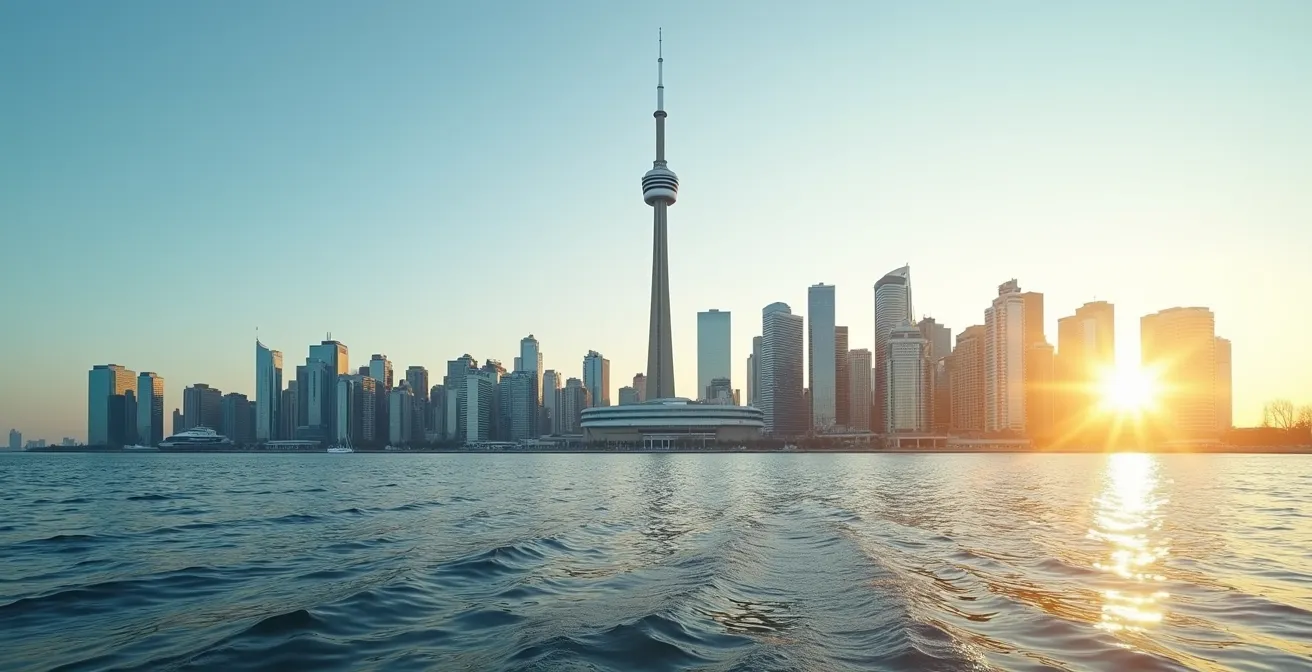
Every visitor to Toronto comes home with a photo of the CN Tower. It’s the city’s undisputed emblem, a needle piercing the sky, visible from almost everywhere. But as a photographer who has walked these streets for years, my lens is drawn elsewhere. The predictable, paid-for panoramas from observation decks often lack soul. They show you the city, but they don’t tell you its story. The real challenge, and the greater reward, lies in capturing Toronto’s iconic essence without spending a dollar on admission—finding the angles, textures, and moments that most people miss.
Many guides will point you toward the same crowded lookout points, offering generic advice. They treat photography as a checklist of places to visit. But what if the key wasn’t just *where* to go, but *how* to see? This guide is built on a different philosophy: that Toronto’s most powerful images are found in the dialogue between its buildings, the quality of light on weathered brick, and the strategic voids in time when the city reveals its quieter self. It’s about trading the postcard for the portrait.
We’ll move beyond the obvious, creating a photographer’s journey through the heart of the city and its hidden corners. We’ll explore how to frame the iconic Toronto Sign to tell a story, chart a walk through a century of architecture, and understand why the best camera is useless without the right timing. This is about learning to see the free gallery that is Toronto’s urban landscape.
This article provides a curated path through Toronto’s most photogenic and free-to-access landmarks. Follow along to discover the secrets a local photographer uses to capture the city’s true character, from its gleaming modern icons to its historic, textured soul.
Summary: Toronto Landmarks: Which Iconic Spots Offer the Best Free Views of the City?
- Why the “Toronto Sign” at Nathan Phillips Square is Essential for Your Feed?
- How to Create a Landmark Walking Tour From Union Station to City Hall?
- Gooderham Building vs. City Hall: Which Architecture Defines Toronto Better?
- The Timing Error That Makes Your Landmark Photos Full of Strangers
- When to Photograph Casa Loma: The Golden Hour Secret?
- Why the Tourist Bus Doesn’t Go to High Park or the Beaches?
- Why the Ceiling of the Great Hall Is a Masterpiece of Renovation?
- Toronto Skyline Photography: How to Capture the Perfect Shot from Polson Pier?
Why the “Toronto Sign” at Nathan Phillips Square is Essential for Your Feed?
The 3D “Toronto” sign at Nathan Phillips Square is more than just a tourist magnet; it’s a dynamic light sculpture in constant conversation with its surroundings. While it attracts a staggering number of people, with data suggesting over 1.5 million visitors annually to the area, the key to a standout photo isn’t fighting the crowd—it’s using the environment and time of day to your advantage. Forget the brightly lit midday selfie; the real art happens when the sun goes down and the sign’s LED lights begin their dance.
Your best tool here is the reflecting pool. On a calm evening, it transforms into a perfect mirror, allowing for a ‘double sign’ composition that adds depth and symmetry. The true magic, however, is during the “blue hour”—that fleeting 30-minute window after sunset when the sky holds a deep, rich blue that perfectly balances the artificial light of the sign and the surrounding buildings. This is when the colours pop without being blown out, creating a scene of urban harmony.
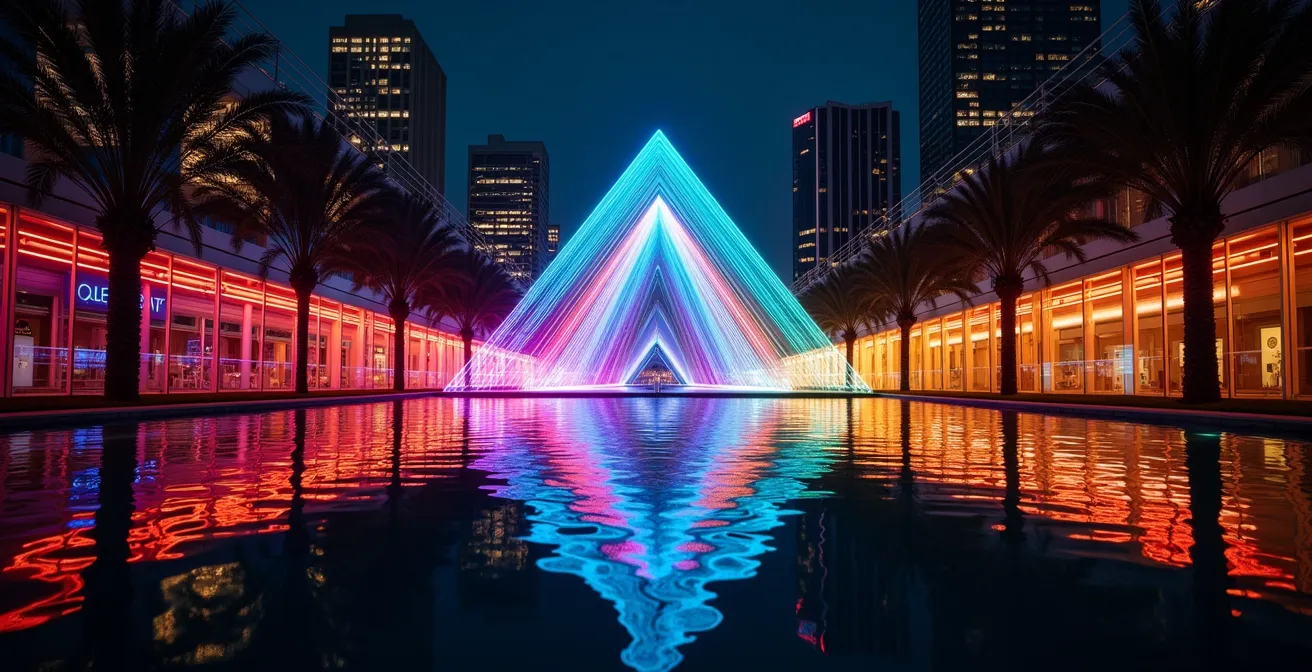
To capture this, think like a painter of light. Use a tripod to steady your camera for a long exposure of 2-4 seconds. This will not only make the lights glow but also blur any ice skaters in winter into beautiful, ethereal light trails, turning the “crowd” into a compositional element. Frame your shot with a wide-angle lens to include the architectural contrast of Old and New City Hall, placing the modern sign in its historical context. This is how you transform a simple landmark photo into a narrative about Toronto’s past and present.
Action Plan: Capturing the Definitive Toronto Sign Photo
- Visit during blue hour (30 minutes after sunset) for balanced city lights and sky exposure.
- Use the reflecting pool for a ‘double sign’ reflection shot during calm evenings.
- Frame the sign with both Old and New City Hall buildings using a wide-angle lens.
- Check the City of Toronto event calendar for special LED colour displays that can add thematic depth.
- Use a tripod and a long exposure (2-4 seconds) to capture light trails from winter ice skaters, turning motion into art.
How to Create a Landmark Walking Tour From Union Station to City Hall?
The short walk from Union Station to Nathan Phillips Square is not just a commute; it’s a free, open-air architectural museum. Instead of taking the subway or the underground PATH, walking above ground allows you to witness a century of design philosophy in a matter of blocks. This is where you capture the “architectural dialogue” of Toronto. The key is to start at Union Station and look at it not as a transit hub, but as your first subject: a grand, Beaux-Arts masterpiece of limestone and vaulted ceilings that speaks of an era of opulent travel.
As you walk north up Bay Street, you enter the Financial District. Here, the language changes abruptly. The stone facades of the 1930s Art Deco banks give way to the soaring glass and steel of the International Style towers from the 1970s. Don’t just look up; look for reflections. The glass curtain walls of modern towers often provide distorted, abstract reflections of their older stone neighbors, creating compelling, layered compositions that tell a story of urban evolution in a single frame. This is a visual conversation between eras, free for any patient photographer to capture.
This walk culminates at Nathan Phillips Square, where Viljo Revell’s Modernist City Hall (1965) awaits. Its curved concrete towers embracing the “flying saucer” council chamber is a radical departure from everything you’ve just seen. The contrast between the rigid geometry of the financial towers and the organic curves of City Hall is the photographic climax of your journey. This self-guided tour is about capturing the tension and harmony between these distinct architectural voices.
The table below breaks down the architectural styles you’ll encounter on this walk, providing a field guide for your photographic exploration.
| Building | Architectural Style | Year Built | Key Features |
|---|---|---|---|
| Union Station | Beaux-Arts | 1927 | Limestone facade, grand hall, vaulted ceiling |
| Financial District Banks | Art Deco/Modern | 1930s-1980s | Stone and glass facades, imposing entrances |
| Bay Street Towers | International/Postmodern | 1970s-2000s | Glass curtain walls, steel frames |
| City Hall | Modernist | 1965 | Curved concrete towers, flying saucer council chamber |
Gooderham Building vs. City Hall: Which Architecture Defines Toronto Better?
Asking whether the Gooderham Building or City Hall better defines Toronto is like asking if the heart or the brain is more important. They represent two different souls of the city, and a true photographic exploration must embrace both. The Gooderham “Flatiron” Building is Toronto’s romantic, historic heart. Its red-brick wedge shape and Richardsonian Romanesque style speak to a 19th-century city of industry and aspiration. It’s a piece of the past, beautifully preserved against a backdrop of modern skyscrapers. For a photographer, it offers textural storytelling at its finest.
As one visitor noted, its unique shape and ornate design immediately capture your attention, making it a must-see. A wide shot from the small park at its eastern tip is classic, but the real secret is to get closer. Use a macro lens to capture the weathered texture of the individual bricks and the intricate masonry. This is where the building’s history is written.

In contrast, City Hall is Toronto’s modernist brain—a symbol of its forward-looking, ambitious future when it was built. It is part of a civic space that, combined with Nathan Phillips Square, is arguably Toronto’s most visited public area, drawing over 2.5 million annual visitors. Photographically, it’s a study in curves, concrete, and scale. Instead of intimate textures, it offers grand, sweeping lines. The best shots are often found by playing with the relationship between its two towers and the central council chamber, using them to frame the sky or other buildings. One doesn’t define Toronto better than the other; they define its duality. The Gooderham Building is the city’s memory, while City Hall is its vision. A complete portfolio of Toronto needs both.
The Timing Error That Makes Your Landmark Photos Full of Strangers
The most common mistake in landmark photography isn’t your lens or your settings; it’s your timing. Showing up at a popular spot at 2 PM on a sunny Saturday is a recipe for a photo album full of strangers’ heads. The secret that separates amateur shots from professional ones is the strategic pursuit of photographic voids—the moments when light is magical and crowds are minimal. This often means embracing what others consider “bad” timing.
For instance, early mornings are your best friend. A sunrise shoot at a place like Riverdale Park not only offers sublime light but guarantees you’ll share the space with only a few dedicated dog walkers. The hours just before and after dawn offer a soft, diffused light that is far more flattering for architecture than harsh midday sun. Similarly, don’t be afraid of “bad” weather. A city just after a rainstorm is a gift. Wet pavement creates stunning reflections that can double your composition, turning a simple street scene into a work of art. Foggy days are equally magical, creating atmospheric depth and simplifying busy backgrounds by shrouding distant objects in mist.
Beyond weather, being aware of the city’s calendar is crucial. Trying to get a clean shot of a downtown landmark during major events like Nuit Blanche, Pride Weekend, or the Toronto Caribbean Carnival (Caribana) is an exercise in futility. These events transform public spaces, flooding them with people and infrastructure that will obstruct your view. Always check the city’s event schedule before planning a shoot. The best time for landmark photography is often when nothing special is happening. By choosing to shoot when others stay home—at dawn, in the rain, or during a quiet Tuesday morning—you are not just avoiding crowds; you are actively choosing better light and a more intimate connection with the city.
When to Photograph Casa Loma: The Golden Hour Secret?
Casa Loma, Toronto’s majestic Gothic Revival castle, presents a unique photographic challenge. With more than 650,000 tourists passing through its halls each year, capturing its grandeur without a sea of people in the foreground requires a specific strategy. While the interior requires a paid ticket, the exterior and its surrounding gardens are free to photograph, and this is where the real magic lies. The “golden hour secret” for Casa Loma isn’t just about showing up at sunset; it’s about understanding how the light interacts with its unique architecture.
The castle is perched on a hill, giving it a commanding presence. In the late afternoon, during the golden hour before sunset, the sun is low in the west. This raking light beautifully sculpts the intricate details of the castle’s stone facade, creating long, dramatic shadows that emphasize its texture and three-dimensionality. The warm, golden light makes the stone glow, transforming it from a simple grey structure into a fairy-tale castle. This is the time to focus on details: the ornate window frames, the crenelated battlements, and the gargoyles that adorn its walls.
For a view of the castle with the city in the background, patience is key. As one guide notes, the reward for climbing to a good vantage point is an incredible view of the skyline. Consider exploring the nearby Baldwin Steps or the quiet residential streets just south of the castle for unique framing opportunities. The secret isn’t a hidden location but a specific moment: that perfect late-afternoon window when the warm light brings the cold stone to life, telling a story of romantic ambition against the modern city below. It’s a free view that feels priceless.
If you make it to the top, however, you will be rewarded with an incredible view of the Toronto skyline.
– CityPASS Travel Guide, The Ultimate Guide to Visiting Casa Loma
Why the Tourist Bus Doesn’t Go to High Park or the Beaches?
The routes of tourist buses are designed for efficiency, sticking to a tight downtown loop of major, easily accessible attractions. They simply cannot navigate the smaller residential streets or dedicate the time required to venture out to sprawling destinations like High Park or The Beaches. This logistical limitation is a gift to the discerning photographer. It means these areas, rich with unique character and stunning views, retain a local feel and are free from the large tour groups that crowd downtown landmarks.
Reaching these “hidden” gems is a quintessential Toronto experience in itself, often involving the city’s iconic streetcars. The Beaches, for example, is best reached via the 501 Queen streetcar, a journey that is a photo opportunity in its own right as it travels through diverse neighborhoods. Once there, you’ll find a relaxed, boardwalk-lined waterfront, the striking Art Deco architecture of the R.C. Harris Water Treatment Plant, and a completely different perspective on Lake Ontario. It feels a world away from the downtown core.
Similarly, High Park is easily accessed via the Bloor-Danforth subway line. This massive urban park offers everything from serene forested trails and the tranquil Grenadier Pond to, in the spring, the world-famous cherry blossoms. These are the places where you can capture authentic Toronto life—scenes that are simply not on the tourist map. The reason the bus doesn’t go there is the very reason you should. They require a little more effort, but the photographic reward is a portfolio that looks genuinely local, not generic.
Your Transit Guide to Toronto’s “Hidden” Photo Spots
- Take the 501 Queen streetcar westbound from downtown to reach The Beaches district and the R.C. Harris Water Treatment Plant.
- Use the Bloor-Danforth subway line to High Park station for direct access to the park’s trails and gardens.
- For another stunning view, access the Humber Bay Arch Bridge by taking the 501 streetcar to the Humber Loop.
- Consider a short ferry ride to Ward’s Island, which is often less crowded than Centre Island and offers beautiful, quiet skyline viewpoints.
- Download a TTC (Toronto Transit Commission) app for real-time transit updates to make your journey seamless.
Why the Ceiling of the Great Hall Is a Masterpiece of Renovation?
Hidden in plain sight on the University of Toronto campus is one of the city’s most breathtaking interior spaces: the Great Hall at Hart House. While many landmarks impress with their exterior scale, the Great Hall’s magic is internal and vertical. Its ceiling is a masterpiece not just of original craftsmanship but of thoughtful heritage preservation. Representing a significant piece of Toronto’s academic history, the building was built in 1919 with Gothic Revival architecture, and its ceiling is a testament to that era’s artistry.
The ceiling is a stunning example of a hammer-beam roof, a complex and beautiful construction technique that allows for a vast, open space without supporting columns. What makes it a masterpiece of renovation is how modern necessities were integrated without compromising the historical integrity. During restoration, modern climate control and lighting systems were discreetly woven into the original structure. Specialized heritage contractors, using traditional materials and techniques documented from the original construction, ensured that the soul of the 1919 design was preserved. It’s a seamless blend of old and new that is nearly invisible to the untrained eye.
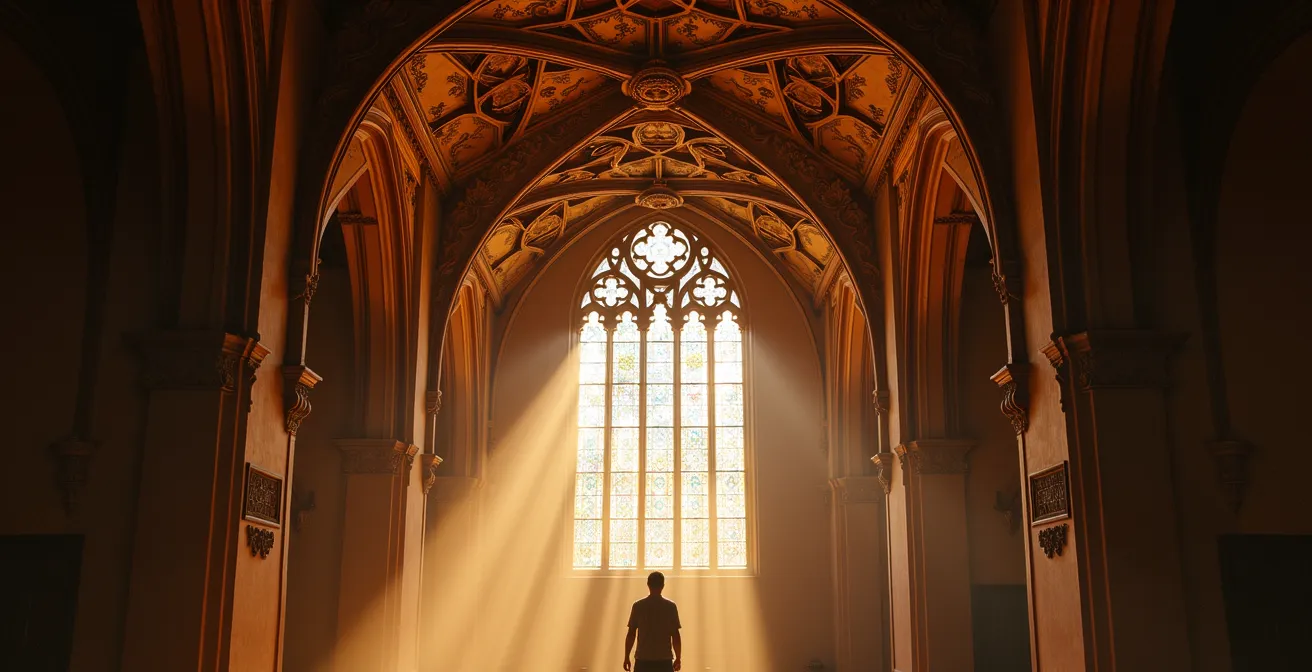
For a photographer, the Great Hall is a lesson in capturing light and scale. The massive leaded glass windows flood the space with light, which plays across the dark, carved wood of the ceiling. The best approach is to use a wide-angle lens and shoot from a low angle, looking straight up, to emphasize the geometric patterns and the soaring height. The challenge is to capture the feeling of awe that the space inspires. It’s a free, publicly accessible interior that rivals the cathedrals of Europe, a quiet testament to the idea that sometimes the most stunning view is right above your head.
Key takeaways
- The best Toronto photos come from focusing on architectural detail, light, and timing, not just famous locations.
- Avoiding crowds is a matter of strategic timing: embrace early mornings, “bad” weather, and off-season weekdays.
- Connect landmarks through a walking tour to capture the “dialogue” between different architectural eras in the city.
Toronto Skyline Photography: How to Capture the Perfect Shot from Polson Pier?
Polson Pier offers, without a doubt, the most iconic postcard view of the Toronto skyline. It’s the money shot, the one you see in magazines and films. But precisely because it’s so famous, capturing a unique photo here requires a more thoughtful approach. It’s not just about pointing your camera at the CN Tower; it’s about composing a shot that includes the industrial, gritty character of the Port Lands foreground, which tells a more interesting story.
The best time to shoot from Polson Pier is indisputably during the blue hour and into the night. This is when the city lights begin to sparkle and reflect beautifully on the surface of Lake Ontario. As one guide perfectly summarizes, the view is “especially beautiful at night when the city lights reflect on the water.” A tripod is non-negotiable here for capturing crisp, long-exposure shots. Use the water’s surface as a key compositional element, waiting for moments of calm to get those perfect, glassy reflections.
The Polson Pier also provides a panoramic view of the downtown skyline, especially beautiful at night when the city lights reflect on the water.
– GetYourGuide Toronto, 9 of the Best Views in Toronto
While Polson Pier is the star, it’s helpful to understand its place in the constellation of Toronto viewpoints. Each location offers a different narrative. The Toronto Islands provide a cleaner, more distant “classic” view, while Riverdale Park East gives an elevated perspective from the other side of the Don River. Polson Pier’s unique advantage is its industrial context and direct water reflections, making it feel more immediate and dynamic.
| Location | Best Time | Distance from Downtown | Key Advantage |
|---|---|---|---|
| Polson Pier | Blue Hour/Night | 3km south | Industrial foreground, water reflections |
| Toronto Islands | Sunset | 2km south | Classic postcard view |
| Riverdale Park East | Sunrise | 4km east | Elevated perspective with foreground park |
| Humber Bay | Sunrise | 8km west | Arch bridge framing opportunity |
Now that you’re armed with the secrets of light, timing, and perspective, the final step is to head out and see the city for yourself. Go beyond the checklist and start looking for the stories written in brick, steel, and glass. The most memorable photograph of Toronto you’ll ever take won’t be of a landmark, but of the connection you make with it.