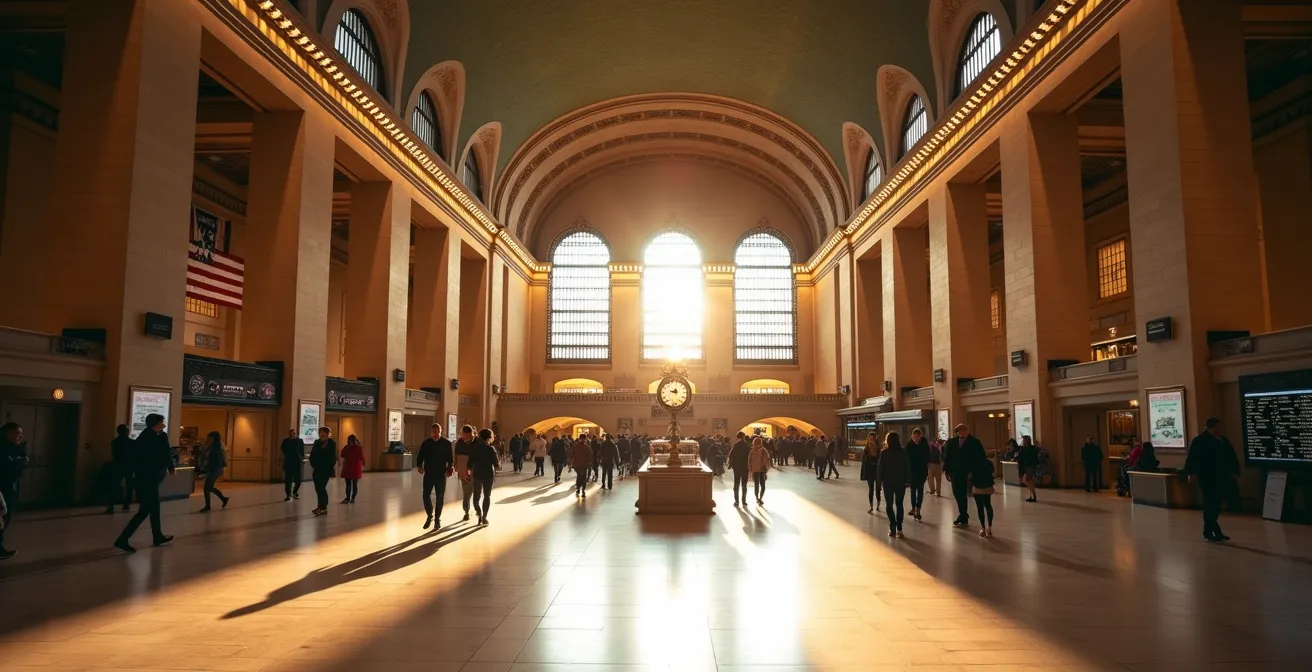
Union Station’s Great Hall is more than a transit point; it’s Toronto’s civic living room, a space whose architectural grandeur and social rhythms can transform a simple meeting into a memorable urban experience.
- The hall’s award-winning restored architecture, from its Gustavino tile ceiling to its Zumbro stone walls, provides a magnificent backdrop.
- Understanding the hall’s “temporal rhythms”—the dynamic rush hour versus the calm weekend—is key to planning both photography and conversations.
- Its grand scale creates a powerful echo, making certain areas unsuitable for calls, but designated quiet zones offer a practical escape.
Recommendation: Treat the hall not as a chaotic corridor to rush through, but as the first landmark on your Toronto journey, a destination in its own right.
For many Torontonians and visitors, the default plan is simple: “Let’s meet at Union Station.” This usually translates to a frantic search for a familiar face amidst a sea of hurried commuters under the main clock. It’s functional, but it misses the point. We treat the Great Hall as a mere passageway, a chaotic but necessary evil of urban transit. We focus on its utility, acknowledging its beauty with a passing glance, but rarely do we engage with it as a space designed for human connection.
The common advice stops at “meet at the clock,” but what if the true art of using the Great Hall lies not in finding a person, but in appreciating the stage itself? What if we reframe it from a transit hub into a ‘Third Place’—a grand, public living room for the city? This perspective shifts the focus from simply passing through to truly inhabiting the space. It’s about understanding the architectural choreography that guides our movements, the temporal rhythms that define its atmosphere, and the hidden details that tell a story of a century of civic life.
This guide moves beyond the obvious. It’s an invitation to see the Great Hall with the eyes of an urban historian and a social observer. We will delve into the secrets of its celebrated ceiling, learn how to strategically navigate its social dynamics, and discover how to leverage its grandeur for everything from a memorable rendezvous to the perfect photograph. By understanding its design, you can transform a simple meeting into an experience deeply rooted in the architectural and social fabric of Toronto.
In this article, we will explore the architectural marvels, practical navigation tips, and cultural heartbeat of this iconic space. The following sections will guide you through using the Great Hall not just as a waypoint, but as a destination.
Summary: A Deeper Look into Toronto’s Great Hall
- Why the Ceiling of the Great Hall Is a Masterpiece of Renovation?
- How to Locate the Information Booth Clock for a Rendezvous?
- Great Hall Rush Hour vs. Weekend Calm: Which Vibe is Better for Photos?
- The Echo Mistake That Makes Phone Calls Impossible in the Hall
- When to Visit the Great Hall for Free Concerts and Markets?
- Panorama Lounge vs. Great Hall: Where to Wait for Your Train?
- How to Create a Landmark Walking Tour From Union Station to City Hall?
- Toronto Landmarks: Which Iconic Spots Offer the Best Free Views of the City?
Why the Ceiling of the Great Hall Is a Masterpiece of Renovation?
To stand in the Great Hall and look up is to witness a triumph of heritage preservation. The ceiling is not merely decorative; it is the architectural soul of the station, a testament to a renovation project that balanced historical integrity with the demands of a modern transit hub. The recent revitalization, which won a 2024 Built Heritage Award, was a monumental undertaking, especially considering that the traffic at Union Station has grown to 65 million passengers annually. This wasn’t just a paint job; it was a meticulous act of conservation.
The centerpiece of this work is the original 1927 Gustavino tile coffered ceiling. This intricate, self-supporting vault system, a marvel of early 20th-century engineering, was carefully cleaned and restored to its original lustre. This process was complemented by the cleaning of the hall’s grand walls, constructed from Zumbro stone from Missouri, which famously contain visible fossils embedded within the creamy limestone. The project went beyond surface beauty, integrating seismic upgrades and environmental remediation to ensure the building’s longevity.
A key challenge was introducing modern amenities without compromising the historic fabric. The solution was an advanced LED lighting system, designed in consultation with heritage experts. It illuminates the architectural features, highlighting the depth of the coffers and the texture of the stone, without causing the heat damage associated with older lighting technologies. This thoughtful integration of old and new is what defines the project as a masterpiece, preserving the hall’s character for future generations to appreciate.
Your Checklist for Appreciating the Renovation
- Spot the Gustavino Tiles: Look up at the vaulted ceiling and notice the intricate, interlocking terracotta tiles that form the coffers.
- Hunt for Fossils: Examine the large, warm-toned Zumbro stone blocks on the walls. Look closely for the faint outlines of ancient marine fossils.
- Observe the Lighting: Notice how the modern LED lights are positioned to graze the architectural details, creating highlights and shadows that enhance the three-dimensional quality of the space.
- Compare Textures: Contrast the smooth, herringbone pattern of the Tennessee marble floors with the textured stone of the walls and the tiled ceiling.
- Assess the Scale: Take a moment to appreciate the sheer volume of the space and consider the engineering required to stabilize and preserve a building of this size and age.
How to Locate the Information Booth Clock for a Rendezvous?
The iconic clock above the central information booth is the traditional heart of the Great Hall, the North Star for countless reunions and first meetings. While “meet me at the clock” is a Toronto cliché, navigating to it with grace, especially during peak hours, is an exercise in urban awareness. The clock’s location is a deliberate piece of architectural choreography, designed to be a central, unmissable beacon within the vast hall.
For the most direct and dramatic approach, enter through the main doors on Front Street. This entrance deposits you directly into the Great Hall, with the grand station clock positioned centrally, demanding your attention. If you are arriving from the GO Transit system, you will emerge from either the York or Bay Concourses; simply follow the overhead signs pointing towards the “Great Hall” or “VIA Rail.” For those arriving via the TTC subway, the journey is an upward one through the PATH system. Follow the well-marked signs for Union Station, and they will guide you into the main hall, where the clock will be immediately visible.
To avoid confusion, especially when meeting someone during a busy period, a little extra precision goes a long way. Instead of just “at the clock,” specify which side: the ‘Bay Street side’ (east) or the ‘York Street side’ (west). This simple clarification can turn a potentially stressful search into a smooth and seamless connection. The area around the clock is more than a landmark; it’s a social stage where the daily drama of the city unfolds.
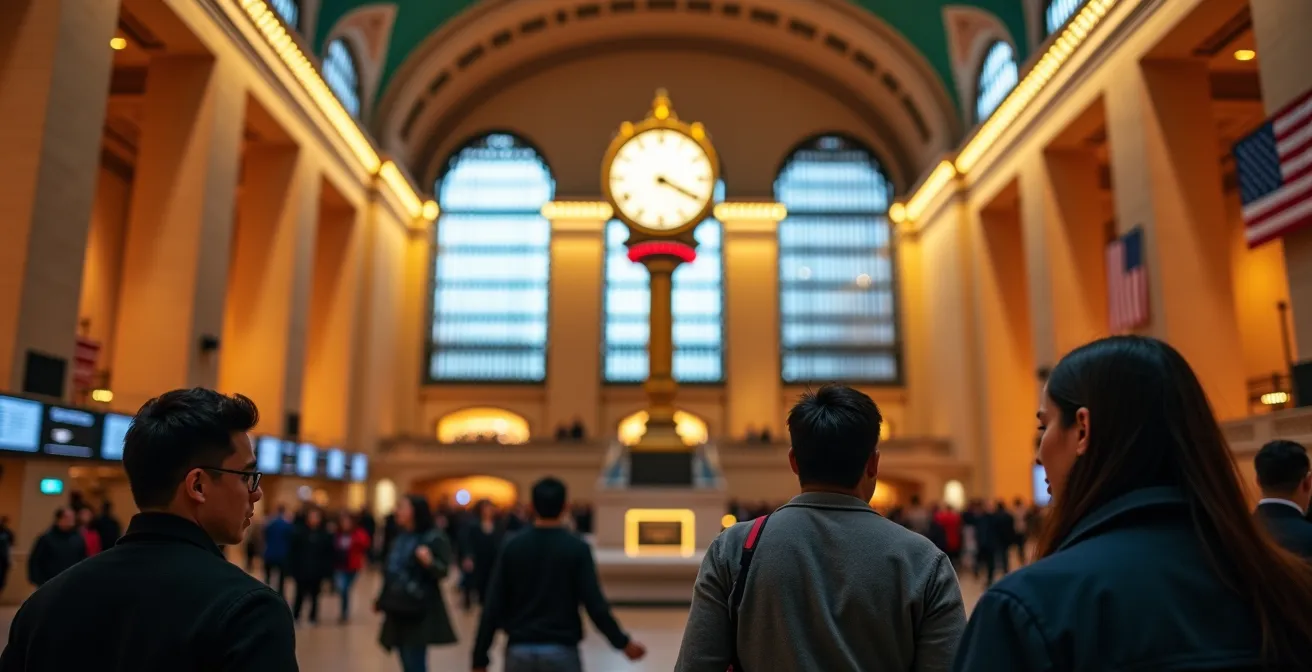
As you can see, the clock serves as a natural anchor point, drawing people together beneath its commanding presence. Its design and placement are fundamental to the hall’s function as a public square, a place where journeys begin and end, and where the city’s residents constantly cross paths.
Great Hall Rush Hour vs. Weekend Calm: Which Vibe is Better for Photos?
The Great Hall is a space of shifting moods, and its photographic potential changes dramatically with its temporal rhythms. The choice between shooting during a chaotic weekday rush hour or a serene weekend morning depends entirely on the story you wish to tell. One is a dynamic portrait of a city in motion; the other is a quiet study of architectural grandeur.
During weekday rush hours (typically 7-9 am and 5-7 pm), the hall transforms into a stage for the “commuter ballet.” The space is filled with the energy of over 300,000 daily visitors, creating a blur of purposeful movement. This is the ideal time for photographers looking to capture the hall’s primary function as a transit hub. Using a long exposure can transform the crowds into artistic streams of light and motion, contrasting the fleeting human element with the permanence of the stone and marble architecture.
Conversely, weekend mornings offer a cathedral-like calm. With significantly reduced foot traffic, the hall’s architectural details take center stage. This is the perfect time for sharp, clean compositions focusing on the coffered ceilings, Zumbro limestone walls, and the grand, four-storey arched windows. As professional photographers note, arriving on an early Sunday morning allows you to capture the golden hour light streaming through the east-facing windows, casting dramatic shadows across the Tennessee marble floors and revealing the full majesty of the space.
The following table, based on observations from photographers and regular visitors, breaks down the key differences to help you plan your visit.
| Aspect | Rush Hour (Weekdays 7-9am, 5-7pm) | Weekend Calm |
|---|---|---|
| Best For | Dynamic shots with commuter movement | Architectural details and clean compositions |
| Lighting | Consistent artificial lighting | Natural light through arched windows |
| Crowd Level | 300,000+ daily visitors on weekdays | Significantly reduced foot traffic |
| Photography Style | Long exposure for motion blur | Sharp architectural photography |
| Access to Features | Limited due to crowds | Full access to coffered ceilings, Zumbro limestone walls |
The Echo Mistake That Makes Phone Calls Impossible in the Hall
One of the Great Hall’s most defining and, for some, frustrating features is its acoustic character. The same design elements that create its sense of grandeur—soaring height and hard, reflective surfaces—also produce a powerful, lingering echo. This is not a design flaw but a natural consequence of its monumental scale. The Great Hall’s massive dimensions of 250 feet long and 88 feet high, combined with its marble floors, stone walls, and tiled ceiling, create a perfect chamber for sound to reverberate.
For the unsuspecting visitor, this can lead to the classic “echo mistake”: attempting to take an important phone call in the middle of the hall. The ambient noise of announcements, conversations, and footsteps is amplified and smeared by the long reverberation time, making clear communication nearly impossible. You’ll often see people pacing, phone pressed to their ear, with a look of growing frustration. Understanding this acoustic property is key to using the space effectively.
Rather than fighting the echo, the savvy visitor knows where to find acoustic relief. The station’s revitalization project and its surrounding design offer several nearby oases of quiet. If you need to make a call or simply escape the cavernous sound, you don’t have to go far. These spots offer a quick retreat without forcing you to leave the station’s orbit entirely.
Action Plan: Finding a Quiet Zone for a Phone Call
- Head for the Moats: Exit the Great Hall to the covered “moats” that run along the Front Street exterior. These areas are weather-protected and offer a significant reduction in echo.
- Use the West Wing: The renovated West Wing office areas, often covered with glass, provide enclosed spaces that effectively block the hall’s reverberations.
- Seek Retail Pockets: Move towards the lower-level retail concourses. The lower ceilings, carpeting in some areas, and storefronts help to absorb sound and create a less echoey environment.
- Step Outside: For immediate acoustic relief, the simplest solution is to step out onto the Front Street promenade.
- Try the Lounge (Conditional): For VIA Rail passengers with appropriate tickets, the VIA Business Class Lounge offers a premium, quiet environment designed for work and relaxation.
When to Visit the Great Hall for Free Concerts and Markets?
The Great Hall truly comes alive as a “Living Landmark” when it hosts public events. Throughout the year, the space and its surroundings are transformed from a transit corridor into a cultural destination, offering free concerts, art installations, and seasonal markets. Planning a meeting or visit to coincide with these events elevates the experience, turning a simple rendezvous into a shared cultural moment.
The station’s event calendar is dynamic, but several signature events have become beloved Toronto traditions. Union Winter often features a free roller-skating rink in the TD West Carriageway, complete with skate rentals and lessons, running from late November to mid-January. In the warmer months, Union Summer takes over the Front Street plaza with outdoor programming, food vendors, and performances. These events activate the station’s exterior, drawing the energy of the Great Hall outwards.
Inside the station, art and music are a constant presence. Union Arts is a year-round program that commissions and displays free public art throughout the building. A recent example is “All Beings Connected,” a powerful exhibit by father-son Anishinaabe artists August and Luke Swinson, exploring relationships between people and the land. In addition to visual arts, it’s common to find live music performances in the Great Hall, often scheduled during evening rush hours to provide a soothing or energizing soundtrack to the commute. Food and craft markets also frequently pop up, particularly on weekends in the York Concourse, adding to the vibrant atmosphere. To stay current, checking the official torontounion.ca/events website is always recommended.
Panorama Lounge vs. Great Hall: Where to Wait for Your Train?
When faced with a long wait for a train, travelers at Union Station have a distinct choice of atmosphere. The decision between waiting in the public grandeur of the Great Hall or the exclusive comfort of the VIA Rail Panorama Lounge is not about which is “better,” but about what kind of experience you seek. It’s a contrast between historical immersion and modern tranquility.
Waiting in the Great Hall is a quintessentially public experience. You are part of the city’s living fabric, surrounded by the echoes of history and the constant flow of fellow travelers. It’s a fantastic spot for people-watching, for soaking in the Beaux-Arts architecture, and for feeling the pulse of Toronto. However, seating is limited, the noise level is high due to the echo, and the atmosphere is one of constant motion. It is best suited for shorter waits where you want to remain connected to the station’s energy.
The Panorama Lounge, accessible to VIA Rail Business Class passengers, offers the complete opposite. As an official source from Metrolinx highlights, it has been fully renovated with premium amenities. It is a quiet, comfortable, and controlled environment. With comfortable seating, complimentary beverages, Wi-Fi, and a low noise level, it is an oasis of calm designed for productivity or relaxation. This space is ideal for business travelers or anyone facing a lengthy wait who values peace and comfort over public spectacle.
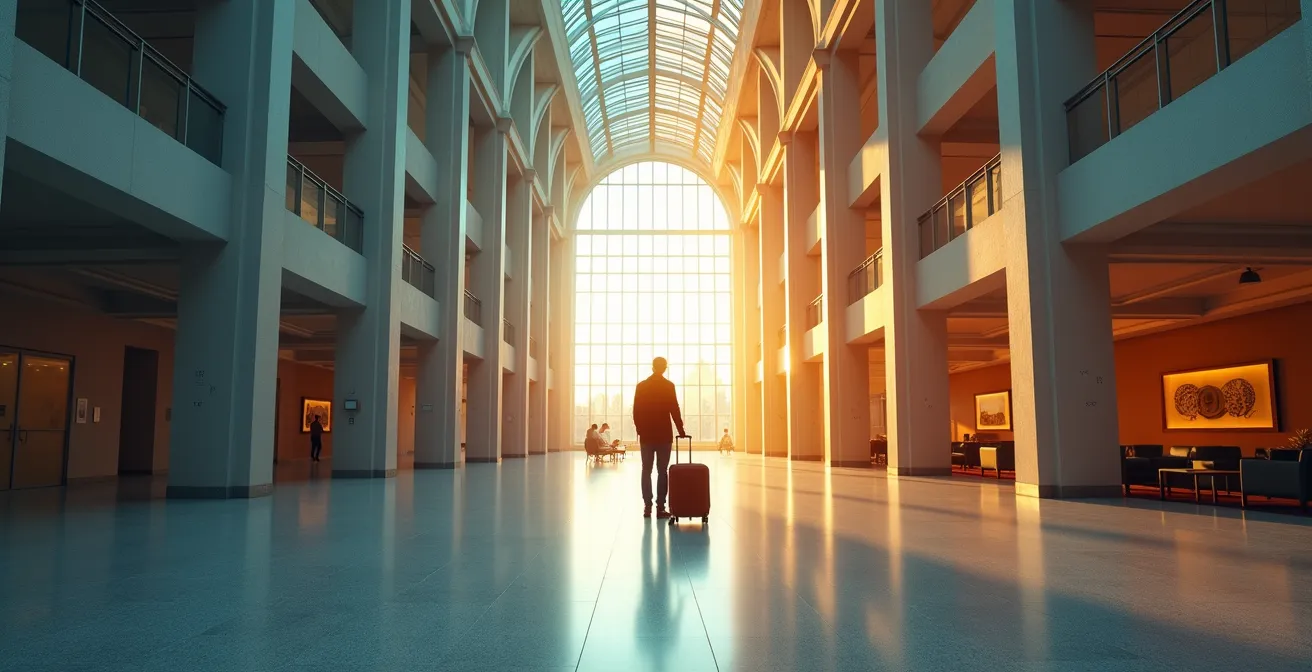
This choice embodies the modern reality of Union Station: a place where a century of history coexists with contemporary needs. The table below summarizes the key differences to help you decide where to spend your time.
| Feature | Great Hall | Panorama Lounge (VIA) | Union Food Court |
|---|---|---|---|
| Access | Free, public | VIA Business Class only | Free, public |
| Atmosphere | Grand, echoing, historic | Quiet, comfortable seating | Casual, family-friendly |
| Amenities | VIA ticket counters, departure boards | Fully renovated with premium amenities | 30+ food vendors |
| Best For | Short waits, people watching | Long waits, business travelers | Families, budget travelers |
| Noise Level | High (echo effect) | Low | Moderate |
How to Create a Landmark Walking Tour From Union Station to City Hall?
Union Station’s Great Hall is not just a destination in itself; it’s the perfect prologue to a larger architectural story. Starting your exploration here allows you to embark on a walking tour that traces the evolution of Toronto’s downtown core, moving from the historic Beaux-Arts style of the early 20th century to the sleek modernism of the mid-century and beyond. This journey on foot to Nathan Phillips Square and City Hall is a tangible lesson in architectural history.
The tour begins by fully absorbing the grandeur of the Beaux-Arts style within the Great Hall (1927). Pay attention to its symmetry, its monumental scale, and its classical details. As you exit onto Front Street and head north on Bay Street, you immediately enter a different era. You’ll pass the TD Centre, a masterpiece of the International Style designed by Ludwig Mies van der Rohe. Its stark black steel and bronze-tinted glass offer a dramatic contrast to the ornate limestone of the station.
As you continue through the heart of the Financial District, you’ll be surrounded by a canyon of glass and steel towers representing decades of architectural innovation. The walk culminates at Nathan Phillips Square, home to Viljo Revell’s iconic New City Hall (1965). Its futuristic curved towers and central “saucer” council chamber represent a bold, forward-looking vision for the city. This walking tour is a narrative that you can read in the city’s skyline, starting with the classical overture of Union Station.
Your Architectural Walking Tour Itinerary
- Start: Union Station (1927): Begin in the Great Hall, admiring the 250-foot-long space, 88-foot-high ceiling, and massive arched windows. Note the herringbone pattern of the Tennessee marble floors.
- North on Bay Street: Exit onto Front Street, turn north on Bay, and enter the modernist landscape of the Financial District.
- Pause: TD Centre (1967): Take a moment to appreciate the minimalist elegance of Mies van der Rohe’s influential black towers.
- Continue North: Walk through the towering skyscrapers, observing the different styles of glass curtain walls and structural designs.
- End: Nathan Phillips Square & New City Hall (1965): Arrive at the public square and admire Viljo Revell’s modernist landmark, a symbol of Toronto’s post-war ambition. For a bad weather alternative, you can navigate much of this route using The Path, the world’s largest underground shopping complex.
Key takeaways
- The Great Hall is more than a transit hub; it’s an architectural masterpiece and a dynamic ‘Third Place’ for the city.
- Leverage the hall’s “temporal rhythms”: use rush hour for dynamic energy and weekends for calm architectural appreciation.
- The echo is a key feature, not a flaw. Know the nearby quiet zones for practical needs like phone calls.
- Use the hall as a gateway to cultural events within the station and as the starting point for exploring Toronto’s other landmarks.
Toronto Landmarks: Which Iconic Spots Offer the Best Free Views of the City?
Once you’ve fully experienced the ground-level grandeur of the Great Hall, the natural next step is to see it within the broader context of the city’s skyline. Union Station serves as the ultimate gateway, a hub from which you can easily access some of the most spectacular and, importantly, free viewpoints in Toronto. It is, as the official Union Station website states, more than the country’s busiest transportation hub; it’s a launchpad for urban exploration for its more than 300,000 daily visitors.
A short walk or a quick TTC ride from Union can transport you to vistas that offer breathtaking perspectives. For the classic postcard view, Riverdale Park East is unparalleled, especially at sunset when the light hits the downtown skyline. It’s easily accessible from Broadview station on Line 2. A little north of there, the Chester Hill Lookout provides a slightly different but equally stunning angle over the Don Valley.
If you prefer an indoor or more central viewpoint, the top floor of the Toronto Reference Library (near Bloor-Yonge station) offers a fantastic, free panoramic view looking south. For a waterfront perspective looking back at the concrete jungle, a 15-minute walk south from Union Station to the Harbourfront is all it takes. And for a hidden gem, the courtyard at Commerce Court, just a 5-minute walk from the station, offers a unique upward view, framing the sky with historic and modern architecture. Each of these spots provides a new way to appreciate the city you just traversed from its very heart.
Now that you understand the rhythms, secrets, and architectural language of the Great Hall, it’s time to put this knowledge into practice. Use it not just as a place to meet, but as the first chapter in your next Toronto adventure.