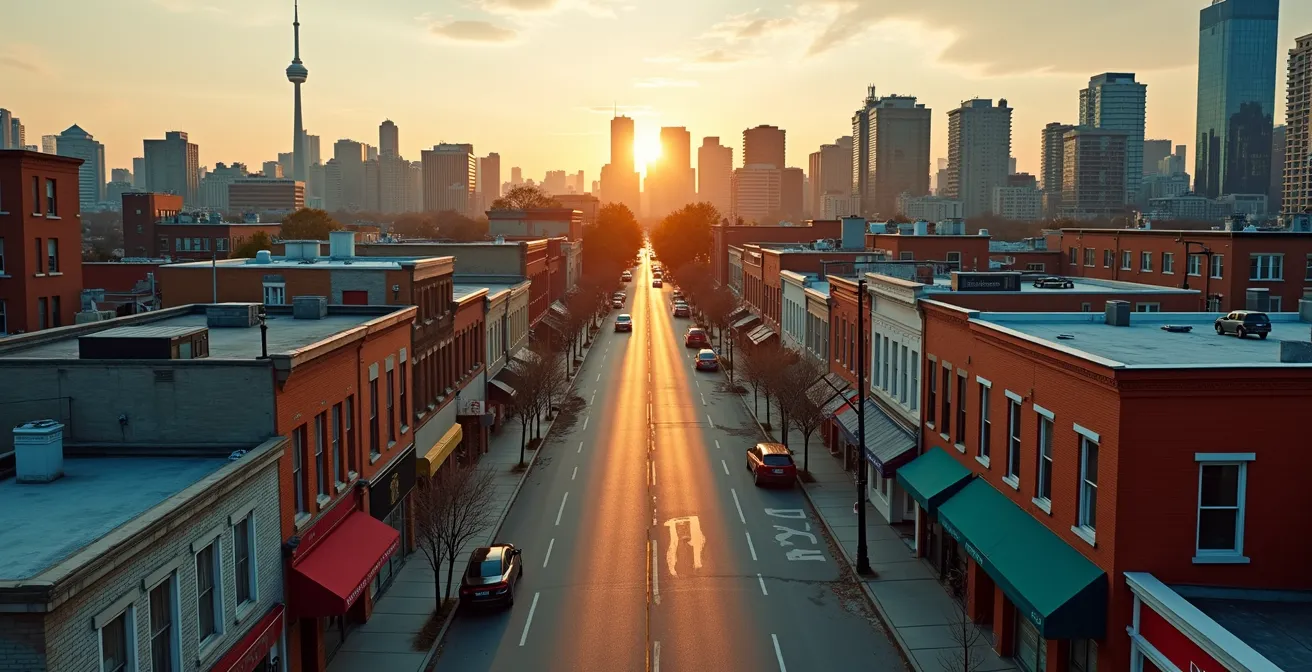
Contrary to the postcard image, Toronto’s “ethnic” neighborhoods are not static museums but are in a constant state of evolution, driven by the socio-economic journeys of their residents.
- The location and character of cultural enclaves like Little Italy and Chinatown have shifted dramatically due to post-war prosperity and new waves of immigration.
- Understanding a neighborhood’s identity requires looking beyond restaurants to its urban planning, architecture, and the “living archives” of community life found in suburbs and local institutions.
Recommendation: To truly grasp a neighborhood’s story, trace the patterns of cultural succession and suburbanization, rather than just visiting the designated tourist zones.
For the history buff or genealogy enthusiast, Toronto presents a fascinating puzzle. The city is celebrated as a multicultural mosaic, a collection of distinct neighborhoods like Greektown, Little Italy, and Chinatown, each seemingly a preserved snapshot of a specific heritage. The common approach is to explore these areas through their food and festivals, assuming they are static representations of their founding immigrant communities. This perspective, however, misses the deeper, more dynamic story of the city.
The truth is that these neighborhoods are not museums. They are living, breathing entities shaped by constant, overlapping processes of change. The real history of Toronto is not just in the establishment of these communities, but in their movement, their transformation, and the complex forces of economic mobility and urban development that redefine them. If we only look at the main streets, we are only reading the first chapter of a much longer book. The real key to understanding Toronto’s identity lies not in viewing its neighborhoods as fixed cultural islands, but as ‘arrival cities’ in perpetual motion.
This exploration will move beyond the superficial to uncover the mechanisms of this change. We will trace the migratory paths of communities, examine how to research your own family’s journey, contrast the evolution of different enclaves, and reveal the authentic cultural experiences that exist just beyond the tourist-trodden path. By looking at the city as a social historian would, we can begin to see the true, ever-shifting cultural landscape of Toronto.
This guide delves into the dynamic history shaping Toronto’s neighborhoods, offering a historian’s perspective on their evolution. The following sections provide a detailed exploration of these cultural shifts and how to uncover them.
Summary: The Evolving Story of Toronto’s Immigrant Neighborhoods
- Why Little Italy Moved Westward Over the Decades?
- How to Research Your Family’s Arrival at Union Station?
- Chinatown vs. Koreatown: Which Retains More Original Immigrant History?
- The Assumption Mistake Visitors Make About “Ethnic” Neighborhoods
- When to Visit Heritage Open Doors to See Historic Immigrant Homes?
- South Market vs. North Market: Where to Find the Farmers?
- Why European-Style Guesthouses Are Rare in Toronto?
- Dining on The Danforth: How to Experience Authentic Greek Culture Beyond the Main Strip?
Why Little Italy Moved Westward Over the Decades?
The story of Toronto’s Little Italy is a classic example of cultural succession and the impact of economic mobility on an immigrant enclave. The vibrant stretch of College Street we know today is more of a historical monument than the demographic centre it once was. The original community, established by Italian immigrants in the early 20th century, has largely moved on, demonstrating a common pattern in the city’s development.
After World War II, a significant shift began. As Italian-Canadian families achieved greater financial security, they sought larger homes and a different lifestyle, sparking a migration first to St. Clair Avenue West, and then a more significant exodus to the suburbs. This pattern is detailed in a case study on the community’s evolution, which notes that by the 1960s, families began moving to what would become major Italian-Canadian hubs in Woodbridge, Vaughan, and Mississauga. The original Little Italy was no longer the primary residential heart of the community.
In its place, a new wave of residents arrived. This process of gentrification is key to understanding the neighborhood’s current form. As the real estate firm Urbaneer notes in their analysis of the area, the transformation accelerated a few decades ago:
Little Italy began gentrifying two decades ago when young first and second generation Canadians began locating here due to the affordable entry-level prices of its eclectic housing stock.
– Urbaneer Real Estate, College Street/Little Italy Real Estate Report
Today’s Little Italy is a complex blend of preserved heritage fabric—historic businesses and cultural symbols—and the influence of new, diverse residents. It serves as a powerful reminder that a neighborhood’s name often refers to a past chapter in its ongoing story, not its present demographic reality.
How to Research Your Family’s Arrival at Union Station?
For any genealogy enthusiast, Union Station is more than just a transit hub; it’s a symbolic gateway to Toronto’s past. Researching an ancestor’s arrival is akin to an archaeological dig into the city’s living archives. The records are scattered across various institutions, but a systematic approach can illuminate your family’s story. The key is to move from broad national records to specific provincial and local sources.
Your journey begins with federal records, which can often be accessed online. Passenger lists and census data provide the foundational details of arrival. Here is a logical sequence to follow:
- Check Census Records: Starting with the 1901 census, these records indicate the year of arrival for immigrants, providing a crucial starting point.
- Access Passenger Lists: Library and Archives Canada holds passenger lists for arrivals from 1865 to 1935, the peak era for many European immigrant waves.
- Consult Provincial Archives: The Archives of Ontario holds a vast collection of provincial immigration records, land registries, and vital statistics that can add significant detail.
- Cross-Reference Employment Records: For many, arrival was tied to work. Railway colonization departments (CNR, CPR) kept records of farm employment that can trace an ancestor’s first steps in the country.
- Request Modern Records: For arrivals after 1935, an Access to Information and Privacy (ATIP) request to Immigration, Refugees and Citizenship Canada is necessary.
To go deeper, you’ll need to visit physical archives in Toronto. Each holds a different piece of the puzzle, from municipal directories that can place your family on a specific street to parish records documenting baptisms and marriages. The following table, based on information from local genealogical societies, outlines the key locations for Toronto-specific family research.
| Archive | Location | Key Records | Access from Union Station |
|---|---|---|---|
| Archives of Ontario | 134 Ian Macdonald Boulevard | Provincial immigration records 1828-1979, births to 1919, marriages to 1944 | Subway Line 1 north to York University station |
| City of Toronto Archives | 255 Spadina Road | Municipal records, city directories, local newspapers | Subway Line 1 north to Dupont, walk one block north |
| Roman Catholic Archdiocese Archives | 1155 Yonge St., Suite 505 | Parish records for Toronto, York, Peel regions | Subway Line 1 north to Summerhill station |
This multi-layered research process transforms a simple family tree into a rich narrative, connecting personal history to the grander story of Toronto’s growth.
Chinatown vs. Koreatown: Which Retains More Original Immigrant History?
When comparing the historical authenticity of Toronto’s Chinatown and Koreatown, it’s not a simple question of which is “better.” Rather, it’s about understanding that they represent different stages in the lifecycle of an immigrant neighborhood. Chinatown, one of the city’s oldest enclaves, exemplifies the full arc of suburbanization of culture, while Koreatown reflects a more recent settlement pattern.
Toronto’s original Chinatown, centered around Spadina and Dundas, has an origin story tied to “The Ward,” a central Toronto neighborhood that was the first home for many marginalized groups, including Jewish, African American, and Chinese immigrants, before it was demolished. Today, this downtown Chinatown acts as a vital historic and tourist hub. However, the demographic and commercial heart of the Chinese-Canadian community—which, according to 2011 data, saw 12% of Torontonians identify as having Chinese ethnic origin—now thrives in the suburbs of Markham and Scarborough. These areas are where you find the sprawling community centers, specialized services, and daily life of the modern diaspora.
This architectural and cultural contrast is a defining feature of the city’s ethnic landscapes, reflecting a journey from historic preservation to modern community building.
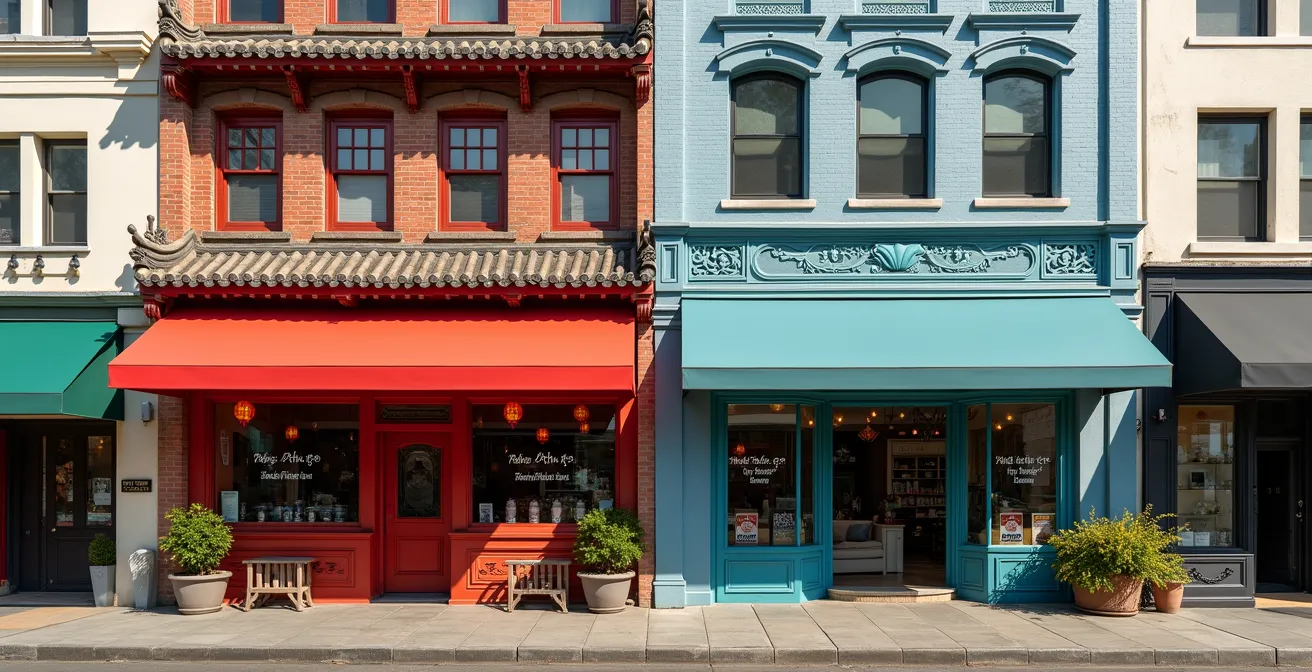
As the image suggests, the heritage fabric of Chinatown is visually distinct, while Koreatown’s identity is expressed through more contemporary commercial activity. Koreatown, concentrated along Bloor Street West in Seaton Village, emerged much later, primarily from the 1970s onwards. As a younger enclave, it has not yet experienced the same degree of demographic dispersal or transformation into a tourist-centric zone. Its history is more concentrated and recent, primarily visible in its thriving businesses, restaurants, and grocery stores that directly serve the local and broader Korean-Canadian population. In essence, Chinatown retains the *architectural memory* of early immigration, while Koreatown embodies the *living commercial energy* of a more recent wave.
The Assumption Mistake Visitors Make About “Ethnic” Neighborhoods
The most significant mistake a visitor or even a resident can make is to assume that Toronto’s culture is neatly compartmentalized into a few designated “ethnic” neighborhoods. This view treats areas like Little Portugal or Greektown as cultural preserves, isolated from the rest of the city. The reality is far more fluid and profound: Toronto, in its entirety, functions as an “Arrival City.”
This concept reframes our understanding of multiculturalism. It’s not about a mosaic of fixed tiles, but a dynamic system where the entire urban landscape serves as a landing pad, an incubator, and a launchpad for newcomers. The data supports this expansive view; demographic information reveals that a staggering 51.2% of Toronto residents were born outside Canada. This isn’t a phenomenon confined to a few downtown blocks; it’s the fundamental demographic reality of the entire Greater Toronto Area.
This idea was powerfully articulated by community leader Kofi Hope in an interview with Urban Land Magazine, where he challenged the very notion of singular ethnic enclaves:
We would argue that with Toronto, it’s not just one neighborhood, actually. The entire city is an arrival city.
– Kofi Hope, Urban Land Magazine
Thinking of the whole city this way changes everything. It means that an “authentic” immigrant experience isn’t just found in a historic downtown market, but also in a strip mall in Scarborough, a community center in Etobicoke, or a religious institution in North York. The heritage fabric is woven throughout the metropolis. The assumption mistake is seeing the signposts (like a “Little Italy” sign) but missing the vast, interconnected network of culture that defines the entire region.
When to Visit Heritage Open Doors to See Historic Immigrant Homes?
Doors Open Toronto, held annually in May, offers a fantastic, curated glimpse into the city’s architectural treasures. For a history enthusiast tracing immigrant stories, it can provide access to significant sites. However, to truly read the heritage fabric of the city, one must look beyond a single weekend event. The history of Toronto’s immigrant communities is not confined to landmark buildings but is inscribed on the very streets and residential pockets of its neighborhoods, accessible year-round.
A more profound understanding comes from self-guided exploration, focusing on the layers of settlement that define an area. Instead of waiting for a formal event, you can create your own heritage tour by focusing on neighborhoods that were shaped by specific waves of migration. The history is often hiding in plain sight, in the architecture, the remaining businesses, and the public plaques.
Here are several year-round alternatives to discover Toronto’s immigrant heritage beyond Doors Open:
- Explore The Annex for Hungarian History: This neighborhood was a key settlement area for the ’56ers,’ Hungarians who fled the 1956 revolution. The architecture and nearby stretches of Bloor Street still hold echoes of the businesses that served this community through the 1960s and 70s.
- Follow the Blue Plaques: Heritage Toronto’s blue plaque program marks historically significant sites across the city, many of which are tied to immigrant stories. Creating a self-guided walking tour based on these plaques is a powerful way to connect with history on the ground.
- Start at Toronto’s First Post Office: This functioning museum and National Historic Site is a perfect starting point for exploring the old Town of York, the nucleus from which Toronto grew and where many early immigrants first settled.
- Uncover the Layers of Kensington Market: Perhaps the city’s ultimate example of cultural succession, Kensington Market has been a gateway for successive waves of Jewish, Portuguese, Caribbean, and Latin American immigrants. Its shops, synagogues-turned-churches, and vibrant streetscape are a living museum of this process.
These approaches allow for a deeper, more personal connection to the city’s past, transforming a simple walk into a historical investigation.
South Market vs. North Market: Where to Find the Farmers?
To the casual visitor, St. Lawrence Market is a singular entity: the grand, bustling South Market hall on Front Street. It’s a world-class food market, a historical landmark, and a top tourist destination. Yet, for the historian tracing Toronto’s agricultural and immigrant roots, the real story lies across the street, in the less assuming North Market. This is where you find the direct descendants of the region’s farming heritage.
The South Market, open six days a week, is home to permanent merchants, butchers, and cheesemongers—many of whom are themselves part of multi-generational family businesses. It is an essential part of the city’s culinary life. The North Market, however, operates under a different, much older tradition. It functions as a true farmers’ market exclusively on Saturdays, a practice dating back to 1803.
This is where the connection to the land and the waves of agricultural settlement becomes tangible. The vendors here often represent the farming communities that settled the fertile lands outside of Toronto. As one analysis of the market’s heritage notes, these farmers are the living link to specific immigrant groups who shaped Southern Ontario’s agricultural landscape, from German-speaking Mennonite communities to Dutch and Eastern European farming families who arrived in the post-war era. They bring their produce directly to the city, continuing a centuries-old economic and cultural exchange.

So, while the South Market offers a spectacular array of global and local foods, the North Market on a Saturday is where you connect with the primary producers. It’s a more rustic, direct experience—a chance to speak with the people who grew the food and to touch a piece of the living archive of Ontario’s agricultural history, a history profoundly shaped by immigration.
Why European-Style Guesthouses Are Rare in Toronto?
Visitors to Toronto, particularly those from Europe, often notice a peculiarity in the city’s accommodation landscape: the scarcity of traditional guesthouses, pensions, or small, family-run inns integrated into residential neighborhoods. This absence is not an accident of commerce but a direct consequence of over a century of urban planning philosophy and zoning regulations rooted in a distinctly British colonial vision.
The city’s foundational residential character was heavily shaped by the “garden suburb” model, an ideal that prioritized the single-family home on its own plot of land above all else. This philosophy was encoded into the city’s legal framework through strict residential zoning laws. As one urban planning analysis explains, this approach created a rigid separation between commercial and residential life.
20th-century city planning, heavily influenced by the British ‘garden suburb’ model, prioritized single-family homes and strict residential zoning.
– Urban Planning Analysis, Toronto’s Zoning History and Development
This model actively discouraged the kind of mixed-use development common in many European cities, where a ground-floor shop might be topped by apartments or a small guesthouse. Toronto’s “Yellowbelt,” a vast area of the city zoned exclusively for single-family detached or semi-detached homes, is the modern legacy of this planning history. It made it legally difficult, if not impossible, to operate small-scale commercial accommodations within these residential zones.
This historical preference for residential separation was compounded by immense growth pressure. As urban growth statistics show, Toronto’s population grew from 2 million in 1990 to 6.5 million by 2016, putting a premium on all forms of housing. The city’s development focused on high-rise condominiums and preserving the single-family character of existing neighborhoods, leaving little room for the guesthouse model to emerge. The result is a city of high-rise hotels in the core and houses in the neighborhoods, with very little in between.
Key Takeaways
- Cultural neighborhoods are dynamic, not static; their identities are constantly reshaped by economic mobility and new immigration waves.
- The concept of an “Arrival City” applies to all of Toronto, with cultural heritage woven throughout the metropolis, not just in designated enclaves.
- Authentic cultural exploration requires looking beyond tourist centers to the suburbs, local institutions, and the living history found in everyday community life.
Dining on The Danforth: How to Experience Authentic Greek Culture Beyond the Main Strip?
The Danforth, or Greektown, is synonymous with Greek food in Toronto. Its main strip, west of Pape Avenue, is a vibrant collection of restaurants serving souvlaki and saganaki to locals and tourists alike. While a fantastic culinary experience, it represents only the most visible layer of the area’s rich Hellenic culture. To experience a more authentic side of the community, a historian’s mindset is required: one must venture off the main path and look for the community’s living archives.
Authentic culture is found where the community lives, worships, and socializes. It’s in the rhythm of daily life, not just the performance of a Saturday night dinner service. This means exploring the side streets and the less-trafficked eastern end of the Danforth, where long-standing businesses and institutions continue to serve the local Greek-Canadian population. It involves observing social rituals and participating in community events that are not designed for tourists.
By shifting your focus from consumption to observation and participation, you can piece together a much richer picture of Greek life on the Danforth. The following plan provides a framework for this deeper exploration.
Your Action Plan: Experiencing Authentic Greek Culture on The Danforth
- Identify Key Cultural Hubs: Look beyond restaurants to community centres, churches like St. Irene Chrysovalantou and Metamorphosis tou Sotiros, and local Greek grocery stores and bakeries, particularly east of Pape Avenue.
- Observe the Living Culture: Visit neighborhood cafés in the morning or late afternoon to witness social rituals, such as older residents gathering to talk and play tavli (backgammon).
- Check for Community Events: Consult church calendars or community bulletin boards for authentic festivals (paniyiri), bake sales, and cultural gatherings which are true reflections of community life.
- Taste Authentic Flavors: Prioritize established, family-style restaurants known to locals, such as Messini or Avli, for traditional gyros and homestyle cooking, over more prominent tourist-focused spots.
- Create Your Heritage Walk: Combine a visit to a local bakery, a café, and a look at a church notice board to build a more complete and personal experience of the community’s heritage fabric.
This approach transforms a simple meal into a genuine cultural immersion, revealing the deep and enduring Hellenic spirit that continues to define this iconic Toronto neighborhood.
By moving beyond the surface, you can begin to read the city’s rich, layered history in its streets, its markets, and its people. The next step is to take this historical lens and apply it to your own explorations of Toronto’s diverse and ever-evolving neighborhoods.