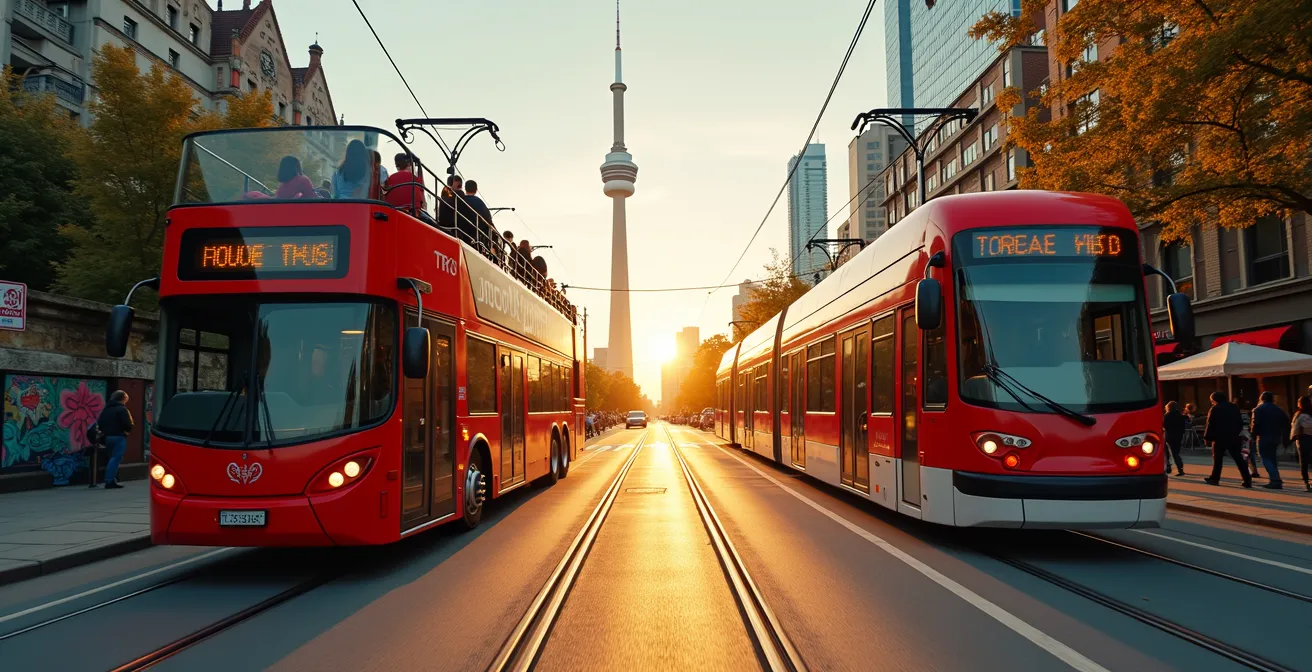
The Toronto Hop-On Hop-Off bus isn’t a transportation service; it’s a curated sightseeing experience with a premium price tag.
- It offers convenient, narrated views of core downtown sights but suffers from long 2-hour wait times and significant traffic delays.
- Toronto’s TTC offers unparalleled city-wide access and frequency for a fraction of the cost, unlocking authentic neighborhoods the bus can’t reach.
Recommendation: Use the Hop-On Hop-Off bus for a single, initial 2-hour orientation loop, then switch to the TTC’s cost-effective Day Pass for flexible, in-depth exploration.
You’re standing at Yonge-Dundas Square, the vibrant heart of Toronto. A bright red, open-top double-decker bus pulls up, promising a whirlwind tour of the city’s greatest hits. The price tag, around $50, gives you pause. For a traveler who can confidently navigate a subway map, the central question emerges: is this a smart shortcut to seeing Toronto, or an expensive tourist trap in a city with one of North America’s best public transit systems?
Most travel guides offer a simple verdict: the Hop-On Hop-Off (HOHO) bus is an easy way to get an overview. But for the value-conscious traveler, this advice is incomplete. It ignores the efficiency of the Toronto Transit Commission (TTC) and the opportunity cost of waiting for a tour bus that might only come every two hours. This isn’t a simple “good vs. bad” debate. It’s a strategic choice between a curated sightseeing experience and an efficient public transit system.
The key isn’t to decide which is better, but to understand which tool is right for the job at different moments of your trip. This guide reframes the discussion. We will not just compare costs; we will analyze the fundamental trade-offs in time, flexibility, and access to authentic local culture. We’ll dissect route limitations, reveal how to maximize value if you do buy a ticket, and explore powerful alternatives that put you in control of your itinerary.
By understanding the distinct roles of the HOHO bus and the TTC, you can craft a hybrid strategy that delivers both the scenic overview and the deep, authentic exploration that makes a trip to Toronto truly memorable. Let’s break down the practical realities to help you make the smartest decision for your travel style and budget.
Summary: Toronto Hop-On Hop-Off: A Value and Utility Guide for Savvy Tourists
- Why the Tourist Bus Doesn’t Go to High Park or the Beaches?
- How to Get Blur-Free Photos from the Top Deck?
- TTC Day Pass vs. City Sightseeing: Which Wins on Value?
- The Rush Hour Mistake That Turns Your Tour into a Parking Lot
- When to Activate Your 24-Hour Ticket for Two Days of Use?
- How to Use the 501 Streetcar to Tour Three Distinct Neighborhoods?
- How to Create a Landmark Walking Tour From Union Station to City Hall?
- Guided Tours in Toronto: How to Choose Between Food, Ghost, and History Walks?
Why the Tourist Bus Doesn’t Go to High Park or the Beaches?
One of the first things a savvy traveler notices about Toronto’s HOHO route map is what’s missing: iconic destinations like High Park and The Beaches. The bus sticks to a predictable downtown and midtown loop. This isn’t an oversight; it’s a practical limitation. The double-decker buses are simply too large for the infrastructure in many of the city’s most charming residential neighborhoods. A review of tour bus constraints highlights that narrow streets, low-hanging tree canopies, and tight turning radii make navigating areas like The Beaches impossible for these vehicles.
This reveals the HOHO bus’s core identity: it is a “greatest hits” tour of the main commercial and institutional corridors, not a tool for deep neighborhood exploration. It’s designed to show you the CN Tower and the Royal Ontario Museum, not the quiet, tree-lined streets where locals live. For travelers wanting to see these vital parts of the city, the TTC is not just an alternative; it’s a necessity.
For example, reaching The Beaches from downtown is a straight shot on the 501 Queen streetcar, a journey that is itself a classic Toronto experience. To get to High Park, you simply take the Bloor-Danforth subway (Line 2) directly to High Park station. A TTC Day Pass gives you unlimited access to this entire network, effectively unlocking the parts of the city the tour bus physically cannot reach. Understanding this distinction is the first step in building a smarter itinerary.
How to Get Blur-Free Photos from the Top Deck?
The promise of an open-top bus is the sweeping, unobstructed view perfect for photography. However, the reality of a moving vehicle on city streets presents a challenge: capturing sharp, blur-free images. The key to success lies in technique and timing. First, you must become a human tripod. Instead of holding the camera out with extended arms, tuck your elbows tightly against your torso. Use the seat rail in front of you to brace your hands or camera body, creating a stable platform that absorbs much of the vehicle’s vibration.
This technique is essential because your photo opportunities are surprisingly limited. The tour’s value proposition is a continuous loop, but this comes with a significant trade-off. Buses can run as infrequently as every 2 hours, with a full loop taking over two hours to complete. This isn’t like a subway where the next train is minutes away. If you see a perfect shot and the bus is moving, you have one chance to get it right. Hopping off means committing to a potentially long wait for the next bus, a major drain on your limited vacation time.
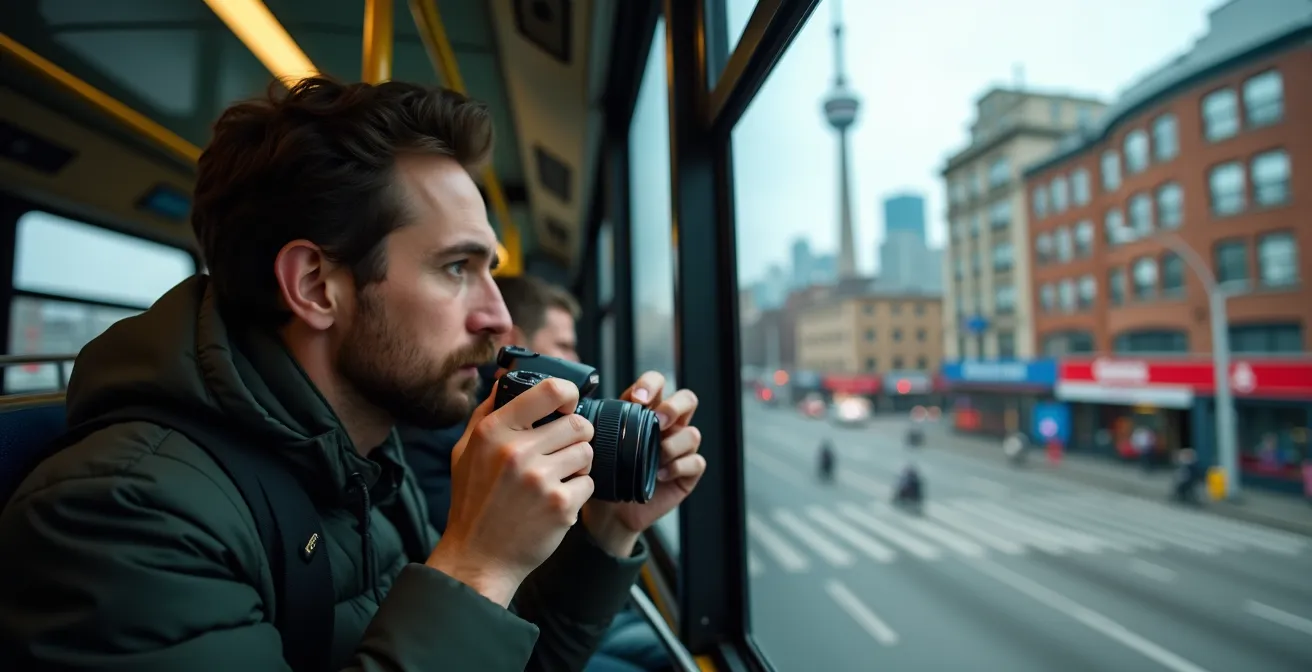
As the image demonstrates, a stable posture is your best defence against motion blur. Anticipate your shots by looking ahead on the route and prepare your stance before you arrive at a landmark. Using a faster shutter speed on your camera or phone (often found in “sport” or “pro” mode) will also help freeze the action. Ultimately, photography from the HOHO bus is an exercise in preparation and quick reflexes, not leisurely composition.
TTC Day Pass vs. City Sightseeing: Which Wins on Value?
For the value-focused traveler, the cost comparison between a single HOHO ticket and a TTC Day Pass is stark. While the bus offers the convenience of on-board commentary, the price difference forces a hard look at what you’re truly paying for. The HOHO ticket is a premium for a curated experience, whereas the TTC pass is a key to city-wide mobility. The raw numbers speak for themselves, but the story is in the details of coverage and frequency.
Let’s break down the direct comparison. A HOHO ticket provides access to a limited loop of tourist-centric stops with long waits in between. The TTC, on the other hand, offers an entire network of subways, streetcars, and buses that cover every corner of the city with far greater frequency. This table, based on an analysis of Toronto tourist transport, clarifies the trade-offs.
| Feature | TTC Day Pass | HOHO 24-Hour |
|---|---|---|
| Price | $13.50 | $48.50 |
| Coverage Area | Entire TTC network | 13 tourist stops only |
| Frequency | 2-10 minutes (subway/streetcar) | Every 2 hours |
| Local Neighborhoods | Full access | Limited tourist areas |
| Transfer Window | Unlimited all day | Must wait for next bus |
The most significant, yet often overlooked, advantage of the TTC for a savvy tourist is the PRESTO payment system. As confirmed by the TTC’s official fare policy, a single fare paid with a PRESTO card or ticket includes a 2-hour unlimited transfer window. This means for one $3.35 fare, you can visit the St. Lawrence Market, then hop on a streetcar to the Distillery District, and then take another bus to a different attraction, all without paying again as long as it’s within two hours. This level of flexibility turns public transit into a powerful and economical tool for spontaneous exploration, a value proposition the HOHO bus simply cannot match.
The Rush Hour Mistake That Turns Your Tour into a Parking Lot
The single biggest factor that can ruin the value of a HOHO ticket is Toronto’s notorious traffic. The open-top deck that seems so appealing can quickly become a front-row seat to gridlock, especially during peak hours. Unlike the subway, which zips under the congestion, the tour bus is subject to the same delays as every other vehicle. This is particularly true in the dense downtown core, where construction is a near-constant feature of the landscape.
One visitor’s review vividly captures this frustrating reality. As a Viator reviewer noted after their trip, “Toronto is under massive construction, cranes and jackhammers are what you experience on the top deck.” Sitting stationary in traffic while the meter runs on your expensive 24-hour pass is the definition of poor value. Avoiding this scenario requires strategic planning.
The most critical mistake is being on the bus during the afternoon rush hour, typically from 3:30 PM to 6:30 PM. A tour that should be a scenic glide becomes a slow, noisy crawl. The same applies to days with major sporting events, when the area around the Rogers Centre and Scotiabank Arena becomes impassable. Smart use of the HOHO bus means treating it as a morning activity and having an exit strategy for the afternoon.
Action Plan: Navigating Toronto Traffic on a HOHO Tour
- Morning Strategy: Start your tour at 9:00 AM from Stop 1 to complete one full loop before lunch traffic builds.
- Avoid 3:30-6:30 PM: Plan to be off the bus or stay north of Queen Street during the intense afternoon rush hour.
- Game Day Alert: Always check the schedules for the Blue Jays, Raptors, and Maple Leafs. Avoid the bus route near the Rogers Centre and Scotiabank Arena on event days.
- Subway Switch Point: If you get stuck, hop off at Museum station (Stop 4) and use the Line 1 subway for faster cross-town travel.
- Evening Alternative: Consider the separate Night Tour (often starting at 7:00 PM), which is designed to avoid rush hour entirely.
When to Activate Your 24-Hour Ticket for Two Days of Use?
If you decide the Hop-On Hop-Off bus is right for you, the next strategic move is to extract maximum value from your ticket. A standard 24-hour pass can, with clever timing, be effectively stretched across two days of your trip. The secret lies in understanding that the “24-hour” clock starts ticking from the moment of your first scan, not from the beginning of the day.
By activating your ticket in the early afternoon, you grant yourself access for the remainder of that day and the morning of the next. This simple trick transforms a one-day pass into a two-day tool. For instance, based on the official schedule from City Sightseeing Toronto, the last bus departure is often around 4:00 PM, meaning a 1:00 PM activation gives you two solid 3-hour windows of bus access across two separate days. This is far more valuable than a 9 AM activation that expires before your second day of touring even begins.
Case Study: Maximizing the 48-Hour Pass
For travelers staying longer, the 48-hour pass often presents even better value. As multiple reviewers have confirmed, the per-day cost drops significantly. One couple reported a successful strategy: they used their 48-hour pass to do one complete, uninterrupted orientation loop on day one to hear all the commentary and map the city. On day two, they used the pass for strategic hop-offs at two or three specific attractions they had identified, effectively using it as targeted transportation and minimizing time lost waiting.
This approach—using the first day for orientation and the second for targeted strikes—is the most effective way to justify the cost of a multi-day pass. It combines the benefit of the guided tour with the efficiency of a planned itinerary, mitigating the downside of the bus’s infrequent service. For the savvy traveler, buying the ticket is only the first step; activating it wisely is how you win the value game.
How to Use the 501 Streetcar to Tour Three Distinct Neighborhoods?
While the HOHO bus sticks to the main arteries, Toronto’s legendary 501 Queen streetcar offers a masterclass in urban discovery for the price of a single TTC fare. This route, one of the longest streetcar routes in North America, acts as a cross-section of the city’s soul, connecting a string of diverse and vibrant neighborhoods. It is, without a doubt, the single best public transit route for a tourist looking for an authentic experience.
Your journey can be a simple, fluid tour across three of the city’s most interesting districts:
- Queen West: Start your trip by boarding the westbound 501 at Queen and Spadina. You’ll glide into the heart of the trendy West Queen West art and design district, famous for its independent boutiques, art galleries, and Graffiti Alley.
- The Entertainment District: After exploring Queen West, hop back on an eastbound 501. The streetcar will take you through the bustling Entertainment District, passing the iconic MuchMusic building and the theatre-lined streets.
- The Beaches: Stay on board as the streetcar continues east from downtown. This 45-minute leg of the journey is a scenic ride that culminates in The Beaches, a charming, laid-back neighborhood with a beautiful boardwalk along Lake Ontario.
This entire multi-neighborhood tour can be done within the TTC’s two-hour transfer window, making it an incredibly cost-effective adventure. This sentiment is echoed by those who know the city best.
I am a resident of Toronto and yet I learned a great deal about the island and Toronto itself from the tour. However, for authentic neighborhood exploration, nothing beats the 501 streetcar – it’s how locals actually experience the city’s diverse communities.
– TripAdvisor Contributor
A pro tip for any streetcar journey in Toronto is to use a transit app on your phone. These apps provide real-time tracking, helping you see exactly where the next streetcar is and, crucially, warning you of “short turns” where a vehicle may not complete the full route.
How to Create a Landmark Walking Tour From Union Station to City Hall?
Sometimes the best way to connect the dots between major landmarks is on your own two feet. The distance between Union Station, Toronto’s grand central transit hub, and the iconic Nathan Phillips Square (home to City Hall and the “TORONTO” sign) is surprisingly manageable. It’s a journey that can be a fascinating walking tour in itself, cutting through the heart of the city’s Financial District.
The surface route is a pleasant and direct walk. According to City Sightseeing Toronto’s own route analysis, the journey is a mere 1.2 kilometers, a comfortable 15-minute stroll up University Avenue or Bay Street. This walk takes you past the towering skyscrapers of Canada’s biggest banks, offering a ground-level perspective of the city’s economic power. However, Toronto offers a unique, weather-proof alternative that is an attraction in its own right.
The PATH System: Your Underground Alternative
Toronto’s PATH is a massive underground pedestrian network that connects major downtown buildings, including the route from Union Station all the way to City Hall. This 30-minute indoor walk is a perfect solution for rainy or cold days—the very days when HOHO buses often switch to enclosed trolleys, losing their open-top appeal. The PATH is more than just a tunnel; it’s a climate-controlled world of its own, featuring public art installations, food courts, and shops, offering a fascinating glimpse into the daily life of downtown commuters.
Choosing to walk, whether above or below ground, represents the ultimate embrace of flexibility. It costs nothing, operates on your own schedule, and allows for spontaneous detours. It highlights a core truth for the savvy traveler: in a dense, walkable downtown core like Toronto’s, your own feet are often the most efficient and rewarding mode of transport for short distances between major sights.
Key Takeaways
- Define the Job: Use the HOHO bus as a 2-hour “experience” for orientation, not as all-day “transit” for transportation.
- Master the TTC: For real exploration and value, a TTC Day Pass and the 2-hour transfer window are your most powerful tools.
- Time is Money: Avoid the HOHO bus during weekday rush hour (3:30-6:30 PM) and on major game days to prevent your tour from becoming a traffic jam.
Guided Tours in Toronto: How to Choose Between Food, Ghost, and History Walks?
Ultimately, the Hop-On Hop-Off bus is just one of many guided tour options in a city rich with stories. For the savvy traveler, the decision isn’t just “HOHO vs. TTC,” but “HOHO vs. a specialized walking tour.” While the bus provides a broad overview with running commentary, specialized tours offer depth and focus that a moving vehicle can never match. As one satisfied customer noted about the bus, the strength is the personality it adds: “The commentary is both informative and amusing, adding personality and local flavour to the journey.”
However, if your interests are more specific, a walking tour can provide a much richer experience. These tours are led by passionate local experts and are designed for intimate, ground-level discovery. They allow you to ask questions, interact with your environment, and delve deep into a particular facet of Toronto’s culture. The choice comes down to your personal travel priorities.
Consider these alternatives as you plan your trip:
- For the Foodie: A Kensington Market food tour is essential. It’s a sensory immersion into one of the most diverse and historic markets in North America.
- For the History Buff: A walking tour of the Distillery District will transport you back to Victorian industrial Toronto, with incredible architecture and stories.
- For the Art Lover: A guided walk through Graffiti Alley offers an expert look at the city’s vibrant street art scene, with context you’d miss on your own.
- For the Thrill Seeker: Evening ghost tours, particularly around the supposedly haunted grounds of the University of Toronto, offer a unique and entertaining perspective on city lore.
Viewing the HOHO bus as the starting point, not the final word, on guided tours in Toronto is key. It serves its purpose as a general introduction, but the city’s real flavor is often found on foot, following an expert who is passionate about food, history, or art.
Now equipped with this detailed breakdown of cost, time, and flexibility, you can confidently build a Toronto itinerary that perfectly suits your style. By strategically blending a single HOHO orientation loop with the freedom of the TTC and the depth of a specialized walking tour, you can craft an experience that is both efficient and authentically Toronto.