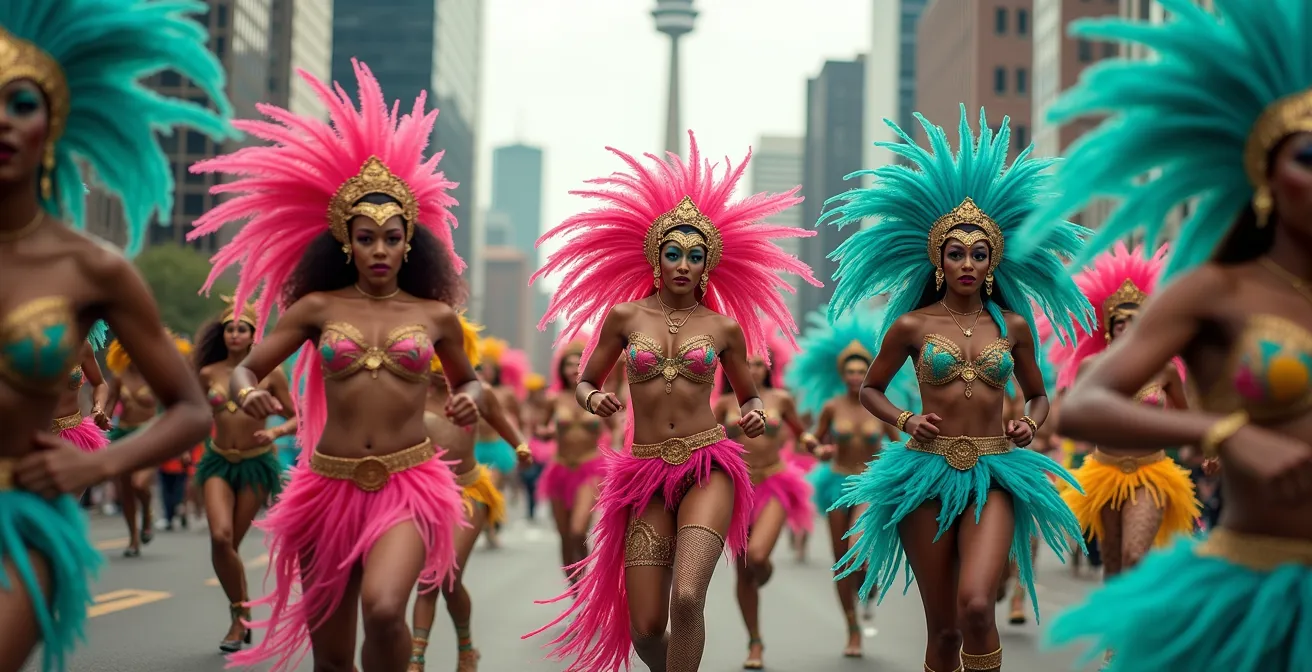
Watching the Grand Parade from the sidewalk means you’re missing the entire point; the real festival happens on “The Road.”
- Joining a “mas band” is the only way to transform from a spectator into an active participant in the celebration.
- Mastering “rhythm discipline”—a strategy for hydration and energy—is the key to enjoying the full day-long experience.
Recommendation: Choose a costume section that fits your budget and energy level, and register with a band by May to secure your spot in North America’s largest street party.
You hear it before you see it. A deep, seismic bassline that travels through the soles of your feet and into your chest. That’s the sound of the Toronto Caribbean Carnival engine firing up. For most, the Grand Parade is a dazzling spectacle viewed from behind a metal barricade. But for those in the know, for the masqueraders, it’s not a parade to be watched; it’s a river of rhythm to be joined. This isn’t about getting a good photo; it’s about becoming part of the moving, breathing, pulsating art form that is “playing mas.” The city understands this, and the celebration’s scale is so massive that the federal government has committed $3.5 million over two years to support it.
Forget the generic advice to “wear comfy shoes.” This guide is your initiation. It’s the roadmap from the sidewalk to the center of the storm, from spectator to participant. We’re going to talk about the carnival’s heartbeat: the music, the movement, and the sheer energy of being on “The Road.” We’ll cover how you secure your place in this moving festival, how you manage your energy to last from the first note to the last, and how you can truly feel the vibration that makes this event a cornerstone of Toronto’s cultural identity. This is your guide to experiencing the Grand Parade not just like a local, but like a masquerader who lives for this day.
This comprehensive guide will walk you through the essential steps and insider knowledge needed to fully immerse yourself in the Grand Parade experience. Follow along to discover the secrets of the road.
Summary: A Masquerader’s Guide to Owning the Grand Parade
- Why Lake Shore Boulevard Is Closed for an Entire Day?
- How to Buy a Costume and “Play Mas” with a Band?
- King and Queen Show vs. Grand Parade: Which Offers Better Spectacle?
- The Hydration Mistake That Causes Heatstroke at the Parade
- Where to Stand Along the Route for the Best Vibration?
- When to Book Your Flight for Caribana to Save 40%?
- Where to Stand for Victoria Day Fireworks to Avoid the Crowds?
- Night Out on Ossington: How to Experience Toronto’s Trendiest Bar Strip?
Why Lake Shore Boulevard Is Closed for an Entire Day?
For one day a year, Toronto’s concrete artery, Lake Shore Boulevard, doesn’t belong to cars. It belongs to us. It becomes “The Road.” The complete shutdown isn’t an inconvenience; it’s a sacred transformation. It’s how the city makes space for a cultural phenomenon that attracts over 1.3 million tourists each year, swelling the total attendance to over two million people. This isn’t just a street closure; it’s the creation of a temporary, mobile kingdom of soca, steelpan, and celebration.
The logistics are staggering. The parade route is a demanding beast, stretching approximately 4 kilometers along the waterfront. It starts near Exhibition Place, travels west past Jameson Avenue, and then loops back. To make this happen safely, the closure is absolute, running from the early hours of Saturday morning until Sunday. This includes shutting down critical on-ramps for the Gardiner Expressway and rerouting numerous TTC bus and streetcar lines. This total lockdown is the only way to accommodate the colossal sound trucks, the thousands of masqueraders, and the massive crowds of spectators.
Think of it as creating the world’s largest, most vibrant stage. The closure carves out a space where the rules of the everyday world are suspended and the rhythm of the carnival takes over. It’s a necessary sacrifice to host a world-class event and allow the sheer energy of the mas bands to flow unimpeded through the heart of the city’s waterfront. The silence of the highway is replaced by the roar of the crowd and the pulse of the music.
How to Buy a Costume and “Play Mas” with a Band?
This is the most important step. “Playing mas” (from masquerade) is the act of joining a band and dancing the parade route in full costume. This is how you move from the audience to the show. The process begins months before the first beat drops on Lake Shore. Around April and May, the major mas bands—like Saldenah, Tribal, and the Toronto Revellers—launch their themes for the year, revealing a stunning array of costume sections you can join.
Your choice of costume is a choice of identity for the day. Sections are organized by tiers, each offering a different level of intricacy and price. A “backline” costume is your entry point, a beautiful but more manageable design. “Midline” adds more elaborate pieces, while “frontline” offers the most extravagant creations, often complete with massive, feathered backpacks. According to a ByBlacks analysis of major bands, you can expect backline costumes to average around $390 CAD, midline at $650, and frontline soaring to $1200 or more. This isn’t just a purchase; it’s your all-inclusive ticket to The Road, covering your costume, security, and access to the band’s food and drink trucks all day.
Once you’ve chosen your band and section online, you’ll pay a non-refundable deposit (usually around $250) to secure your spot. The full balance is typically due by a deadline in July. The week of the carnival, you’ll head to the band’s “mas camp”—a bustling hub of feathers, gems, and last-minute adjustments—to pick up your costume package. This is the moment it becomes real: holding the pieces of your carnival identity, ready to be assembled for the bacchanal.
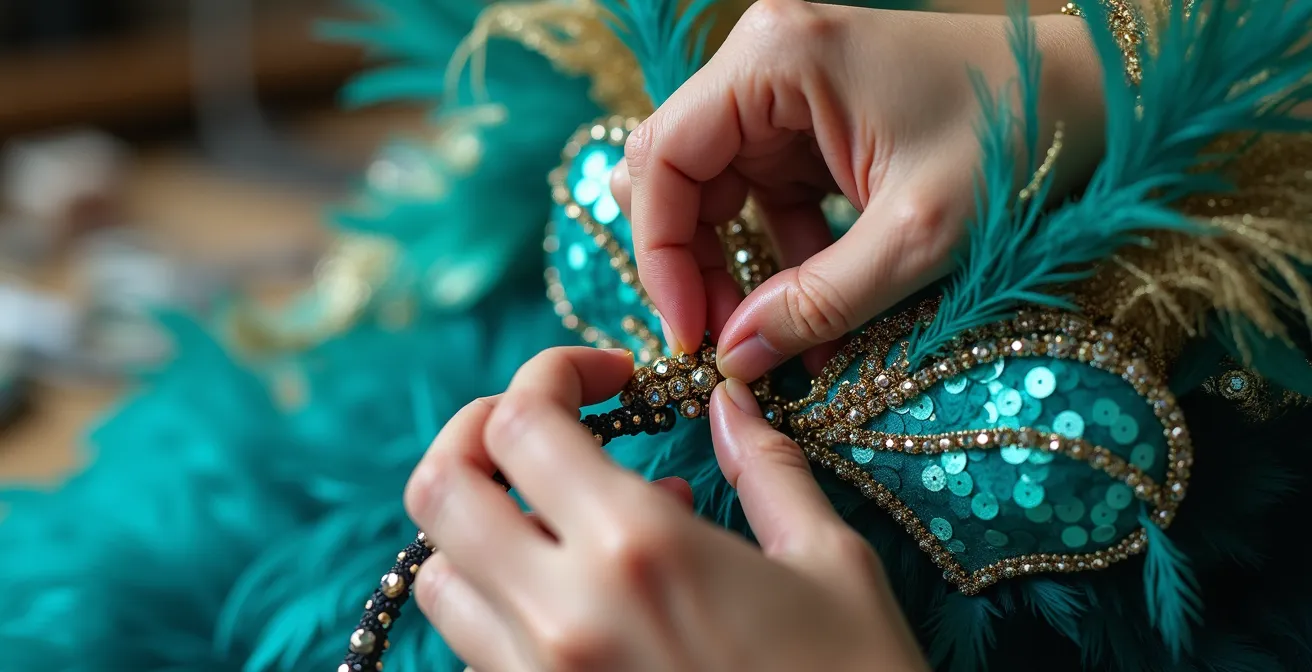
This behind-the-scenes artistry is the engine of the carnival. What you see on The Road is the culmination of months of design, wiring, gluing, and sewing by dedicated artisans. Each costume is a piece of wearable art, designed to move and flow with the rhythm of the music. Understanding this process deepens your appreciation for the spectacle you are about to join.
King and Queen Show vs. Grand Parade: Which Offers Better Spectacle?
This is a classic question for any carnival newcomer, and the answer depends entirely on what kind of spectacle you’re seeking: breathtaking artistry or infectious energy. The King and Queen Show is a theatrical showcase, a night of giants where you can truly appreciate the engineering and narrative of the most colossal costumes. The Grand Parade is an immersive, kinetic explosion of collective joy. One is a gallery, the other is a party.
The King and Queen competition, held at a venue like Lamport Stadium, is a seated event. Here, the focus is purely on the individual. You witness the “big mas”—costumes so large and elaborate they are architectural marvels, often requiring wheels and a team to maneuver. You can see every detail, every sequin, and understand the story each character represents without the distraction of a moving crowd. It’s a showcase of pure, unadulterated artistry under dramatic lighting.
The Grand Parade, in contrast, is about the power of the collective. The spectacle isn’t one single costume, but thousands moving as one organism. It’s about participation, not observation. You lose the fine details of a single costume but gain the overwhelming feeling of the music, the energy of the crowd, and the freedom of dancing in the street. The following table breaks down the core differences in the experience.
As you can see from this comparison of the two signature events, the choice is between appreciating art and becoming it.
| Aspect | King & Queen Show | Grand Parade |
|---|---|---|
| Venue | Lamport Stadium | Lake Shore Boulevard |
| Format | Seated theatrical showcase | Street parade participation |
| Duration | 7-11:50 PM (August 1) | 8 AM-8 PM (August 3) |
| Attendance | Stadium capacity | 1 million+ spectators |
| Experience Type | Observer/appreciation | Immersive/participatory |
| Comfort Level | Stadium seating | Standing/walking 5+ hours |
| Focus | Individual costume artistry | Collective energy & music |
The Hydration Mistake That Causes Heatstroke at the Parade
Every year, you see them: masqueraders wilting on the sidelines by 2 p.m., their energy gone. The common enemy is the Toronto August heat, but the mistake isn’t just forgetting to drink water. The critical error is a lack of rhythm discipline. Surviving—and thriving—on The Road for 8+ hours requires a hydration strategy that starts the day before and goes beyond simple water. Dehydration is the number one fun-killer, and it’s completely avoidable.
Relying solely on water is the rookie mistake. As you sweat, you lose vital electrolytes like sodium and potassium, which water alone can’t replace. This leads to cramps, dizziness, and heat exhaustion. The veteran masquerader’s secret is an electrolyte-focused approach. This means pre-loading with electrolyte-rich drinks the day before, and bringing your own reinforcements on parade day. Powdered electrolyte packets or coconut water (look for Grace or Goya brands in any West Indian grocery store) are your best friends. They are lightweight and easy to mix into the water bottles provided by your band.
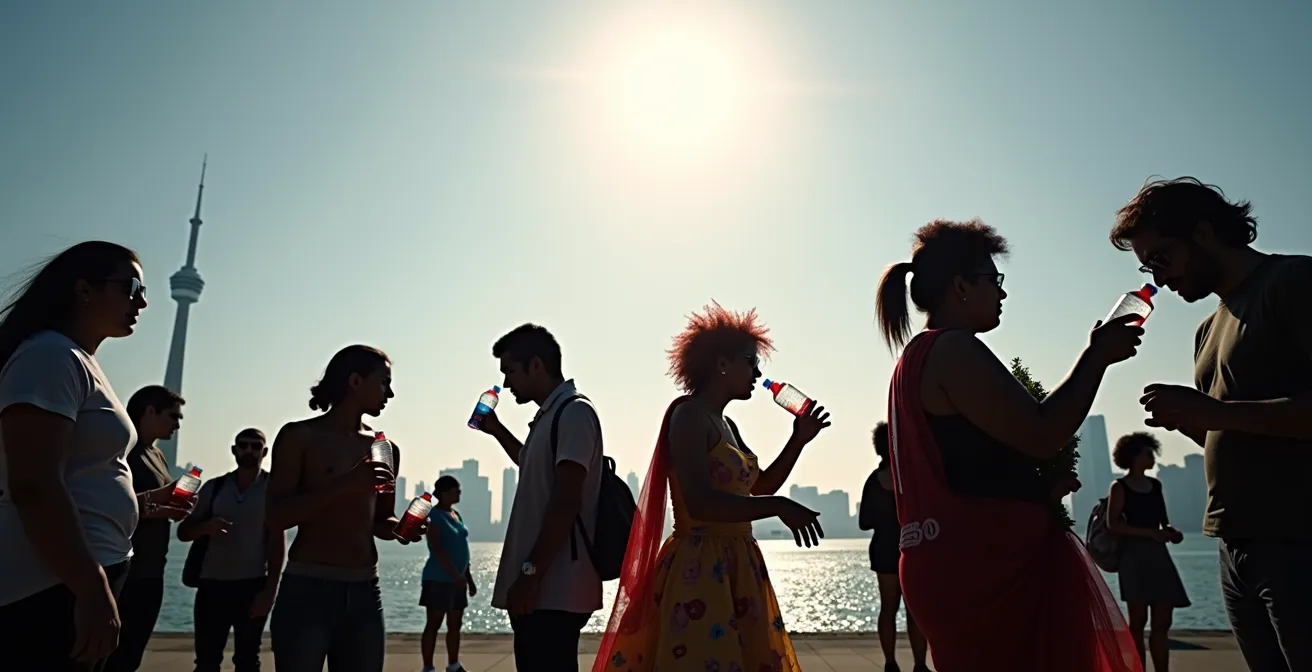
The other key to rhythm discipline is pacing. The free-flowing drinks on the music truck are tempting, but alcohol is dehydrating. The pro move is the 1-to-1 rule: for every alcoholic beverage, you must drink one full bottle of water. Combine this with strategic shade breaks. The Gardiner Expressway overpasses along Lake Shore are perfect spots to cool down for a few minutes without losing the vibe. Following a smart hydration plan ensures your energy lasts until the last “wuk” of the day.
Your Carnival Hydration Survival Plan
- Pre-Load Your System: Start hydrating 24 hours before the parade, focusing on water and electrolyte drinks.
- Pack Smart Fuel: Bring single-serving electrolyte powders or small cartons of coconut water to add to your water bottles.
- Follow the 1:1 Rule: For every alcoholic drink you have from the band’s truck, consume one entire bottle of water.
- Hunt for Shade: Use the Gardiner Expressway overpasses and other shaded spots for brief, strategic cool-down breaks.
- Commit to Recovery: Continue hydrating with water and electrolytes after the parade to prepare for the next day’s festivities.
Where to Stand Along the Route for the Best Vibration?
If you’re playing mas, your “spot” isn’t on the sidewalk—it’s on The Road itself, inside the moving ecosystem of your band. But even within the parade, your position matters. The key is to find the “vibration”: that sweet spot where you feel the full, chest-rattling power of the sound truck’s speakers. To feel the music, not just hear it. For the spectator, the question is where to watch; for the masquerader, the question is where to *be*.
The parade route is not a monolithic experience. It’s a series of zones, each with a different energy. The “Performance Zone” inside Exhibition Place is for the judges. Here, the band is tight and organized, putting on its best show. The energy is focused but controlled. Once you exit the Ex and hit the main stretch of Lake Shore, you enter the “Party Zone.” This is where the band spreads out, the discipline loosens, and the real bacchanal begins. The stretch between Dufferin and Strachan Avenue is legendary for its high energy, where the crowd’s roar mixes with the music.
For spectators who want the best free view, the Dufferin Street bridge offers a priceless elevated vantage point over the entire spectacle. You can see the waves of colour and movement from above. But for the best *sound*, you want to be at street level between Bathurst Street and Fort York Boulevard. This area often becomes a “sound clash” zone, where the bass from your truck collides with the one ahead or behind, creating an immersive wall of vibration. As one of over 10,000 masqueraders on the road, finding your personal space within this sonic wave is part of the art of carnival.
When to Book Your Flight for Caribana to Save 40%?
The rhythm of carnival planning starts long before the rhythm of the soca. For out-of-towners, securing your flight is a strategic move that can save you hundreds of dollars—money better spent on a frontline costume. The key is to book before the hype wave hits. Once the official event schedule is released, usually around March or April, flight prices to Toronto for the August long weekend begin their steep climb.
To get ahead of the demand, aim to have your tickets booked by late February or early March. This is the sweet spot where airlines haven’t yet adjusted their prices for the massive influx of visitors. Beyond timing, your arrival and departure dates are your next biggest lever for savings. The majority of travelers will aim to fly in on the Friday before the parade and leave on the holiday Monday. By simply adjusting your schedule, you can dodge the price surge. Arriving on the Wednesday or Thursday before and leaving on the Tuesday after can often lead to savings of up to 40%.
Finally, think outside the box when it comes to your arrival airport. While Toronto Pearson (YYZ) and Billy Bishop (YTZ) are the most direct, they are also the most expensive. Consider these alternative booking strategies:
- Fly into alternative airports: Check fares for Hamilton (YHM) or even Buffalo, New York (BUF). The one-to-two-hour drive or bus ride can be well worth the significant savings on airfare.
- Compare total transit cost: When looking at Toronto airports, factor in ground transportation. A flight into Pearson might be slightly cheaper, but the cost of the UP Express train into the city could negate those savings compared to flying into the downtown Billy Bishop airport and taking a simple streetcar.
Key Takeaways
- True immersion in the Grand Parade comes from “playing mas” in a costume, not watching from the sidelines.
- The parade’s logistics, like the full-day closure of Lake Shore Blvd, are what enable the massive scale of the celebration.
- Endurance is key; a smart hydration strategy based on electrolytes and pacing is more important than just drinking water.
Where to Stand for Victoria Day Fireworks to Avoid the Crowds?
Now, you might see “Victoria Day” in the title and think we’ve time-traveled from August to May. Don’t worry, you haven’t missed the parade. But if you’re looking for the explosive energy—the real *fireworks*—that cap off a day on The Road, the show isn’t in the sky. It’s in the streets, the clubs, and the after-parties where the carnival spirit refuses to die down. The end of the parade is just the beginning of the night.
For the authentic post-parade experience, avoid the massive, mainstream clubs. The real vibration continues at the official band after-parties. When you pick up your costume, you’ll often get flyers or info about your band’s exclusive “cool-down” fete. This is where you and your fellow masqueraders can continue the party in a more intimate setting, still high on the day’s energy and surrounded by the same rhythms. These events are the carnival’s unofficial second act.
If you’re looking for a more spontaneous vibe, head towards the Liberty Village neighborhood, just north of Exhibition Place. As thousands of masqueraders spill out from the parade’s end, the bars and patios here become an unofficial gathering spot. You’ll find a mix of people from different bands, costumes half-on, sharing stories from The Road. This is where you find the communal fireworks of shared experience, a far cry from the crowded, tourist-filled destinations.
Night Out on Ossington: How to Experience Toronto’s Trendiest Bar Strip?
After you’ve showered off the glitter and sweat of the parade, the carnival energy still thrums in your veins. You’re not ready for the night to end, but you’re ready for a change of scenery. This is where you pivot to Ossington Avenue. This strip, known as Toronto’s trendiest corridor for bars and restaurants, offers the perfect “cool-down lime” for the discerning masquerader. It’s where the raw energy of carnival meets the chic vibe of the city.
Don’t just show up and wander. Experiencing Ossington post-carnival requires a strategy. Start at the southern end, near Queen Street West, and work your way north. The vibe shifts from bustling, high-energy spots to more relaxed, intimate cocktail bars. Begin with a celebratory drink at a place like Reposado Tequila Bar to keep the energy high, then gradually move north to a spot like Sweaty Betty’s for a more laid-back, dive-bar atmosphere where you can actually have a conversation about the day’s highlights.
The key is to bring the carnival spirit with you, but adapt it to the environment. You might not be “wining” in the middle of the street, but the confidence and joy you felt on The Road should fuel your night. Ossington is a place for storytelling. It’s where you dissect the day: the best song the DJ played, the funniest moment on The Road, the most beautiful costume you saw. It’s the final, reflective chapter of the Grand Parade experience, where the personal memories of the bacchanal are forged over a well-earned drink.
Now that you have the masquerader’s roadmap, the only thing left to do is answer the call of The Road. Start browsing the mas band launches in the spring, gather your crew, and commit to transforming your next Toronto Caribbean Carnival from a spectator sport into a life-changing experience.