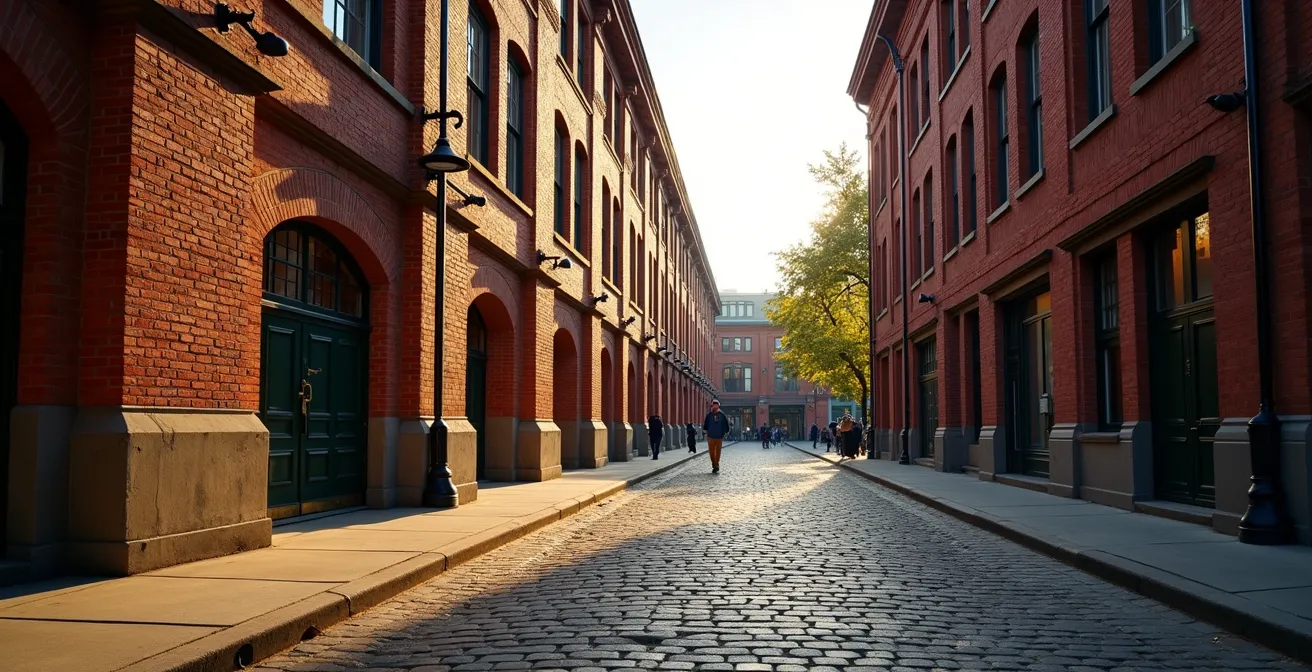
The true marvel of the Distillery District isn’t just its preserved Victorian buildings, but the story they tell through their materials and design—a language of industrial might and masterful renovation.
- The district’s preservation is a unique North American case study, born from the unexpected catalyst of the 2003 SARS crisis which provided a skilled, available workforce.
- Understanding the difference between the district’s robust industrial forms and Yorkville’s domestic Victorian style provides a complete picture of Toronto’s architectural heritage.
Recommendation: Approach your walk not as a tourist, but as a historian. Look for the dialogue between original brickwork and modern art, and notice how the very structure reveals its 19th-century purpose.
For any lover of history or architecture, a stroll through Toronto’s Distillery District is a requisite pilgrimage. Many visitors are drawn by the charming atmosphere of boutiques and galleries set against a backdrop of red brick. They admire the “old buildings” and walk the “cobblestone streets,” capturing photos of a seemingly bygone era. Yet, this surface-level appreciation misses the profound narrative embedded in the very structure of the site. It treats the architecture as passive scenery rather than the main character in a story of industrial ambition, decline, and one of the most remarkable heritage preservation projects in North America.
The common advice is to simply wander and soak it all in. But this approach fails to equip you with the architectural literacy needed to truly understand what you are seeing. The key to unlocking the district’s genius lies not in just looking, but in learning how to *read* the buildings. Why was this brick pattern chosen? What does the scale of that timber frame tell us about the original machinery? How do modern additions interact with the historic fabric without compromising it? This is not just a collection of old structures; it is a masterclass in material honesty and adaptive reuse, a living palimpsest where layers of history are visible to the trained eye.
This guide moves beyond the platitudes. It provides a focused lens, transforming your walking tour into an expert-led exploration. We will delve into the unique circumstances of its preservation, analyze the dialogue between heritage materials and contemporary art, and even examine the practicalities of navigating its historic terrain. By the end, you will see the Distillery District not just as a beautiful place, but as a complex and fascinating text waiting to be deciphered.
For those who prefer a condensed format, this video summarizes the essential points discussed in our guide. It offers a complete presentation to get you straight to the heart of the matter.
This article is structured to build your architectural literacy step by step. The following summary outlines the key areas we will explore, from the grand story of the district’s preservation to the specific details that define its character, allowing you to navigate our analysis with ease.
Summary: A Heritage Conservationist’s Tour of the Distillery District
- Why the Distillery District Preservation Is Unique in North America?
- How to Book a Segway Tour to Cover the Cobblestones Comfortably?
- Brickwork vs. Modern Art: Which Dominates the Distillery Atmosphere?
- The Shoe Mistake That Makes Walking the Distillery Painful
- How to Find the Secret Prohibition Tunnel Entrances?
- Gooderham Building vs. City Hall: Which Architecture Defines Toronto Better?
- Why the Ceiling of the Great Hall Is a Masterpiece of Renovation?
- Yorkville Shopping: How to Experience Luxury in Restored Victorian Homes?
Why the Distillery District Preservation Is Unique in North America?
The Distillery District is not merely another “historic neighborhood”; it represents a singular achievement in heritage conservation. Its significance stems from both scale and circumstance. The site is home to North America’s largest preserved collection of Victorian industrial architecture, with over 40 heritage buildings consolidated within a 13-acre, pedestrian-only village. This density of period-specific industrial design is unparalleled, offering a coherent and immersive journey into 19th-century manufacturing might. The oldest and largest building, the five-storey limestone Stone Distillery designed by David Roberts Sr. in 1861, stands as a testament to the site’s explosive growth, which increased production from 80,000 to two million gallons of spirits annually.
However, the truly unique aspect of its preservation lies in the bizarre catalyst for its rebirth: the 2003 SARS outbreak. For years, the derelict but atmospheric district was a popular filming location. According to a story documented by the National Trust for Canada, when SARS shut down Toronto’s film industry, developers Cityscape Holdings seized an unprecedented opportunity. They hired over 400 suddenly unemployed film crew workers—artisans, carpenters, and riggers who knew the buildings intimately from years of productions. This skilled workforce, organized into three shifts around the clock, used their expertise to meticulously rehabilitate the very structures they had once used as sets. This impromptu, large-scale effort accelerated the restoration in a way that typical development timelines could never achieve, resulting in the pristine yet authentic state we see today.
How to Book a Segway Tour to Cover the Cobblestones Comfortably?
While walking the district is a romantic notion, the sheer scale of the 13-acre site and its uneven historic paving can be fatiguing. For a comfortable yet comprehensive exploration, a Segway tour offers a distinct advantage. It allows you to cover far more ground without exhaustion and, more importantly, provides an elevated vantage point. This height difference is crucial for an architectural enthusiast, as it brings you eye-level with the second-storey details—ornate cornices, window arches, and ghost signs—that are often missed from a pedestrian perspective. It shifts your focus from the ground to the rich tapestry of the facades.
Booking a tour is straightforward. In Toronto, the sole official operator for the area is Go Tours Canada, which has been conducting tours in the Distillery District since 2005 and has trained over 150,000 riders. Their tours are designed for small groups and proceed at a comfortable pace, ensuring you can absorb the architectural surroundings. Tours typically last about 60 minutes and commence from their location at 11 Gristmill Lane, covering the core six blocks of the district. Booking can be done directly through their website, and it’s advisable to do so in advance, especially during peak tourist season. This ensures you can experience the structural narrative of the district efficiently and with a unique perspective.
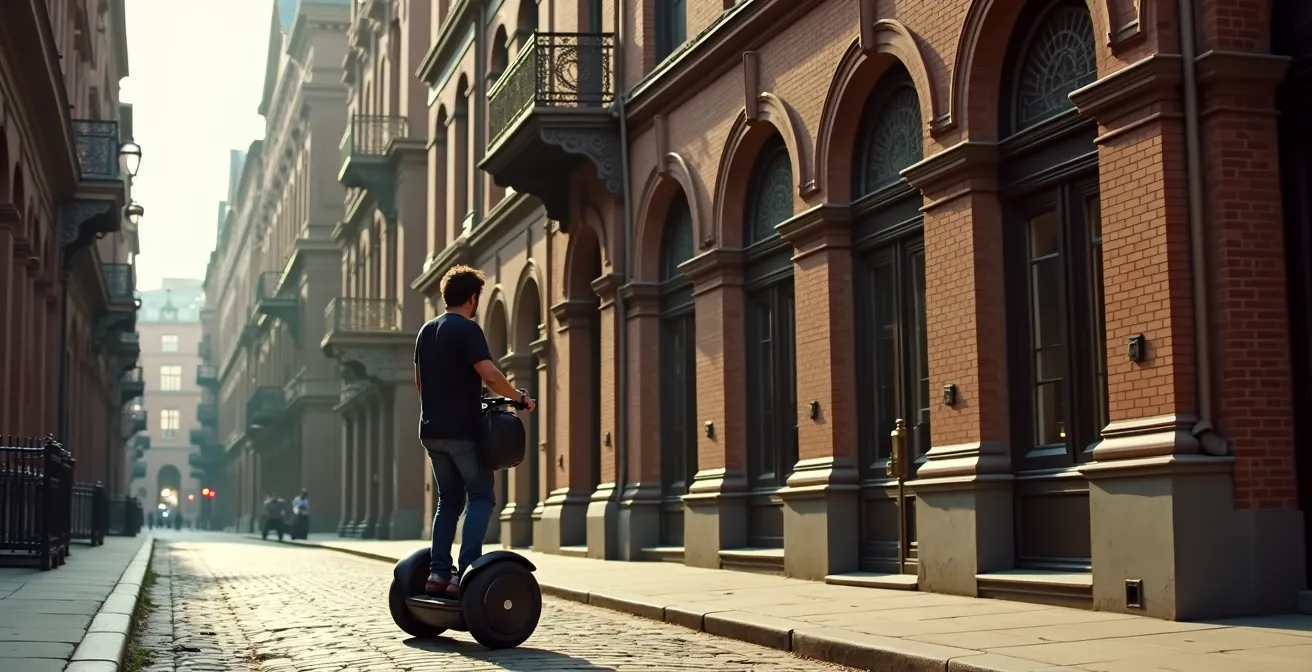
As this image illustrates, the Segway provides a unique line of sight to the intricate Victorian brickwork and upper-floor details that define the district’s character. This elevated perspective is invaluable for appreciating the full scope of the architectural craftsmanship that pedestrians at ground level might overlook, turning a simple tour into a more profound observational experience.
Brickwork vs. Modern Art: Which Dominates the Distillery Atmosphere?
The atmosphere of the Distillery District is defined by a dynamic and carefully curated tension between its original Victorian industrial fabric and the contemporary art that now inhabits it. Neither truly dominates; rather, they engage in a continuous dialogue. The robust, textured honesty of the 19th-century brickwork, stone foundations, and timber frames provides a powerful, authentic canvas. Against this, modern sculptures and art installations are strategically placed not to overshadow the heritage but to highlight it through contrast. This approach creates moments of discovery, where a sleek, modern form draws your eye towards the intricate detail of an old brick wall or a rusted iron element.
The success of this balance lies in a philosophy of “touching lightly,” where new interventions are designed to be reversible and have a minimal footprint. This ensures the integrity of the historic structures remains paramount. The renovation wasn’t about creating a theme park of the past but about fostering a living, breathing cultural space. This careful integration of old and new is the cornerstone of the district’s adaptive reuse strategy, a concept best summarized in the following comparison.
The following table, based on analysis from the project’s architects, breaks down how these two seemingly opposing forces coexist and create the district’s unique character.
| Victorian Heritage Elements | Modern Interventions | Integration Approach |
|---|---|---|
| 40+ brick & stone buildings (1864-1927) | Contemporary art installations | Strategic placement to create dialogue |
| Flemish bond brick patterns | Steel & glass additions | Minimal footprint, ‘touching lightly’ |
| Original timber frames & columns | Modern acoustic panels in theatres | Preservation with functional updates |
| Historic cobblestone streets | LED lighting & public art | Reversible installations |
This approach was lauded by the architectural community. As the RAIC Jury for the Governor General’s Medal in Architecture noted when awarding the project, it is “An intelligent adaptation of the distillery infrastructure, re-purposing the building to effective ends… requires strategic intervention, drawing out its latent qualities and giving it renewed meaning.”
The Shoe Mistake That Makes Walking the Distillery Painful
A common complaint from first-time visitors to the Distillery District is sore feet. This discomfort is almost always traceable to a simple but critical mistake: inappropriate footwear. Many assume the “cobblestone” streets are a quaint, modern affectation for aesthetic charm. In reality, they are a piece of authentic industrial heritage, and they were never designed for pedestrian comfort. The historic lanes, such as Trinity Street, are paved with brick and Belgian setts—durable, uneven stones laid to withstand the immense weight of horse-drawn carts laden with barrels and the relentless traffic of iron-shod hooves.
Wearing shoes with thin soles, high heels, or poor support is the fastest way to turn an enjoyable architectural tour into a painful ordeal. The uneven surfaces create constant, small twists and impacts on the foot and ankle. The ideal footwear is a comfortable, sturdy walking shoe with a thick, cushioned sole and good grip. This provides both shock absorption from the hard stones and stability on the irregular surfaces. In winter, this becomes even more critical; warm, waterproof boots with excellent traction are non-negotiable to handle potentially icy or snowy conditions on the bricks.
For those sensitive to the terrain, a smart strategy is to plan your route to alternate between the historic paved lanes and the modern paved paths or wooden boardwalks that have been integrated into the site. This provides periodic relief while still allowing you to immerse yourself in the historic environment. Acknowledging that you are walking on a 19th-century factory floor, not a modern sidewalk, is the first step to ensuring your focus remains on the magnificent architecture above you, not the aching feet below.
How to Find the Secret Prohibition Tunnel Entrances?
The lore of the Distillery District is rich with tales of secret tunnels used for smuggling liquor during Prohibition. This romantic image, however, is more fiction than fact. The search for open “secret entrances” is a futile one, but the search for their architectural ghosts is a fascinating exercise in reading the buildings’ history. Gooderham & Worts, as a federally licensed entity, was legally permitted to produce spirits for “medicinal” and industrial purposes throughout both Canadian and American prohibitions. While smuggling undoubtedly occurred, the firm’s primary operations were legitimate, and the need for a vast, secret tunnel network is largely exaggerated in popular myth.
So, how does one “find” the tunnels? The key is not to look for an opening you can enter, but to look for the scars of their existence in the foundations of the buildings. The district was a complex industrial machine, crisscrossed with utility tunnels for steam pipes, water mains, and moving materials between buildings. These are the “tunnels” of history. To find them, you must become an architectural detective. Walk along the base of the old stone and brick buildings, particularly the Stone Distillery and the Tank Houses. Look for sealed archways in the foundation walls—arches made of brick or stone that have been filled in with newer mortar and materials. These are the tell-tale signs of former passages.
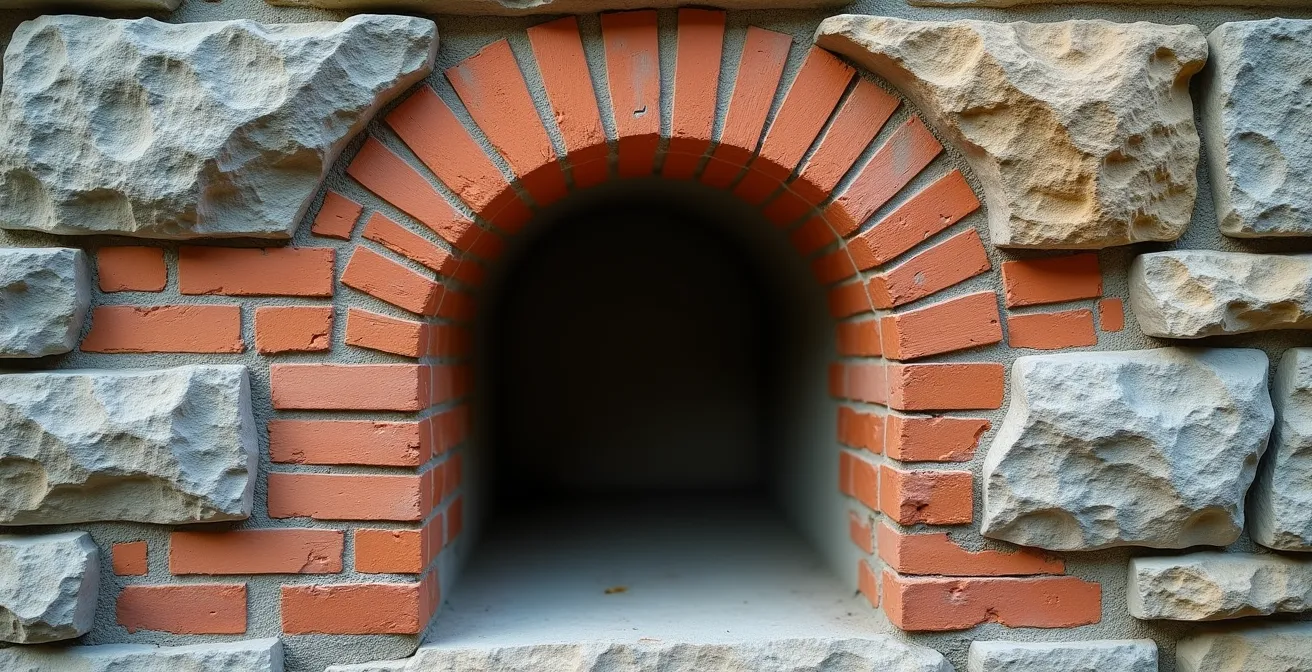
This sealed archway is a perfect example of an architectural palimpsest. The texture and colour difference between the original stone foundation and the later brick infill tells a story. It is a physical scar, a filled-in doorway to the past. Spotting these remnants is far more rewarding than searching for a mythical secret passage, as it connects you directly to the building’s authentic structural narrative and its evolution over time.
Gooderham Building vs. City Hall: Which Architecture Defines Toronto Better?
When considering the architectural soul of Toronto, two buildings often come to mind as defining icons: the Gooderham “Flatiron” Building and Viljo Revell’s new City Hall. They are, however, avatars of two completely different Torontos. To ask which defines the city better is to ask which version of Toronto’s story you want to tell. The Gooderham Building represents the city’s 19th-century mercantile ambition, while City Hall embodies its 20th-century modernist civic identity. The Distillery District, as the industrial engine that powered the era of the Gooderham Building, aligns firmly with the former.
The Gooderham Building, completed in 1892, is a romantic, red-brick jewel box. Its Romanesque Revival style, designed by David Roberts Jr., speaks of private entrepreneurial spirit and the commercial confidence of Victorian Toronto. It is an icon of “Old Toronto,” a postcard image of a city built on trade and industry. In contrast, City Hall (1965) is a bold, sweeping statement of public ambition. Its two curved towers embracing a central council chamber express a forward-looking, cosmopolitan identity, a backdrop for the multicultural celebrations that define modern Toronto.
The Distillery District is the raw, industrial heart that made the polished commercial face of the Gooderham Building possible. While the Flatiron is a refined office block, the Distillery’s buildings are powerful, functional structures of material honesty. One cannot fully define Toronto without the other. They are two sides of the same Victorian coin: the industrial powerhouse and the commercial headquarters. This comparative table highlights their distinct roles in shaping the city’s identity, based on data from historical architectural analyses.
| Aspect | Gooderham Building (Flatiron) | Toronto City Hall |
|---|---|---|
| Era | 1892 – Victorian mercantile | 1965 – Modernist civic |
| Architect | David Roberts Jr. | Viljo Revell |
| Style | Romanesque Revival with terra cotta | Finnish Modernism with curved towers |
| Urban Role | Private entrepreneurial spirit | Public civic ambition |
| Cultural Impact | Postcard icon of ‘Old Toronto’ | Backdrop for multicultural celebrations |
Why the Ceiling of the Great Hall Is a Masterpiece of Renovation?
Within the Young Centre for the Performing Arts, located in the repurposed Tank House buildings, lies the Michael Young Theatre, often referred to as the Great Hall. Its ceiling is not a decorative flourish but a masterwork of “adaptive reuse” and a microcosm of the entire district’s preservation philosophy. To the casual observer, it might just look like an old wooden ceiling. To a conservationist, it is a brilliant example of how to integrate modern functional requirements into a historic structure without erasing its soul.
The genius of the renovation, undertaken by KPMB Architects, was in preserving the building’s raw, industrial character. The ceiling is a forest of original, heavy timber frames and columns. Instead of hiding them behind drywall or painting them over, the architects celebrated them. They left the wood exposed, complete with the marks and scars of its century-long service. The challenge was to insert the complex technical grid required by a modern theatre—lighting, sound systems, acoustic panels—into this historic fabric. The solution was to float the new elements between the old, creating a “building-within-a-building” concept. Transparent materials and a minimalist aesthetic ensure that the new interventions are clearly distinguishable from the original structure, honoring the principle of material honesty.
The project’s complexity cannot be overstated. The overall Distillery District renovation required an astonishing number of approvals, including over 70 building permits and more than 130 heritage permits. The success of the Great Hall’s ceiling is a testament to the meticulous negotiation between preservation and modernization. It retains the powerful verticality of the original tank house while functioning as a state-of-the-art performance space, allowing audiences to feel the history of the building all around them.
Key Takeaways
- The Distillery District’s preservation is a unique North American success story, thanks to its scale and the unusual catalyst of the 2003 SARS outbreak.
- True appreciation requires “architectural literacy”—learning to read the stories told by the brickwork, timber frames, and structural design.
- A core philosophy of “adaptive reuse” allows for a dynamic dialogue between historic industrial forms and modern art and functionality.
Yorkville Shopping: How to Experience Luxury in Restored Victorian Homes?
To fully solidify your understanding of Toronto’s Victorian architecture, a visit to Yorkville after the Distillery District is essential. Where the Distillery showcases the raw power of Victorian industrial architecture, Yorkville presents its elegant, domestic counterpart. Here, luxury boutiques and art galleries are housed not in massive brick factories, but in charming, restored Victorian-era houses. This contrast provides a complete education in the city’s 19th-century architectural spectrum.
In Yorkville, you will not find the monumental scale and robust functionality of the Distillery. Instead, you’ll see the intimate and ornate details of residential life. Look for the characteristic Bay-and-Gable style, a uniquely Torontonian housing vernacular featuring prominent bay windows and steep, decorative gables. The materials are still often brick, but the scale is human, the details more delicate. Notice the preservation approach: where the Distillery practices adaptive reuse of entire industrial structures, Yorkville often employs “facadism,” where the historic street-facing wall is preserved while a modern structure is built behind it.
Experiencing luxury in Yorkville is therefore an architectural experience in itself. As you browse a high-end shop, take a moment to notice the original fireplace, the high ceilings, or the intricate window mouldings. You are engaging with history on an intimate, domestic scale. The following checklist will help guide your comparative exploration of these two essential Toronto heritage sites.
Action Plan: Comparing Toronto’s Victorian Heritage
- Identify Forms: In the Distillery, spot the robust, functional industrial forms. In Yorkville, identify the signature residential Bay-and-Gable style.
- Compare Preservation: Contrast the Distillery’s holistic ‘adaptive reuse’ with Yorkville’s common practice of ‘facadism’ (preserving only the front wall).
- Notice Scale: Observe the monumental scale in the Distillery, built for machines and mass production, versus the intimate, human scale of Yorkville’s former homes.
- Analyze Materials: Note the shared use of brick but observe how it’s employed for industrial strength in one and domestic elegance in the other.
- Synthesize Knowledge: By exploring both, synthesize your understanding of Toronto’s complete Victorian heritage—from its industrial engine to its residential heart.
By learning to see the Distillery District and its counterparts through the lens of a conservationist, you transform a simple visit into a deep engagement with Toronto’s history. This architectural literacy allows you to read the city’s past in its present-day form. To put this knowledge into practice, the next logical step is to plan your own comparative walking tour.