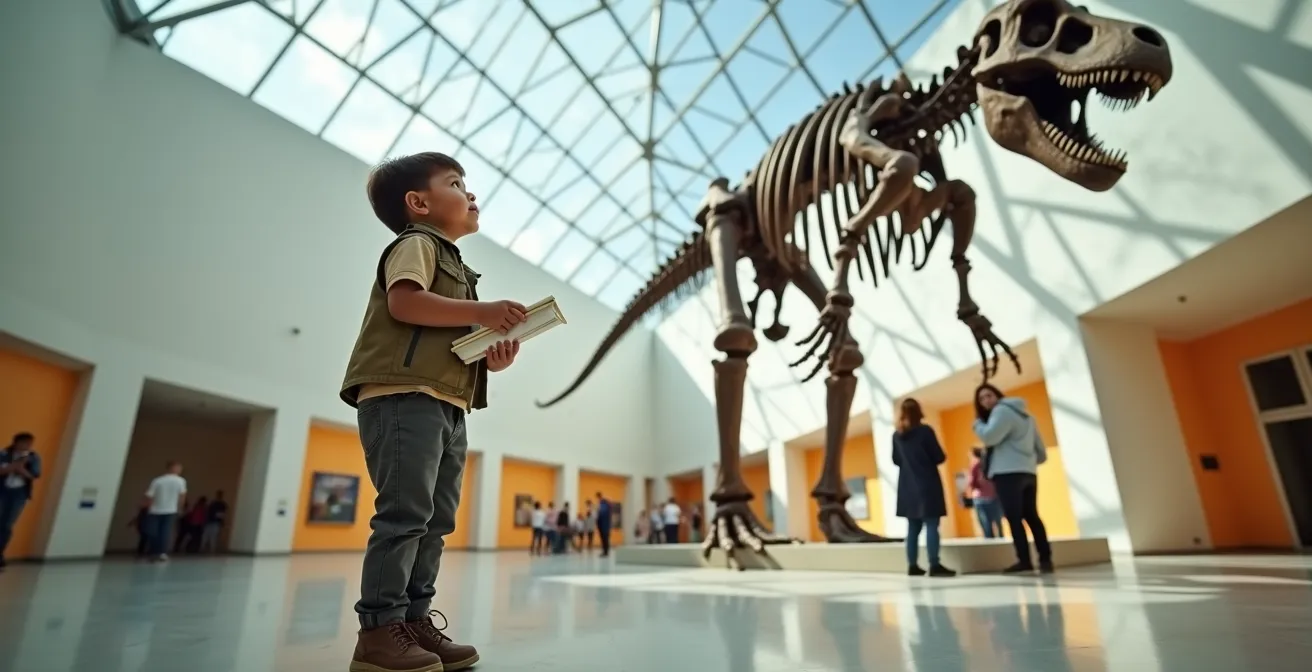
Taking a dinosaur-obsessed child to the Royal Ontario Museum can feel more like a high-stakes paleontological exam than a family day out.
- Focus on “star” specimens with incredible stories, like the massive Barosaurus, “Gordo.”
- Use the ROM’s augmented reality features to bring the skeletons to life and answer tough questions.
- Target the Cretaceous gallery for the most famous predators, including T-Rex’s fearsome cousins.
Recommendation: Instead of wandering, follow a “Fossil Hunter’s Mission” itinerary that hits the most impressive exhibits, avoids crowds, and makes you the hero guide of the expedition.
Stepping into the Royal Ontario Museum with a child who can casually differentiate a Carnotaurus from an Allosaurus is a unique kind of pressure. You’re not just a parent; you’re the expedition leader, and your junior paleontologist has high expectations. The sheer scale of the ROM is daunting. While many guides will tell you to “see the dinosaurs,” they often miss the point: your expert kid doesn’t just want to see *any* dinosaur. They want to see the biggest, the most complete, the most scientifically significant specimens. They want the stories behind the bones.
Forget the generic advice to “go see the T-Rex.” While impressive, it’s only one piece of a vast prehistoric puzzle spread across multiple galleries. A truly memorable visit—one that will have your child buzzing for weeks—requires a strategy. It demands insider knowledge of which exhibits pack the most scientific punch, which hidden gems are often overlooked, and how to navigate the museum like a seasoned fossil hunter. This isn’t just about avoiding crowds; it’s about curating an experience.
But what if the key wasn’t just to look at fossils, but to understand the story they tell? This guide transforms your visit from a simple tour into a targeted paleontological mission. We will equip you with the “specimen-specific intel” needed to guide your young expert to the most awe-inspiring displays. We’ll uncover the secrets of the museum’s most fearsome predators, reveal how to bring skeletons to life with technology, and share a tactical plan to make your day a resounding success. Get ready to lead the ultimate dinosaur hunt.
This article provides a complete mission briefing for your family’s expedition into the Age of Dinosaurs. Below, you’ll find a detailed table of contents breaking down each stage of our fossil-hunting strategy, from identifying the must-see giants to planning your route through the museum’s vast collections.
Table of Contents: Your ROM Dinosaur Expedition Plan
- Why “Gordo” the Barosaurus is a Must-See for Dinosaur Fans
- How to Use the Interactive AR Scoops in the Dinosaur Gallery
- Jurassic or Cretaceous Gallery: Which Has the Most Fearsome Predators?
- The Hidden Gem in the Fossil Wing That 80% of Visitors Walk Past
- When to Visit the Dinosaur Wing to Avoid School Groups?
- Aquarium or Tower: Which Attraction Fits a 2-Hour Window?
- Why the Bat Cave Might Scare Children Under 5 Years Old?
- Royal Ontario Museum for Families: How to Navigate 40 Galleries in One Day?
Why “Gordo” the Barosaurus is a Must-See for Dinosaur Fans
Our first mission objective is the undisputed heavyweight champion of the ROM: “Gordo” the Barosaurus. Standing as Canada’s largest mounted dinosaur skeleton, this colossal sauropod is more than just big; it’s a masterpiece of paleontological storytelling. The entire assembled skeleton is approximately 27 metres (90 feet) long, a scale that truly has to be seen to be believed. When alive, this gentle giant from the Late Jurassic period would have weighed as much as 15,000 kilograms. Nicknamed in honour of Dr. Gordon Edmund, the paleontologist who acquired the specimen for the museum, Gordo isn’t just a collection of bones—it’s an icon.
What makes this exhibit so compelling for a young enthusiast is its dramatic pose. Gordo is displayed rearing up on its hind legs, a defensive posture to protect its young from a lurking Allosaurus. This dynamic display isn’t just for show; it’s based on scientific theories about sauropod behaviour, turning a static skeleton into a frozen moment of prehistoric drama. It provides a perfect opportunity to discuss predator-prey relationships, defensive strategies, and the sheer power of these magnificent creatures. This is the kind of “specimen-specific intel” that elevates a visit from a viewing to an educational adventure.
Capturing the perfect memory of this giant requires a plan. The sheer size of the exhibit makes it a challenge to photograph, especially with crowds. Following a few key steps can ensure you get that jaw-dropping shot that will become the centerpiece of your child’s dinosaur memories.
Your Action Plan: Get the Perfect Gordo Photo Without Crowds
- Arrival Time: Arrive right at the ROM’s opening (10 AM, Tuesday-Sunday) and go directly to Level 2 via the Weston Entrance on Queen’s Park.
- Best Vantage Point: Position yourself on the second-floor walkway that overlooks the main gallery. This angle gives you the full 27-meter perspective of Gordo’s rearing pose.
- Camera Settings: For the low museum lighting, use settings like ISO 800-1600, an aperture of f/2.8-f/4, and a shutter speed around 1/60 to get a clear, bright shot.
- Frame the Story: Don’t just shoot the dinosaur; frame your shot to include the dramatic narrative—Gordo rearing up to defend against the Allosaurus skeleton below.
- Second Opportunity: For unobstructed floor-level shots, return after 1 PM on a weekday when most school groups have left the main hall.
Standing beneath this towering skeleton is a humbling experience that statistics alone cannot convey. It viscerally connects you and your child to the immense scale of life during the Jurassic period.
How to Use the Interactive AR Scoops in the Dinosaur Gallery
After being awestruck by Gordo, our next mission is to bring these ancient bones back to life. The ROM’s Temerty Galleries of the Age of Dinosaurs feature a fantastic tool that transforms your smartphone or tablet into a paleontological time machine: the Ultimate Dinosaurs augmented reality (AR) app. This is your secret weapon for answering your child’s toughest questions, like “What did it *really* look like?” or “How did it move?” Instead of just looking at static skeletons, the AR overlays skin, muscle, and movement onto the fossils right before your eyes.
This technology is more than a gimmick; it’s a powerful educational tool that bridges the gap between fossil and living creature. Look for the designated AR station markers next to key skeletons like the Barosaurus, Hadrosaurs, and Ceratopsians. Activating the app allows you to see these dinosaurs in their full glory, with textured skin and realistic colour patterns based on the latest scientific research. For a budding expert, seeing a Triceratops with a vibrant frill or a Parasaurolophus with its crest intact is a game-changing experience. It helps them visualize concepts of display structures, camouflage, and biomechanics in a way that static bones cannot.
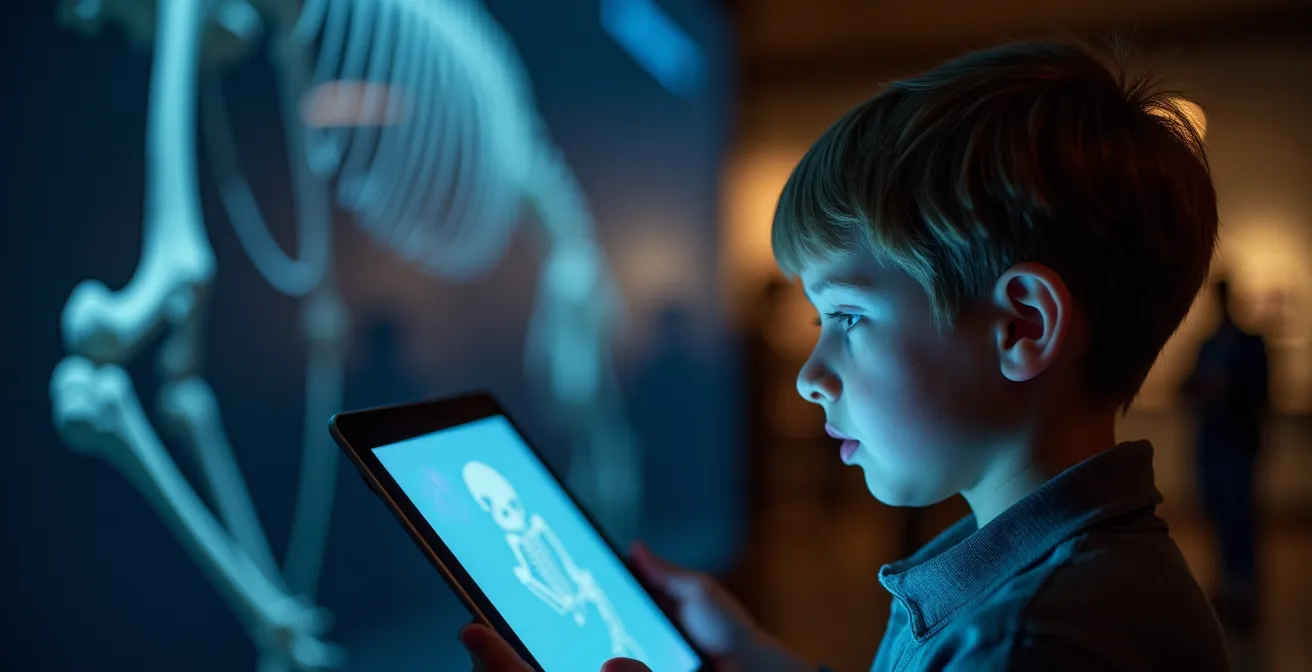
The app’s most impressive feature is the “scrubbing” timeline. This allows you to slide your finger across the screen to see the dinosaur’s movement patterns, from a slow walk to a running gait. It’s a brilliant way to explore how these animals’ unique skeletal structures translated into motion. The key is to download the app before you arrive to save time and data. By mastering this tool, you shift from being a spectator to an interactive explorer, making the entire gallery a hands-on laboratory for discovery.
Jurassic or Cretaceous Gallery: Which Has the Most Fearsome Predators?
Every dinosaur enthusiast has a favourite fearsome predator, and the ROM offers a fantastic head-to-head showdown between two different prehistoric eras. A key part of our expedition is deciding where to focus our hunt for the most impressive carnivores: the Jurassic or the Cretaceous gallery? While both have incredible specimens, they offer very different experiences for a young predator fan. The Jurassic gallery’s star is the mighty Allosaurus, a nine-meter-long hunter displayed in a dynamic pose, stalking its prey. It’s a classic, quintessential predator that sets the stage perfectly.
However, for sheer star power and local significance, the Cretaceous gallery often wins. This is where you’ll find the Tyrannosaurs. While the iconic T-Rex is a major draw, the gallery also showcases its equally terrifying cousin, Gorgosaurus. These specimens are not only larger (upwards of 12 meters) but also more complete. Crucially for a Canadian museum, many of these fossils were unearthed in Alberta, providing a fantastic link to Canada’s own rich paleontological history. The ROM’s Cretaceous gallery showcases that between 80 and 66 million years ago, western Canada was home to a diverse group of tyrannosaurs, making this gallery a point of national pride.
To help you guide your expedition, here is a field guide comparing the two galleries’ top predators, allowing you to tailor the visit to your child’s specific interests.
| Feature | Jurassic Gallery | Cretaceous Gallery |
|---|---|---|
| Star Predator | Allosaurus (9m long) | T-Rex & Gorgosaurus (12m+) |
| Canadian Content | Limited | Alberta specimens dominate |
| Fossil Completeness | 60-70% complete | 85-95% complete |
| Kid Appeal | Good (diverse species) | Excellent (T-Rex factor) |
| Unique Feature | Hunting pose displays | Real fossil skulls |
The verdict? If your child is fascinated by the sheer power and fame of the T-Rex and its family, the Cretaceous gallery is the undisputed champion. The high degree of fossil completeness and the real fossil skulls on display offer an unparalleled level of authenticity.
The Hidden Gem in the Fossil Wing That 80% of Visitors Walk Past
While the colossal dinosaurs rightly command the spotlight, a true paleontological expedition involves uncovering the secrets that most visitors miss. Our next target is a “hidden paleo-gem” of immense scientific importance: the Burgess Shale exhibit. Tucked away in the Dawn of Life gallery on Level 2, this display is easily overlooked by families rushing towards the giant skeletons. However, it contains some of the most important fossils in the entire world. These are not giant bones, but small, exquisitely preserved imprints of strange and wonderful creatures.
What makes the Burgess Shale so special? Found in a UNESCO World Heritage site in the British Columbia Rockies, these fossils chronicle the “Cambrian Explosion,” a pivotal moment in Earth’s history when complex life first appeared. The ROM’s incredible collection contains specimens that are around 508 million years old, making the dinosaurs seem like recent history by comparison. Pointing out creatures like the bizarre five-eyed Opabinia or the fearsome-looking Anomalocaris will blow your young expert’s mind. It’s a chance to explain that the story of life is much bigger than just dinosaurs.
Leading your child to this exhibit is like revealing a secret level in a video game. You can frame it as a hunt for the very first complex animals on Earth. While other visitors are mesmerized by size, your expedition is digging deeper into the origins of life itself. This gallery also houses other incredible finds often missed in the dino-frenzy, including the massive skeletons of Ice Age mammals like the Mastodon that once roamed Ontario, and the sleek marine reptiles like the six-meter Ichthyosaur. Making a point to find these treasures demonstrates a deeper level of expertise and curiosity, turning a good museum day into a great one.
When to Visit the Dinosaur Wing to Avoid School Groups?
Even the most dedicated fossil hunter can have their expedition hampered by an immovable obstacle: a sea of school groups. Timing your visit is the most crucial piece of tactical planning you can do to ensure a successful mission. A quiet gallery allows for better views, clearer photos, and the mental space to actually absorb the information and answer your child’s questions without shouting. The key is to understand the museum’s peak traffic patterns and use some “crowd-hacking” strategies to your advantage.
The main challenge during the school year is the wave of field trips that descend upon the museum on weekday mornings. According to ROM’s own school booking system, from September to June, school bookings are available Tuesday to Friday, primarily between 10 AM and 2 PM. This means that arriving at 10:30 AM on a Wednesday is likely to land you in the middle of the busiest period. However, this predictable pattern is also your greatest strategic advantage. By planning around it, you can secure precious quiet time in the dinosaur halls.
The most effective strategy is to zig when everyone else zags. School groups almost universally start on Level 2 in the dinosaur and mammal galleries. A simple but brilliant pro-tip is to begin your visit on the upper floors (like Level 4’s world cultures) and work your way down, arriving at the dinosaur exhibits after 2 PM when the groups have departed for their buses. Alternatively, aim for times when schools are not in session or the museum has special hours. With the right timing, you can transform a crowded, chaotic experience into a private viewing of some of the world’s greatest treasures.
Aquarium or Tower: Which Attraction Fits a 2-Hour Window?
After a successful morning expedition at the ROM, your team might have the energy for one more Toronto mission. Two of the city’s biggest attractions, Ripley’s Aquarium of Canada and the CN Tower, are located adjacent to each other in the Entertainment District, a short subway ride away. But with limited time and energy, especially with kids, which one is the smarter choice for a two-hour window? This decision requires a logistical analysis. Both are about a 25-minute journey from the museum via the TTC subway (Museum Station to St. Andrew or Union Station).
The CN Tower offers breathtaking views, but it’s highly weather-dependent and can have significant wait times for security and elevators, often eating up 20-40 minutes before you even start your ascent. The experience at the top can be relatively quick (45-60 minutes), but the total time commitment often pushes past 2.5 hours, making it a tight squeeze. Ripley’s Aquarium, on the other hand, is an entirely indoor experience, making it a reliable, all-weather option. Entry is typically faster, and the layout is designed for a continuous flow, with a minimum visit time of around 90 minutes. It’s particularly well-suited for younger children who might find the heights of the tower less engaging than the immersive underwater tunnels.

To help you make the best tactical decision for your family, here is a breakdown of the time and suitability factors for each attraction post-ROM.
| Factor | CN Tower | Ripley’s Aquarium |
|---|---|---|
| Distance from ROM | 4.5km (25 min TTC) | 4.3km (23 min TTC) |
| Security/Entry Time | 20-40 minutes peak | 10-15 minutes |
| Minimum Visit Time | 45-60 minutes | 75-90 minutes |
| Weather Dependent | Yes (views crucial) | No (indoor) |
| Toddler Friendly | Limited | Excellent |
| Total Time Needed | ~2.5 hours | ~2.25 hours |
Why the Bat Cave Might Scare Children Under 5 Years Old?
One of the ROM’s most famous and beloved exhibits is the Bat Cave on Level 1. It’s a short, immersive walk-through that simulates a real Jamaican cave, complete with a colony of model bats. While it’s a rite of passage for many Toronto kids, it’s a side quest that requires careful consideration if your expedition includes a junior member under the age of five. The very elements that make it so effective—the gradual darkness, cool air, and realistic sounds—can be overwhelming for very young children.
The experience is designed to be educational, not terrifying. It’s never pitch black, subtle floor lighting ensures safety, and the recorded sounds of chirping and flapping wings are kept at a moderate volume. The walls are textured to feel like rock, and hundreds of detailed models of bats hang from the ceiling. For most, it’s a thrilling and memorable two-minute adventure. However, for a toddler or preschooler whose imagination is running wild after seeing giant dinosaur skeletons, the sudden transition into a dark, enclosed space with things hanging overhead can trigger genuine fear.
The key to a successful Bat Cave mission is preparation. Knowing what to expect allows you, the expedition leader, to frame the experience positively and have a plan in case your little one gets scared. Talking about it beforehand, holding their hand, and explaining the sounds can turn a potentially scary moment into an exciting one. Having an “exit strategy” is also a smart move, reassuring your child that they are in control. With the right script, you can assess whether your child is ready for this classic ROM experience or if it’s a mission best saved for a future visit.
Key Takeaways
- A successful ROM trip with a dino-expert kid requires a mission plan, not a casual stroll.
- Focus on the “star” specimens like Gordo the Barosaurus and the Cretaceous predators for maximum impact.
- Use technology like the AR app and “crowd-hacking” strategies to enhance the experience and avoid frustration.
Royal Ontario Museum for Families: How to Navigate 40 Galleries in One Day?
Our expedition has covered specific targets, from colossal giants to hidden gems. Now it’s time to assemble these pieces into a grand strategy. How do you conquer the Royal Ontario Museum in a single day without succumbing to “museum fatigue”? The challenge is immense; The ROM officially houses 40 gallery and exhibition spaces filled with millions of artifacts. A lack of a plan will lead to aimless wandering and an exhausted team long before you’ve seen the best exhibits. The secret is to accept that you can’t see everything and to prioritize a “Dinosaur Hunter’s Mission” that hits the absolute highlights of prehistoric life.
For families on this specific quest, this means focusing your energy almost exclusively on Level 2. This floor is the heart of the ROM’s prehistoric collection, containing the Temerty Dinosaur Galleries, the Dawn of Life Gallery (with our hidden gem, the Burgess Shale), and the Mammals Gallery, which features incredible Ice Age megafauna. By dedicating the majority of your time here, you ensure a deep, satisfying dive into the subject your child loves most. Other exhibits, like the Bat Cave, can be treated as short, strategic “side quests.”
For members or families who plan to return, many report that a “two-visit strategy” is the ultimate solution. This involves splitting your exploration into a “Prehistoric Life Day” (dinosaurs, fossils, mammals) and a separate “Human History Day” (world cultures, Egypt, etc.). But for a single-day expedition, a focused itinerary is your best tool. Below is the ultimate mission plan designed to maximize your dinosaur discoveries and make your family’s day at the ROM a triumphant success.
The Ultimate ROM Dinosaur Hunter’s Mission Itinerary
- 10:00 AM: Enter via the Weston Entrance on Queen’s Park. Grab a map at the info desk to orient your team.
- 10:15 AM: Proceed directly to Level 2. Begin your 90-minute exploration of the Temerty Dinosaur Galleries (Gordo, Predators, AR stations).
- 11:45 AM: Take a strategic 30-minute snack and recharge break at the Druxy’s ROM Café on Level 1.
- 12:15 PM: Return to Level 2 for the “hidden gems.” Spend 30 minutes in the Dawn of Life Gallery to find the Burgess Shale fossils.
- 12:45 PM: Move next door to the Mammals Gallery to see the Ice Age giants like the Mastodon (30 minutes).
- 1:15 PM: Head down to Level 1 for the quick Bat Cave side quest (15 minutes).
- 1:30 PM: If energy levels are still high, descend to Level B1 for an optional 30-minute tour of the dazzling Earth’s Treasures gallery.
By following this focused mission plan, you transform a potentially overwhelming day into a targeted and triumphant paleontological expedition. You will have guided your young expert to the most impressive specimens, uncovered scientific secrets, and created lasting memories, solidifying your status as the ultimate expedition leader.