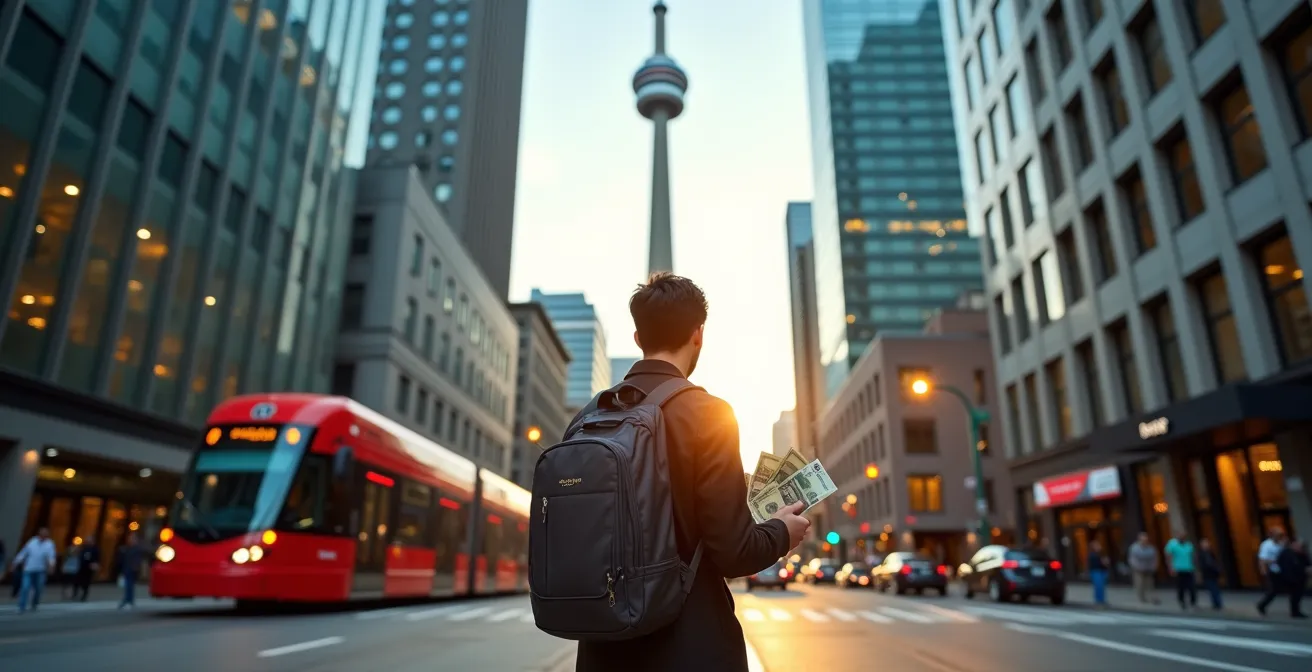
In summary:
- Never pay directly with USD cash; you’ll lose money on poor exchange rates set by merchants.
- Use credit cards widely, but always choose to pay in Canadian Dollars (CAD) at the terminal to avoid high conversion fees.
- Find ATMs within the Global ATM Alliance (like Scotiabank) to withdraw cash without extra operator fees.
- Carry a small amount of cash for specific locations like Kensington Market food stalls and small, traditional shops.
- Master Toronto’s tipping etiquette (15-20% pre-tax is standard) to avoid confusion and awkwardness.
You’ve planned your Toronto itinerary, booked your flight, and are ready to explore. But a crucial question remains: how do you handle your money without getting hit by a barrage of unexpected fees? Many visitors arrive armed with US dollars or rely solely on their home bank’s credit card, assuming it’s the easiest path. This is often the first, and most costly, mistake.
The common advice is to exchange money at your bank before leaving or to simply find the nearest ATM upon arrival. While not entirely wrong, this approach lacks the nuance required for a city like Toronto. It overlooks the hidden costs of merchant exchange rates, the trap of dynamic currency conversion, and the specific payment cultures of different neighborhoods, from the high-tech financial district to the cash-friendly market stalls.
The key isn’t to find one single “best” way to pay. The real secret to financial savvy in Toronto is to adopt a situational payment strategy. It’s about understanding the financial mechanisms at play and knowing precisely when to use a credit card, when to tap your phone, and when a handful of Canadian cash is non-negotiable. This guide is built not just on what to do, but on *why* you’re doing it, transforming you from a tourist into a savvy spender.
This article will break down the eight pillars of this strategy. We will dissect common financial mistakes, reveal how to find fee-friendly ATMs, clarify the city’s tipping culture, and show you how to leverage technology to make your trip smoother and more affordable.
Summary: Your Complete Guide to Financial Savvy in Toronto
- Why Using USD Cash in Toronto Stores is a Financial Mistake?
- How to Find ATMs That Don’t Charge $5 Fees?
- Credit Card vs. Cash: Which Is Better for Small Vendors?
- The Tipping Mistake That Offends Servers (Or Costs You Too Much)
- When to Choose “Pay in CAD” on Your Card Terminal?
- Why You Must Carry Cash When Visiting Kensington Food Stalls?
- Why Buying a PRESTO Card Saves You Money After 4 Days?
- Going Cashless in Toronto: How to Pay for Everything with Your Phone?
Why Using USD Cash in Toronto Stores is a Financial Mistake?
It might seem convenient to use the US dollars in your wallet, especially since many Toronto shops near the border or in tourist-heavy areas will accept them. However, this convenience comes at a significant hidden cost. When a merchant accepts your USD, they are not giving you the official bank rate; they are creating their own, on-the-spot exchange rate that is always in their favor. This is a classic case of rate leakage, where you lose money without even noticing.
These “tourist rates” can be substantially worse than the mid-market rate you see on financial news sites. The difference is pure profit for the store. For example, a detailed analysis found that the average markup when exchanging USD for CAD was around 1.5% higher than the mid-market rate. While 1.5% may sound small, it adds up quickly over dozens of transactions for coffee, souvenirs, and meals during your trip. You are essentially paying an extra, invisible tax on every purchase.
Think of it as a fee for convenience, but one you have complete control over. The fundamental rule for a forex advisor is clear: pay in the local currency whenever possible. By obtaining Canadian dollars (CAD) through proper channels or using a card correctly, you take control of the exchange rate and eliminate this unnecessary friction cost. Paying with USD is a financial trap designed for uninformed travelers, and it’s the first one you should learn to sidestep.
How to Find ATMs That Don’t Charge $5 Fees?
Once you’ve decided against using USD cash, the logical next step is to withdraw Canadian dollars. But this is where many travelers encounter their next financial hurdle: exorbitant ATM fees. You’ll often face a double charge: one from your own bank for using an out-of-network ATM, and a “convenience fee” from the ATM’s owner. These independent, “white-label” ATMs found in convenience stores and bars are the worst offenders. In Canada, they can range between $1.50-$5 per transaction, and that’s before your home bank adds its own fee.
The solution is not to avoid ATMs altogether, but to be strategic about which ones you use. The single best strategy for many international visitors is to leverage the Global ATM Alliance. This is a network of major international banks that have agreed to waive ATM operator fees for each other’s customers. In Canada, the key member is Scotiabank. If your home bank is part of this alliance (such as Bank of America in the US, Barclays in the UK, or Deutsche Bank in Germany), you can withdraw cash from any Scotiabank ATM without paying the local operator fee. You might still incur a foreign currency conversion fee from your bank, but you eliminate the hefty $3-$5 charge on the spot.
Before your trip, check if your bank is a member of the Global ATM Alliance. If it is, locate Scotiabank branches near your hotel or planned routes. This simple piece of research can save you $20-$30 in fees over the course of a week-long trip, freeing up that money for an extra poutine or a ticket up the CN Tower.
Credit Card vs. Cash: Which Is Better for Small Vendors?
In a largely cashless city like Toronto, your credit card will be your primary payment tool. It’s accepted almost everywhere, from major museums to the local Tim Hortons. However, assuming you can use it for 100% of your transactions is a mistake. The real ‘situational payment strategy’ comes into play when dealing with Toronto’s vibrant scene of small, independent vendors, food stalls, and historic eateries.
For these small businesses, credit card processing fees can be a significant burden, eating into their already slim profit margins. While many have adapted with Square readers, some still operate as cash-only, or at least strongly prefer it. As one experienced traveler noted on a forum, this is especially true for certain beloved local spots:
You may need some cash for visiting old school places like some stalls in St. Lawrence Market, The Patrician Grill on King, Square Boy on Danforth, Swatow on Spadina.
– Tripadvisor Forum Member, Tripadvisor Toronto Forum
Having a small amount of cash ($50-$100 CAD) is essential for fully experiencing the city. It ensures you won’t be turned away from a must-try food stall or miss out on a unique find in a vintage shop. In some Chinatown stores, you may even be offered a small discount for paying in cash.
This table breaks down the payment etiquette for some of Toronto’s most popular vendor-heavy locations, helping you decide when to pull out your card versus your cash.
| Location | Card Acceptance | Cash Preferred | Notes |
|---|---|---|---|
| St. Lawrence Market | Most vendors | Some stalls | Cheese/meat counters accept cards, peameal bacon sandwich vendor prefers cash |
| Kensington Market | Limited | Yes | Many food stalls are cash-only |
| Food Trucks | Most have Square readers | During lunch rush | Cash speeds up lines 12-1 PM |
| Chinatown Shops | Yes | Discounts available | Ask for cash discount on electronics/jewelry |
The Tipping Mistake That Offends Servers (Or Costs You Too Much)
Tipping culture is one of the most stressful financial aspects for international visitors in North America, and Toronto is no exception. Gratuity is not just a bonus; it’s a fundamental part of a server’s income. Not tipping, or tipping too little, can be perceived as an insult to their service. Conversely, not understanding the norms can lead you to overpay, especially as modern payment terminals suggest tips as high as 25-30%.
The golden rule is straightforward. For standard table service in a restaurant, a tip of 15-20% on the pre-tax bill is standard for good service. If the service was truly outstanding, a tip approaching 25% is a generous compliment. The most common mistake tourists make is calculating the tip on the final bill, which includes a 13% Harmonized Sales Tax (HST). Always calculate your tip based on the subtotal *before* tax to tip correctly and fairly.
However, the 15-20% rule doesn’t apply everywhere. Different services have different expectations, and knowing them is part of mastering the local financial etiquette. The key is to adapt your gratuity to the context of the service being provided.
Your Action Plan: Toronto Tipping Guide by Service Type
- Large Restaurant Parties: If dining in a group of more than five, it’s customary to tip 18-20%. Always check your receipt first, as some restaurants automatically add a service charge for large groups.
- At the Bar: When ordering drinks directly from the bartender, leave about $1 to $2 per drink. For a $6 beer, a $1 tip is considered standard.
- Cafés and Counter Service: For a simple coffee or pastry, tipping is appreciated but less rigid. The prompt on the terminal will suggest 10-20%; many locals will choose the lower end or leave a dollar in the tip jar.
- Food Delivery: A tip of 15-20% is standard, especially if the driver has to navigate bad weather or a hard-to-find downtown condo building.
- Hair Salons: For a haircut or styling, a tip in the 5-10% range for the stylist is customary.
When to Choose “Pay in CAD” on Your Card Terminal?
You’re at a restaurant, you’ve calculated the perfect tip, and the server brings the payment terminal. You tap your foreign credit card, and a question flashes on the screen: “Pay in your home currency (e.g., USD) or in local currency (CAD)?” This is the moment you face Dynamic Currency Conversion (DCC), and it is arguably the most deceptive fee in travel finance. The correct answer is always, without exception, to choose the local currency (CAD).
DCC is marketed as a “convenience.” The terminal shows you the exact amount you’ll be charged in your home currency, removing any guesswork. However, this service comes at a steep price. When you choose to pay in your home currency, you are giving the terminal’s payment processor—not your own bank—permission to perform the currency conversion. They will do so at a highly unfavorable exchange rate, often adding a markup of 3-7% on top of the mid-market rate. This is far worse than the standard 2.5% foreign transaction fee that most banks charge.
As the experts at Wise advise, whether at an ATM or a point-of-sale terminal, you must “choose to be charged in the local currency (CAD).” By doing so, you decline the terminal’s expensive conversion service and pass the task back to your own credit card network (Visa, Mastercard). They will use a much more competitive, near-mid-market rate. Even with your bank’s standard foreign transaction fee (often around 2.5%), you will still come out significantly ahead. The difference between choosing CAD and your home currency on a C$200 dinner bill could be as much as $10.
Why You Must Carry Cash When Visiting Kensington Food Stalls?
While the broader trend in Toronto is towards a cashless society, there are vibrant pockets of the city where cash is not just preferred—it’s essential. The most famous example is Kensington Market. This bohemian neighborhood is a multicultural mosaic of independent grocers, vintage clothing shops, and, most importantly, a huge variety of small, often family-run food stalls and bakeries.
Many of these beloved vendors operate on very thin margins and have not adopted digital payment systems. For them, cash is king. Trying to buy a hot empanada, a fresh churro, or a Jamaican patty with a credit card might get you a polite refusal. This isn’t just about avoiding transaction fees; for many, it’s a business model that has worked for decades. To truly immerse yourself in the culinary tapestry of Kensington, you absolutely need a stash of Canadian bills and coins.
This “cash-only” culture extends to other “old school” gems scattered across the city. Think of the iconic peameal bacon sandwich stand in St. Lawrence Market, classic diners, or certain specialty shops in Chinatown. These are places that trade on tradition and authenticity, and their payment methods are often part of that charm. Showing up with only a credit card means you might miss out on some of the city’s most unique and delicious experiences.
This reinforces the core of our situational payment strategy: your card is for the 90%, but that small reserve of cash is your golden ticket to the other 10%—the part of Toronto that digital payments haven’t reached. Without it, you’re only getting a partial taste of what the city has to offer.
Why Buying a PRESTO Card Saves You Money After 4 Days?
For any visitor staying in Toronto for more than a couple of days, public transit will be a major part of your budget. The Toronto Transit Commission (TTC) is the city’s network of subways, streetcars, and buses. While you can tap your credit or debit card for a single fare, this is not the most cost-effective method for a multi-day stay. The key to unlocking savings is the PRESTO card.
A PRESTO card is a reloadable smart card used for transit across Toronto and its surrounding regions. There is a one-time C$6 fee to purchase the card, but the long-term savings quickly outweigh this initial cost. The primary benefit is a lower fare per ride compared to paying with cash or even tapping a credit card. Furthermore, the PRESTO card is your gateway to other discounts and programs, like the recently introduced One Fare Program, which provides free transfers between the TTC and other regional transit systems like GO Transit.
Let’s look at the direct cost comparison. A single adult fare is cheapest with PRESTO. While the difference per ride seems small, it accumulates. If you take just two round trips a day, the savings start to add up, and by the fourth day of your visit, the lower fares will have typically paid for the initial cost of the card itself. From that point on, it’s pure savings.
This table illustrates the clear financial advantage of opting for a PRESTO card over other payment methods for navigating the TTC.
| Payment Method | Single Fare | Card Cost | Transfer Benefits | Other Perks |
|---|---|---|---|---|
| PRESTO Card | C$3.35 | C$6 one-time | Free 2-hour transfers | Discounts at attractions, UP Express savings |
| Credit/Debit Tap | C$3.40 | None | Free 2-hour transfers | None |
| Cash | C$3.50 | None | Paper transfer only | None |
Key Takeaways
- Always Decline DCC: When a payment terminal offers to charge you in your home currency, always refuse and choose to pay in Canadian Dollars (CAD) to get a better exchange rate from your own bank.
- Leverage the Global ATM Alliance: If your bank is a member (like Bank of America), use Scotiabank ATMs in Toronto to withdraw cash without paying the local ATM operator fee.
- Blend Your Payments: Rely on credit cards for most purchases, but always keep a small amount of Canadian cash on hand for small vendors, food markets like Kensington, and tipping.
Going Cashless in Toronto: How to Pay for Everything with Your Phone?
While we’ve established the necessity of carrying some cash, the future of payments in Toronto is undoubtedly digital. For the tech-savvy traveler, your smartphone can become your primary wallet, streamlining nearly every transaction from your morning coffee to your subway ride. Adopting a mobile-first approach can offer an unparalleled level of convenience and security.
The foundation of this strategy is loading your credit and debit cards into a mobile wallet like Apple Pay or Google Pay. This allows you to tap your phone at virtually every modern payment terminal in the city. Beyond simple payments, Toronto’s ecosystem is rich with apps that integrate payments directly into their services. You can add your PRESTO card to your Apple Wallet to tap your phone or watch to pay for transit, eliminating the need to carry the physical card.
This digital integration extends beyond transit. The Green P app allows you to find and pay for street parking without ever touching a meter. Food apps like Ritual are ubiquitous in the downtown core, letting you order ahead and pay from your phone to skip the lunch-hour lines. This digital approach is not just about convenience; it’s also about efficiency. Ontario’s One Fare Program, for instance, automatically applies transfer discounts when you consistently tap with the same payment method, be it a PRESTO card or a credit card in your mobile wallet.
By embracing these tools, you can navigate the city with incredible speed and ease. Your phone becomes your transit pass, your parking meter, and your wallet, all in one. This is the final layer of the situational payment strategy: using technology not just to pay, but to make your entire experience of the city more seamless.
Now that you are equipped with this situational payment strategy, you have the financial knowledge to navigate Toronto with confidence. Begin by checking if your bank is part of the Global ATM Alliance and ensure you have a credit card with low foreign transaction fees loaded into your mobile wallet.
Frequently Asked Questions about Managing Money in Toronto
Which Toronto locations still require cash?
While most of Toronto is card-friendly, you will likely need cash for “old school” places. This includes certain food stalls in St. Lawrence Market and Kensington Market, historic diners like The Patrician Grill, and some small, independent shops in neighborhoods like Chinatown and the Danforth.
How much cash do locals typically carry?
It varies, but many locals who primarily use cards might keep around C$80-C$100 in their wallet for emergencies or for the rare cash-only vendor. For a tourist actively visiting markets, having a similar amount on hand is a good benchmark.
Do I really need a PRESTO card if I have a credit card with tap?
For a short trip of 1-2 days, tapping your credit card is fine. However, if you are staying for four days or more and plan to use transit frequently, the C$6 investment in a PRESTO card will pay for itself through lower per-ride fares. It also provides access to other potential discounts.