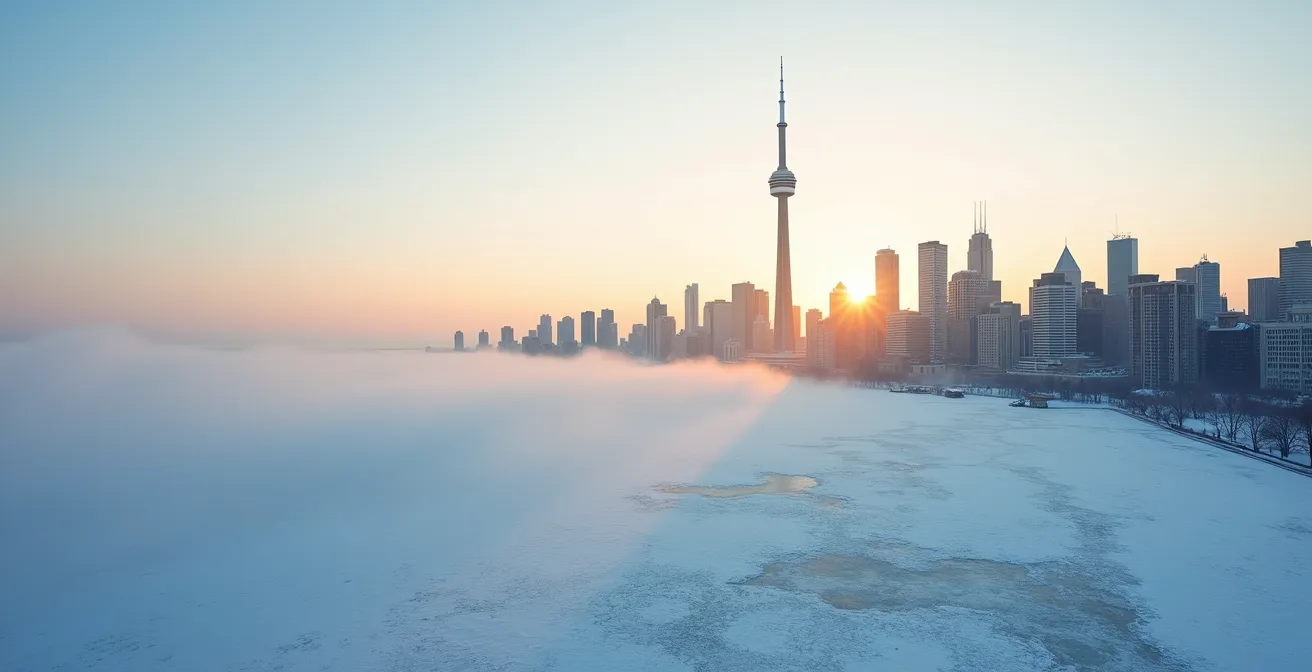
Most visitors believe a Toronto winter is about enduring the cold or hiding indoors. That’s a mistake. The key to truly enjoying the city isn’t avoiding the frigid temperatures, but mastering the physics of warmth. This guide teaches you how to think like a thermal engineer, using the city’s unique infrastructure and the right gear to manage your body’s energy budget and transform a daunting -20°C day into a comfortable, memorable adventure.
The first time you see a Toronto weather forecast in January, your eyes will likely fixate on one number, then jump to a second, more terrifying one: the “Feels Like” temperature. A reading of -12°C can feel like -20°C or colder, a chilling prospect for anyone visiting from a warmer climate. The typical advice is predictable: “dress in layers,” “drink hot chocolate,” and “visit a museum.” While not wrong, this advice treats you like a passive victim of the cold, merely surviving until you can get back indoors.
This approach is fundamentally flawed. Enjoying a Toronto winter isn’t about hiding from it; it’s about actively engaging with it on your own terms. It requires a mental shift from simply “staying warm” to strategic “thermal management.” Think of your body as having an energy budget. Every gust of wind, every damp sock, and every inch of exposed skin is a withdrawal. The secret is to minimize those withdrawals while making smart, comfortable “deposits” of warmth and energy throughout the day.
This guide will deconstruct the science of staying comfortable in the extreme cold. We will move beyond the platitudes to give you a survivalist’s toolkit. We will explore why the “Feels Like” temperature is the only number that matters, how to engineer a day of fun without ever stepping outside, the critical difference between “water-resistant” and “waterproof” on slushy sidewalks, and how to navigate the city’s hidden network of underground tunnels like a seasoned local. Forget just surviving; it’s time to learn how to thrive.
To help you conquer the cold with confidence, this article breaks down the essential strategies for thermal management and urban navigation. You’ll find everything you need to engineer a comfortable and exciting winter experience in Toronto.
Summary: How to Master a Toronto Winter When it Feels Like -20°C
- Why “Feels Like” Temperature Matters More Than the Thermometer?
- How to Spend an Entire Saturday Without Going Outdoors?
- Nathan Phillips Square vs. The Bentway: Which Rink Has Better Ice?
- The Dry Skin Mistake That Ruins Photos After 2 Days in Winter
- When to Plan Outdoor Photos Before the 4:Toronto Landmarks: Which Iconic Spots Offer the Best Free Views of the City?
- The Winter Commute Strategy That Prevents Being Late During Snowstorms
- Why “Water-Resistant” Is Not Enough for Toronto Sidewalks?
- Navigating the PATH: How to Walk from Union to Eaton Centre Without Getting Lost?
Why “Feels Like” Temperature Matters More Than the Thermometer?
The number on a thermometer measures the ambient air temperature. This is a simple, static fact. However, humans don’t experience temperature in a vacuum; we lose heat to our environment primarily through two relentless processes: convection and conduction. The “Feels Like” temperature, or wind chill, is a pragmatic metric that accounts for the accelerated heat loss caused by convection. Wind strips away the thin layer of warm air trapped close to your skin, forcing your body to spend more energy to replace it. The faster the wind, the faster you lose heat.
This isn’t a trivial difference. It’s a matter of safety and core to your thermal management strategy. In fact, the City of Toronto issues Extreme Cold Weather Alerts based on Environment Canada’s criteria for Toronto, which includes a forecast of -30°C wind chill for at least two hours. This is the point where the risk of frostbite and hypothermia becomes significant for exposed skin. For a visitor, this means your entire strategy should be built around defeating wind.
This is why a windproof outer layer is the single most important piece of gear in your arsenal. It acts as a shield, preserving the pocket of air your other layers have warmed. Without it, even the best fleece or wool insulation becomes dramatically less effective. Ignoring the wind chill is the first and most common mistake a winter visitor makes. Always plan your day, and especially your clothing, based on the “Feels Like” temperature, not the number on the thermometer.
How to Spend an Entire Saturday Without Going Outdoors?
On days when the wind chill is particularly brutal, the city of Toronto offers a unique solution for comfort engineering: a vast, interconnected network of indoor spaces. It’s entirely possible to have a full day of shopping, dining, and entertainment without exposing yourself to the elements for more than a few seconds. This is achieved by mastering the city’s greatest winter asset: the PATH system.
The PATH is a 30-kilometre network of underground pedestrian tunnels, elevated walkways, and at-grade connections that links dozens of downtown office towers, shopping centres, and transit hubs. It’s not just a sterile series of corridors; it’s a bustling subterranean city-within-a-city, a vibrant and warm micro-climate teeming with life while the wind howls above ground. The system connects major destinations like Union Station, Scotiabank Arena, Roy Thomson Hall, and the CF Toronto Eaton Centre.
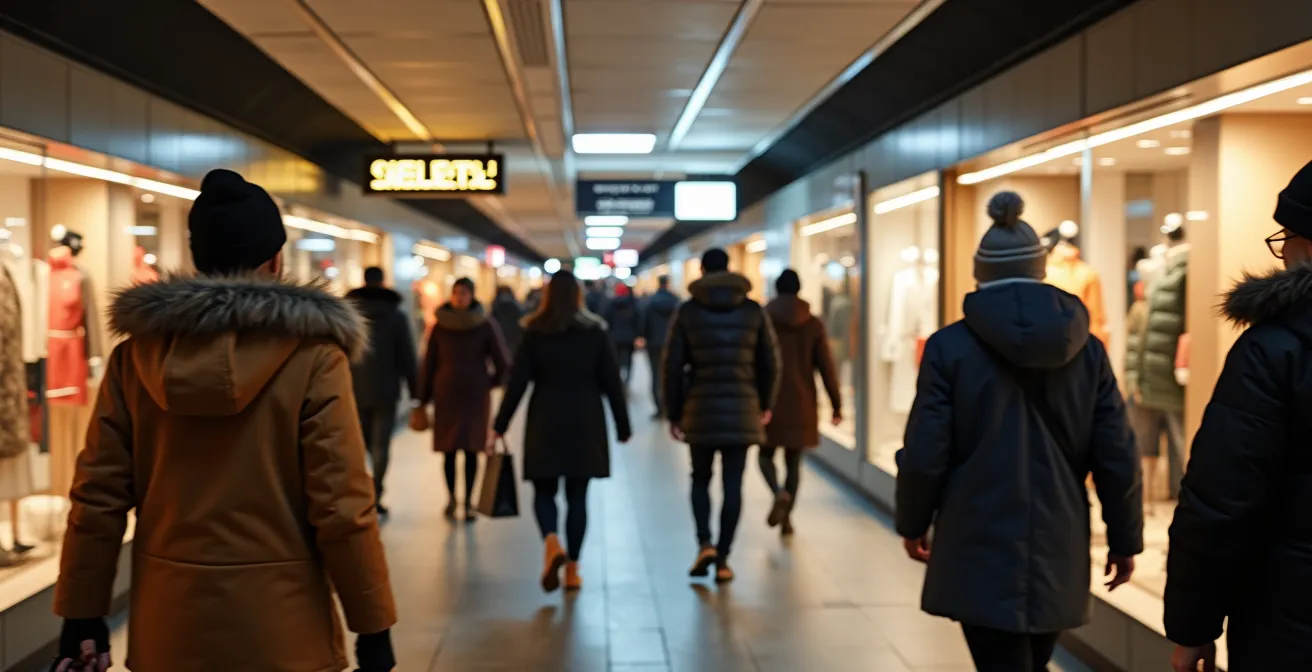
As you can see, this network is far from a simple tunnel; it’s a destination in itself. An entire Saturday can be planned around it. You could start your morning with a coffee near Union Station, walk underground to explore the shops at Brookfield Place, have lunch in the food court at First Canadian Place, and then continue on to the massive CF Toronto Eaton Centre for an afternoon of world-class retail therapy. As a resource for newcomers notes, through the PATH, you can walk from Union Station all the way to Eaton Centre and only spend a few seconds outdoors, demonstrating the immense scale and utility of this network.
Nathan Phillips Square vs. The Bentway: Which Rink Has Better Ice?
Ice skating is a quintessential Toronto winter experience, but choosing the right rink depends on the atmosphere you’re seeking. Two of the most popular outdoor options, Nathan Phillips Square and Harbourfront Centre, offer distinct experiences, while a third, The Bentway, provides a uniquely urban alternative. The quality of the ice itself is generally well-maintained at all major city rinks, so the decision often comes down to location, facilities, and vibe.
Nathan Phillips Square is arguably Toronto’s most iconic rink, set against the backdrop of City Hall and the famous “TORONTO” sign. It’s a vibrant, often crowded hub of activity. Harbourfront Centre’s rink, on the other hand, offers a different kind of beauty with its scenic views of Lake Ontario. A direct comparison reveals their different strengths.
| Feature | Nathan Phillips Square | Harbourfront Centre |
|---|---|---|
| Opening Season | Early December to mid-March | Early December to mid-March |
| Location | Downtown, by Old City Hall | Waterfront location |
| Atmosphere | Iconic Toronto sign, evening lights | Lake Ontario views |
| Facilities | Washrooms, skate rentals on site | Washrooms, lockers, benches |
| Best Time | Evening for lights | Daytime for lake views |
While these two are classics, for a truly unique Toronto experience, you must consider The Bentway. As the travel guide Toronto2Anywhere highlights, this is not your typical rink: “Another fun place to go in Toronto in winter is the Bentway Skate Trail. Here, you will skate underneath the Gardiner Expressway for a completely unique urban experience.” This figure-eight loop offers protection from falling snow and a one-of-a-kind industrial-chic atmosphere that feels quintessentially Toronto.
The Dry Skin Mistake That Ruins Photos After 2 Days in Winter
After two days in Toronto’s winter, many visitors notice something disheartening in their photos: their skin looks dull, flaky, and tired. The culprit is the extremely dry air, both outdoors and indoors. Cold air holds very little moisture, and heated indoor environments are even drier. This low-humidity air acts like a sponge, relentlessly pulling moisture from your skin through evaporation, leaving it dehydrated and stressed.
The most common mistake visitors make is relying on the same lightweight, water-based moisturizer they use in a warmer, more humid climate. These lotions often contain humectants (like hyaluronic acid), which are great at pulling moisture from the air. But when the air has no moisture to give, they can actually have the opposite effect, pulling water from the deeper layers of your skin. This leads to a cycle of dehydration that no amount of light lotion can fix.

The solution is to switch your skincare strategy from hydration (adding water) to occlusion (trapping water). You need a barrier. Look for a thick, rich cream containing ingredients like ceramides, shea butter, or even petrolatum. These ingredients form a protective layer on the skin’s surface, physically blocking water from escaping. Apply it morning and night, especially after showering, to lock in moisture. This simple switch from a light lotion to a heavy-duty barrier cream is the difference between a radiant winter glow and dry, irritated “vacation skin.”
When to Plan Outdoor Photos Before the 4:Toronto Landmarks: Which Iconic Spots Offer the Best Free Views of the City?
Capturing the beauty of Toronto under a blanket of snow is a rewarding experience, but it requires strategic planning. Winter days are short, with the sun setting as early as 4:44 PM in December. Your window for good natural light is limited, making timing everything. The most coveted time for photography is the “golden hour,” the period shortly after sunrise or before sunset, when the light is softer and warmer. In winter, this magical window is fleeting, so you must be prepared.
To maximize your chances, aim to be at your chosen location about 60-90 minutes before the official sunset time. This gives you time to scout a location and capture the changing light. But where to go? While the CN Tower offers a famous (and expensive) view, some of the city’s most breathtaking skyline vistas are completely free. For a classic, postcard-perfect shot of the skyline, Riverdale Park East is unmatched. It offers a clear, elevated view across the Don Valley, and the hill is also a popular spot for tobogganing, adding a sense of wintery action to your photos.
Other fantastic locations for winter photography include the snowy trails of Rouge National Urban Park or the industrial-natural contrast at Evergreen Brick Works. For something different, the dramatic sculptures at Guild Park & Gardens look especially striking against a snowy backdrop. The Waterfront also provides starkly beautiful views of the frozen lake and ice-covered breakwaters. The key is to choose your spot in advance and have your gear ready to make the most of the limited daylight.
Your Action Plan: Winter Photography Timing in Toronto
- Check sunset times daily (typically around 4:44 PM in December).
- Start your golden hour photography session 60-90 minutes before sunset for the best light.
- Prepare camera batteries by keeping spares warm in an inside pocket to preserve their charge.
- Use a lens hood to prevent snow from hitting the front element of your lens.
- Acclimatize your camera in a sealed bag when coming back inside to prevent condensation from fogging the lens and internal electronics.
The Winter Commute Strategy That Prevents Being Late During Snowstorms
Navigating Toronto during a significant snowstorm is a masterclass in urban survival. While the city is well-equipped to handle snow, major storms can and do cause significant delays, especially on surface transit routes. A true winter commute strategy isn’t just about leaving early; it’s about understanding the vulnerabilities of the system and having a robust backup plan. The biggest threat to your schedule isn’t just the snow on the ground, but the force of the wind that accompanies it.
Blizzards and winter storms are powerful events. In addition to heavy snowfall, Environment Canada reports that winter storms bring winds that can gust from 60 to 80 km/h. These winds create blowing snow and drifts that can halt buses and streetcars, which are the most vulnerable parts of the Toronto Transit Commission (TTC) network. The subway is generally more reliable, but a single problem at a station can have a cascading effect.
Your strategy should be proactive, not reactive. First, monitor information channels relentlessly. Follow @TTCnotices on Twitter for real-time alerts and use an app like Transit or Citymapper for up-to-the-minute tracking. Second, know your alternatives. If you normally take a bus to the subway, identify a walking route or an alternate streetcar line. Third, during the most severe storms, consider a different system entirely. The GO Train network, which primarily serves commuters from outside Toronto, also has several stops within the city. It runs on different tracks and can sometimes be a more reliable option for moving east-west or north-south during a major TTC surface disruption.
Why “Water-Resistant” Is Not Enough for Toronto Sidewalks?
This is where the physics of conduction deals its harshest lesson. On a Toronto winter sidewalk, your greatest enemy isn’t fresh, powdery snow; it’s the treacherous, grey slush that pools at every crosswalk. This mixture of melting snow, dirt, and road salt is a boot’s worst nightmare, and it’s the primary reason why “water-resistant” footwear is woefully inadequate. Water-resistant materials can shed a light sprinkle or a brief walk through dry snow, but they cannot withstand prolonged submersion in slush.
Once moisture penetrates your boot, it soaks your sock. A wet sock is a thermal catastrophe. Water conducts heat away from your body 25 times faster than air. Your body’s energy budget goes into freefall as it desperately tries to warm the cold, wet fabric clamped to your skin. This is how you end up with painfully cold, numb feet even when the air temperature isn’t extreme. It’s a direct path to misery and can ruin an entire day.
As a student at Toronto Metropolitan University aptly puts it in a blog about surviving the city’s winter, the choice of footwear is non-negotiable:
Winter boots are an absolute necessity as when the snow isn’t ankle-deep, the ground is covered in a layer of ice and slush. However, even with winter boots, it’s important that you tread carefully as sidewalks can go unsalted.
– Toronto Metropolitan University, Student Blog – How to Survive a Toronto Winter
The only viable solution is a pair of truly waterproof boots, preferably with a rubber shell bottom and sealed seams. This creates an impenetrable barrier against slush. Combine this with warm, moisture-wicking wool socks, and you have created a personal micro-climate for your feet, effectively defeating the threat of thermal conduction from the wet ground. It’s the difference between enjoying a long winter walk and being forced back indoors after just ten minutes.
Key Takeaways
- Master Thermal Physics: Your primary goal is to manage heat loss from convection (wind) and conduction (wetness). A windproof outer layer and waterproof boots are your most critical tools.
- Engineer Your Environment: Actively use Toronto’s unique infrastructure, like the PATH system, to create “micro-climates” and move through the city in comfort, regardless of the weather outside.
- Gear for Function, Not Fashion: Prioritize performance. “Waterproof” is superior to “water-resistant,” and mittens are warmer than gloves. Your comfort depends on these functional choices.
Navigating the PATH: How to Walk from Union to Eaton Centre Without Getting Lost?
The PATH system is your ultimate tool for comfort engineering, but for a first-time visitor, its sheer scale can be intimidating. The key to navigating it successfully lies in a combination of digital preparation and on-the-ground observation. The specific route from Union Station to the CF Toronto Eaton Centre is one of the most common and useful journeys, allowing you to traverse a significant portion of the downtown core in complete warmth.
Before you even enter the system, your first step should be to consult the official PATH map online. This will give you a bird’s-eye view of the route and the major buildings you’ll pass through. The journey from Union Station to the Eaton Centre generally involves walking north through Brookfield Place, the Richmond-Adelaide Centre, and finally connecting to the mall via the Hudson’s Bay Centre. Knowing these key “landmarks” will help you stay oriented.
Once inside, the most important skill is learning to read the color-coded signage. The system is designed around the four letters of its name, each corresponding to a cardinal direction: P (red) for South, A (orange) for West, T (blue) for North, and H (yellow) for East. To get from Union to the Eaton Centre, you will primarily be following the blue “T” signs for North. Look for these signs at every major intersection within the tunnel system. While it may seem confusing at first, taking a moment to stop and locate the directional signs will quickly become second nature. Mastering this simple route is a rite of passage and will empower you to explore the downtown core with confidence, no matter the weather.
By shifting your mindset from one of passive endurance to active thermal management, you transform your relationship with the cold. A Toronto winter is no longer an obstacle to be feared, but a unique environment to be mastered. Plan your layers, choose your gear wisely, and use the city’s brilliant infrastructure to your advantage. Now you are ready to plan your trip with the confidence of a seasoned survivalist.
Frequently Asked Questions About a Toronto Winter
Are there free winter activities in Toronto?
While Toronto is typically a pretty expensive city, there are lots of free ways to get outside and enjoy the holiday season. From free skating at public rinks (if you have your own skates) to exploring wintery parks like Riverdale Park for skyline views, there are many economically-friendly activities to check out.
When are the best times to visit free outdoor locations?
Early mornings offer the emptiest parks and best sunrise photography opportunities, although they are often the coldest part of the day. Late afternoons, during the “golden hour” before sunset, provide beautiful light and transition into illuminated city views in the evening.
Which free locations offer warming spots nearby?
Most major parks and outdoor attractions downtown, like Nathan Phillips Square or the Waterfront, are located near TTC stations or have an abundance of coffee shops and public buildings nearby. These serve as excellent, accessible “warming spots” for taking a break between outdoor viewing sessions.
What are the PATH system hours?
Most sections of the PATH are open during standard business hours on weekdays (roughly 7 AM to 7 PM). Access on weekends and evenings can be more limited, as some connections pass through private office buildings that may be closed to the public after hours.
Is the PATH system free to use?
Yes, the PATH is completely free and accessible to the public during its operating hours. It is a public pedestrian walkway system.
How do I navigate the color-coded signage?
The signage is based on the four letters of PATH. Each letter corresponds to a cardinal direction: P/Red means you are heading South, A/Orange means West, T/Blue means North, and H/Yellow means East. Following the correct color/letter is the key to not getting lost.