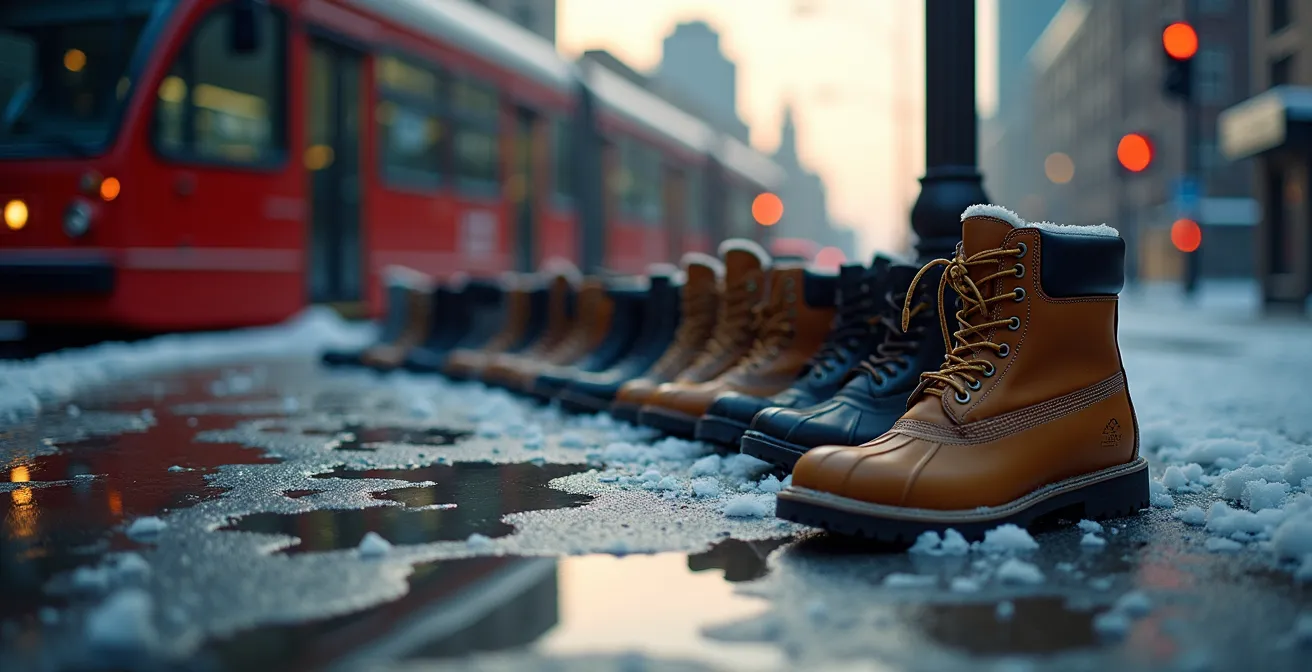
The standard advice to buy ‘waterproof’ and ‘warm’ boots is a costly mistake for a Toronto winter; survival depends on a footwear system built to defeat corrosive salt slush.
- Most “water-resistant” materials fail under Toronto’s freeze-thaw cycles and aggressive calcium chloride road salt.
- Traction on icy concrete is a science, and a shocking number of boots fail basic safety tests conducted right here in Toronto.
Recommendation: Prioritize fully waterproof construction (like vulcanized rubber), a sole specifically rated for wet ice, and insulation matched to your daily activities to avoid both freezing and overheating.
The first sign that you’ve made a terrible footwear mistake in Toronto isn’t the cold; it’s the damp. It’s that chilling sensation of wetness seeping into your sock after stepping into a puddle of brown slush that looked deceptively shallow. For newcomers and visitors, the winter boot market is a minefield of false promises. You are told to look for “water-resistant” materials and “good insulation,” and you reasonably assume this will be enough to handle Canadian snow. This is the first and most expensive myth to debunk.
The enemy on Toronto’s streets is not pristine, powdery snow. It is a uniquely hostile substance: a corrosive slurry of water, dirt, and aggressive road salt. This city’s winter is defined by a relentless freeze-thaw cycle that attacks footwear from the inside out, and sidewalks that can turn to skating rinks in a matter of hours. A boot that performs well in a dry, cold climate will often fail catastrophically within weeks when exposed to the specific challenges of a Toronto winter commute.
But if the standard advice is flawed, what is the right approach? The key is to stop thinking about buying a “winter boot” and start thinking about selecting a footwear system. This is a technical decision, not a fashion one. It requires understanding the specific forces that will be working to destroy your boots and compromise your safety. The real solution lies not in brand names or styles, but in materials, construction, and sole technology engineered to defeat the triple threat of corrosive slush, temperature swings, and urban ice.
This guide provides the framework for making that decision. We will dissect why common materials fail, provide a scientific method for maintaining your investment, compare two of the most popular boot choices on Toronto’s streets, and reveal the single biggest mistake that leads to dangerous falls. This is the consultation you need to ensure your feet stay dry, warm, and firmly on the ground from November through April.
Table of Contents: A Guide to Conquering Toronto’s Winter Streets
- Why “Water-Resistant” Is Not Enough for Toronto Sidewalks?
- How to Remove White Salt Stains from Your Leather Boots?
- Blundstone vs. Sorel: Which Boot Rules the Toronto Streets?
- The Sole Mistake That Leads to Ice Falls on Concrete
- When to Buy Winter Boots to Get Selection Before Stock Vanishes?
- How to Spend an Entire Saturday Without Going Outdoors?
- The Shoe Mistake That Makes Walking the Distillery Painful
- Winter in Toronto: How to Enjoy the City When It Feels Like -20°C?
Why “Water-Resistant” Is Not Enough for Toronto Sidewalks?
The term “water-resistant” on a boot’s label is one of the most misleading phrases in winter apparel. While it might suffice for a brief walk through dry snow, it’s an invitation for failure on Toronto’s streets. With Toronto receiving an average of 133 centimeters (52 inches) of annual snowfall, the sheer volume of moisture is significant. However, the real problem is not the snow itself, but the environment it creates when mixed with salt and fluctuating temperatures. This environment presents three specific challenges that typical “water-resistant” boots are not engineered to handle.
First is the Freeze-Thaw Cycle. Toronto winters often feature daytime temperatures hovering around +2°C, melting snow into slush, followed by nighttime plunges to -10°C. When moisture penetrates the seams or porous materials of a “water-resistant” boot, it freezes and expands overnight. This expansion physically tears at the material’s fibers and compromises stitching, creating larger entry points for water the next day. This cycle repeats, progressively degrading the boot’s integrity from the inside.
Second, the city’s extensive use of road salt introduces Calcium Chloride Corrosion. Toronto uses millions of tonnes of road salt, which is far more aggressive than standard rock salt. This chemical brine doesn’t just stain leather; it actively breaks down the glues, threads, and water-resistant coatings on boots. A 1993 study found that 55% of salt in one Toronto area remained in subsurface water, meaning your boots are exposed to this corrosive agent long after the snow has melted.
Finally, there’s the “Curb-Side Lake Effect.” Poor drainage at many intersections and TTC streetcar stops creates deep, unavoidable puddles of corrosive slush. Only a truly waterproof construction, often featuring a vulcanized rubber lower and a gusseted tongue (where the tongue is attached to the boot on both sides), can withstand being submerged in this winter soup. “Water-resistant” simply means you’re delaying the inevitable wet sock.
How to Remove White Salt Stains from Your Leather Boots?
The chalky white lines that appear on leather boots are the battle scars of a Toronto winter. These are not just dirt; they are mineral deposits of calcium chloride left behind after the slush evaporates. If left untreated, these alkaline deposits will permanently dry out and damage the leather, leading to cracking. A proactive maintenance system is essential for preserving your investment.
The process is twofold: prevention before the damage occurs, and a science-based approach to removal once it does. The most effective strategy begins before the first snowfall. Pre-treating your leather boots with a heavy-duty waterproofer like mink oil or a wax-based product such as Sno-Seal creates a physical barrier that prevents the salt-laden water from penetrating the leather in the first place. These products are readily available at local retailers like Canadian Tire or MEC, and Toronto’s independent cobblers can also provide professional-grade treatments.
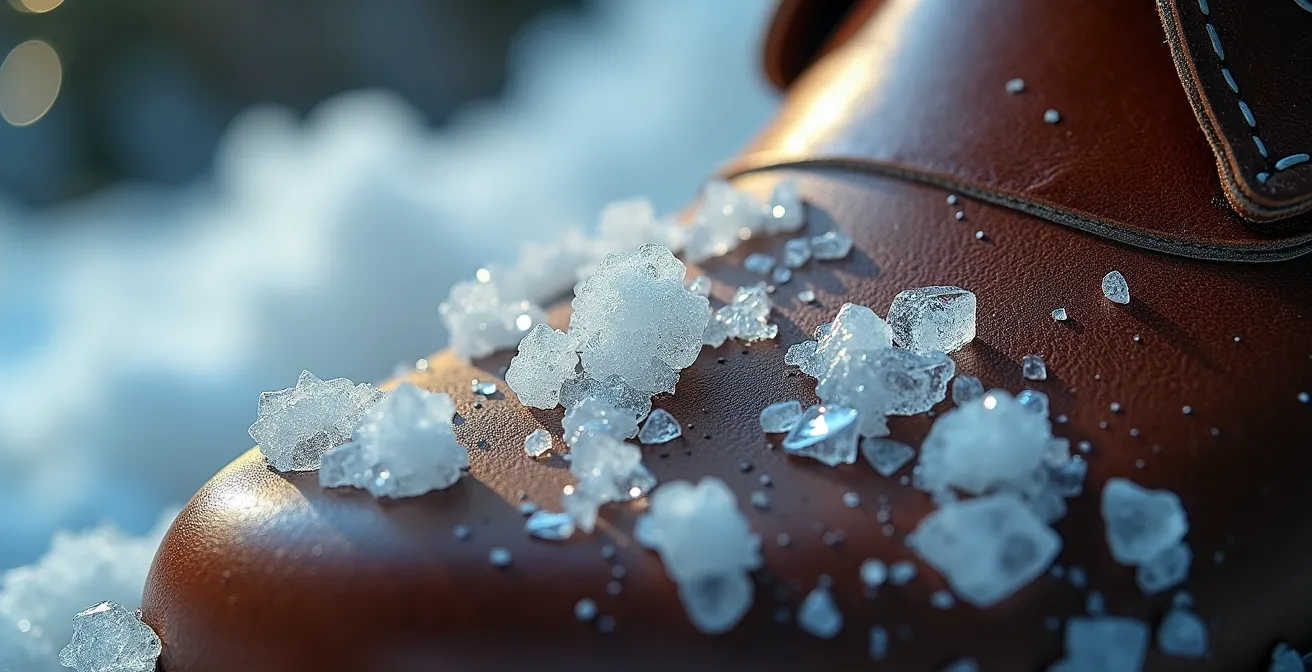
Once stains appear, as seen in the crystalline patterns above, a specific chemical reaction is needed to remove them. The most common and effective home remedy is a simple solution of equal parts white vinegar and water. The acid in the vinegar neutralizes the alkaline salt deposits, dissolving them so they can be wiped away without excessive scrubbing, which could damage the leather’s finish. Apply the solution with a soft cloth, wipe clean with a damp cloth, and then allow the boots to air dry completely, away from direct heat sources which can cause the leather to shrink or crack.
Your Action Plan: The Boot-Saving Salt Stain Audit
- Identify Entry Points: Inspect all seams, the welt (where the sole meets the upper), and any decorative stitching. These are the most common areas where corrosive slush first penetrates.
- Gather Your Arsenal: Assemble your cleaning kit: soft cloths, a small bowl, white vinegar, water, and a high-quality leather conditioner or mink oil.
- Test for a Reaction: Before applying the vinegar solution to the entire boot, test it on a small, inconspicuous area (like the inner side of the ankle) to ensure it doesn’t discolor your specific leather.
- Assess the Damage: After cleaning, check if the leather feels dry or stiff. This is a sign of salt damage. If it is, a deep conditioning treatment is not optional, it’s essential.
- Create a Protection Plan: Based on the severity of the staining, schedule your next waterproofing application. For a daily commuter, this might be every 2-3 weeks.
Blundstone vs. Sorel: Which Boot Rules the Toronto Streets?
Walk down any Toronto street in winter and you will see two boots dominate the landscape: the sleek, versatile Blundstone and the robust, utilitarian Sorel. For a newcomer, the choice can be confusing as they represent two fundamentally different philosophies of winter footwear. The Blundstone is the uniform of the TTC commuter, prized for its style and ease of use, while the Sorel Caribou is the weapon of choice for those facing deep snow and frigid temperatures. Deciding which one is “better” depends entirely on your specific Toronto lifestyle and tolerance for the cold.
The Blundstone’s primary advantage is its versatility. It transitions seamlessly from an icy streetcar platform to a downtown office or a cozy restaurant in the Distillery District without looking out of place. They are easy to pull on and off, a significant benefit when entering homes and establishments. However, their standard models are not insulated and their soles, while decent, are not designed for serious ice. The insulated “Winter” models offer more warmth, but the fundamental design is best suited for those whose winter exposure is limited to short walks between the subway, the office, and home.
The Sorel Caribou, on the other hand, is an unapologetic winter boot. It is built for the worst conditions with a heavy-duty, fully waterproof vulcanized rubber lower and a removable felt liner rated to an extreme -40°C. This makes it the superior choice for prolonged outdoor activities like walks in the Don Valley, tobogganing, or navigating unplowed side streets after a major storm. Its main drawback is its bulk. They can be cumbersome to walk in and are often too warm and heavy for extended indoor wear, making them impractical for a day spent on the TTC or in the PATH system. In a direct comparison, a testimony to their longevity is telling; one user reported his father’s Sorel Caribou boots are still going strong with just a liner replacement after two decades of use, a feat impossible for Blundstones, which cannot be resoled.
This comparative analysis from a recent gear review highlights the critical lifestyle differences between the two boots.
| Factor | Blundstone | Sorel Caribou |
|---|---|---|
| Best For | TTC Commuter (office to streetcar) | Deep Winter Warrior (Don Valley walks) |
| Temperature Rating | Not rated (insulated version available) | -40°F with ThermoPlus™ liner |
| Repairability | Cannot be resoled | Replaceable liners after 20+ years |
| Ice Performance | 4mm tread with steel shank | Superior traction on deep snow |
| Distillery District Test | Easy on/off for indoor transitions | Too bulky for restaurant visits |
| Price Point | $249.95 CAD | $225-280 CAD |
The Sole Mistake That Leads to Ice Falls on Concrete
For all the focus on warmth and waterproofing, the single most critical failure of a winter boot in Toronto is a loss of traction on ice. A wet foot is uncomfortable; a slip and fall on a patch of black ice on a concrete sidewalk can be life-altering. The mistake many consumers make is assuming that a deep, aggressive-looking tread automatically translates to good grip on ice. The reality is far more complex and comes down to the science of the sole’s material composition and its performance at cold temperatures.
Fortunately, this is an area where Toronto is a global leader. The KITE Research Institute, part of the UHN-Toronto Rehabilitation Institute, developed the world’s first evidence-based slip resistance testing method for winter footwear. In their state-of-the-art WinterLab, they test boots on real ice surfaces that can be angled to determine the maximum slope a boot can handle before slipping. The results are published in a “snowflake rating” system. The findings are sobering: extensive KITE Research Institute testing reveals that a staggering 67% of all winter boots on the market fail to achieve even the minimum one-snowflake rating, meaning they slip on bare ice at an angle of just 7 degrees.
This research highlights that the key to micro-traction on ice is not just tread pattern, but the rubber compound of the sole. Many rubber compounds become hard and plastic-like at freezing temperatures, losing their ability to grip. The best-performing boots use special sole materials infused with elements like fiberglass or have tread designs that include abrasive, high-traction zones. As Dr. Geoff Fernie, a Senior Scientist at KITE, explains, the research is driven by a critical need:
Canada has some of the iciest terrain in the world and our ratings system is built to test the limits of these conditions and help consumers find the highest-performing footwear on the market.
– Dr. Geoff Fernie, Senior Scientist at UHN’s KITE Research Institute
Case Study: Canada Post’s Adoption of Snowflake-Rated Boots
Facing high rates of winter-related injuries among its letter carriers, Canada Post turned to the KITE Institute’s research for a solution. By adopting a policy that required all employee winter footwear to pass the “Rate My Treads” test and achieve a minimum snowflake rating, the crown corporation saw a significant reduction in winter-related fall injuries. This real-world application proves that prioritizing a scientifically-validated sole is the most effective strategy for preventing falls.
When to Buy Winter Boots to Get Selection Before Stock Vanishes?
In Toronto, the act of buying winter boots is a race against the weather forecast. The demand curve is not a gentle slope; it is a sheer cliff that begins the moment the first significant snowfall hits the ground. Waiting until you feel you *need* the boots is the surest way to be faced with picked-over shelves, missing sizes, and a limited selection of less-desirable models. For newcomers, understanding the seasonal retail cycle is just as important as understanding boot technology. A strategic approach to timing your purchase can save you from months of discomfort.
The ideal time to buy winter boots for the best selection is in the early autumn, from September to October. During this period, stores like Sporting Life, MEC, and other specialized footwear retailers have received their full inventory for the season. You will pay full price, but you will have your pick of every brand, model, and size. This is the “Full-Price Paradise” window for those who prioritize choice above all else.
The first opportunity for discounts typically arrives with Black Friday in late November. This can be a good time to find a deal, but it is a gamble. A forecast predicting more than 5 cm of snow in the following two weeks can trigger city-wide panic buying, wiping out popular sizes and models before the sale even officially begins. Once the first major snowfall occurs, the game changes entirely. Within 48 hours, it becomes a desperate search, with stock levels of popular boots like Sorels or insulated Blundstones plummeting across the city.
For the true bargain hunter willing to risk it, the post-Christmas Boxing Day sales offer deep discounts, but it’s a “Clearance Hunger Games” scenario, especially at large department stores like The Bay at the Eaton Centre. Selection will be extremely limited. The ultimate secret for the patient and prepared is to shop off-season in April, when stores are clearing out the last of their winter stock at discounts of 50-70%. This is the best way to get a premium boot for a low price, but it requires you to anticipate your needs for the *next* winter.
How to Spend an Entire Saturday Without Going Outdoors?
There are days in a Toronto winter, particularly during a deep freeze in January or February, when the prospect of going outside is simply unappealing. But an indoor day doesn’t have to be an unproductive one. For the savvy footwear owner, a frigid Saturday is the perfect opportunity to perform the essential maintenance that will keep your boots protecting you for the rest of the season. An “Indoor Boot Care Saturday” is a ritual that pays dividends in both the longevity of your footwear and your future comfort.
This ritual turns a chore into a structured, satisfying process. The morning can be dedicated to damage control: systematically removing the week’s buildup of salt and grime. Using the vinegar-water solution, you can dissolve all the calcium chloride residue from the leather uppers, seams, and soles. The midday period is for deep conditioning. Once the boots are clean and fully dry, applying a rich leather conditioner or mink oil restores the essential fats that the salt has stripped away, keeping the leather supple and preventing cracks.

The afternoon is for proactive protection. This is the time to apply a fresh coat of waterproofing treatment, paying special attention to high-stress areas like the seams around the toe box and heel. Finally, the evening can be spent on upgrades. Installing a new pair of thermal or wool insoles can dramatically increase the warmth and comfort of your boots for the week ahead, especially if your commute involves walking through Toronto’s vast underground PATH system, a city beneath the city that allows you to traverse much of the downtown core without ever stepping outside.
This dedicated care routine ensures that when you do venture back out into the cold, your primary line of defense against the elements is in peak condition. It’s an investment of time that protects your financial investment in quality footwear and ensures your feet remain dependably dry.
The Shoe Mistake That Makes Walking the Distillery Painful
Toronto’s historic Distillery District during the winter, especially during its famous Christmas Market, is a magical experience. It’s also a uniquely challenging environment for footwear, and one where many common boot choices lead to painful consequences. The primary mistake visitors and newcomers make is one of thermal mismatch: wearing a boot that is either dramatically over- or under-insulated for the activity. The result is either frozen toes or, just as uncomfortably, sweaty, damp feet that get cold the moment you stop moving.
The environment of the Distillery District presents a triple threat. The beautiful but uneven historic cobblestones become treacherous when coated with a thin layer of ice, demanding boots with excellent ankle support and a flexible sole that can feel the ground. Furthermore, the layout of the old industrial buildings creates powerful wind tunnels that can make the “feels like” temperature plummet, attacking any exposed skin at the ankle. A low-cut fashion boot offers no protection here.
The most common error, however, is wearing heavy-duty pac boots, like a Sorel Caribou rated to -40°C, for an activity that involves constantly moving between the cold outdoors and overheated indoor shops, galleries, and restaurants. While your feet are warm outside, they begin to sweat profusely the moment you step inside. This moisture gets trapped in your socks and the boot’s liner. When you go back outside, that sweat rapidly cools, leaving your feet feeling colder and damper than if you had worn a less insulated boot to begin with. The key is to match the insulation level to the specific activity.
This principle of matching insulation to activity is crucial for comfort across all Toronto winter experiences, from a frigid skate on an outdoor rink to a sweltering subway commute.
| Location/Activity | Temperature Range | Recommended Insulation | Common Mistake |
|---|---|---|---|
| Distillery Christmas Market | -6°C to -1°C | Moderate (200g) | Wearing -30°C rated boots causes sweaty feet indoors |
| Outdoor skating rinks | -20°C possible | Heavy (400g+) | Under-insulating for prolonged exposure |
| TTC commute | Mixed indoor/outdoor | Light with breathability | Heavy boots become ‘foot saunas’ on subway |
| PATH system shopping | Mostly indoor | Minimal with good grip | Fashion boots with no traction for icy entrances |
Key Takeaways
- Waterproof over Water-Resistant: For Toronto’s slush, “water-resistant” is not enough. Demand fully waterproof construction, such as a sealed rubber shell and a gusseted tongue.
- Sole Science is Non-Negotiable: A boot’s ability to grip wet ice is determined by its sole compound, not just its tread pattern. Look for boots with a KITE Institute “snowflake rating” for proven safety.
- Avoid Thermal Mismatch: Match your boot’s insulation level to your activity. Overly-insulated boots on a TTC commute lead to sweaty, cold feet. A single -40°C boot is not the solution for every situation.
Winter in Toronto: How to Enjoy the City When It Feels Like -20°C?
Surviving, and even enjoying, a Toronto winter when the temperature drops to -20°C is entirely possible, but it hinges on having the right equipment. A common mistake is to view winter boots as a single-purpose item for dealing with snow. In reality, a well-chosen footwear system is the key that unlocks the city’s best winter experiences, from tobogganing in Riverdale Park to skating at Nathan Phillips Square. Without proper footwear, these activities become uncomfortable or even dangerous. The stakes are high; according to research from Toronto’s KITE Institute, winter slips and falls on ice cause over 21,000 Ontarians to visit emergency rooms annually.
The secret is to think like a strategist and pair the right boot with the right activity. A heavy-duty pac boot, for example, is essential for a day of tobogganing or any extended outdoor play where you will be standing in deep snow for long periods. Its high shaft protects from snow entry and its heavy insulation is critical for sedentary periods. However, that same boot would be clumsy and excessively warm for a night out on Queen West, where a stylish but fully waterproof leather boot offers the right balance of protection for the walk from the streetcar and style for the venue.
Similarly, a lightweight, insulated hiker might be the perfect choice for a brisk walk through High Park, offering both warmth and agility. For bird watching at the Leslie Spit, where you might encounter deeper snow drifts, a mid-height boot with at least a 10-inch shaft is a more prudent choice. The fundamental principle is that there is no single “do-it-all” winter boot for the diverse experiences Toronto offers. An experienced Torontonian often has a small quiver of 2-3 pairs of boots, each serving a distinct purpose within their winter life.
Choosing the right boot is not about enduring the winter; it’s about empowering yourself to embrace it. With the correct footwear system, the city doesn’t shut down when it gets cold—it opens up.
Now that you possess the technical knowledge to assess materials, evaluate soles, and plan your purchase, the final step is to apply it. Invest in a footwear system that matches your real-world Toronto lifestyle, and you will not only survive the winter—you will be equipped to enjoy everything the city has to offer, no matter the weather.