
The biggest mistake in Toronto hotel planning is choosing a location based on map proximity instead of its logistical efficiency.
- A hotel listed as “near downtown” can cost you over 90 minutes of round-trip commute time due to transit bottlenecks.
- Calculating a “transit penalty”—the real-world time lost to transfers, waits, and walking—is essential for an efficient itinerary.
Recommendation: Treat your hotel choice as a strategic decision. Analyze your itinerary, calculate the true commute time from potential “logistical hubs,” and select the base that minimizes your total time in transit, not just the distance on a map.
Choosing a hotel in Toronto seems straightforward: find a spot “downtown” and you’re set. This is the conventional wisdom, and it is fundamentally flawed. For the strategic planner, a trip to Toronto is an exercise in managing a finite resource: time. The city’s immense sprawl, coupled with a transit system that services over 2.3 million riders on an average weekday, means that a poor logistical choice can cost you hours. Your hotel isn’t just a place to sleep; it’s your operational base. Its value isn’t measured in amenities, but in its efficiency at dispatching you to your destinations.
Most guides will point you toward the Entertainment District or Yorkville, and for good reason. But they often fail to quantify the trade-offs. What about that cheaper Airbnb in a “hip” neighborhood? Or the hotel in Etobicoke that advertises itself as being “close to downtown”? These options present a deceptive proximity. The true cost isn’t on the booking receipt; it’s paid in 10-minute waits for a connecting bus, navigating crowded transfer stations, and long walks from the subway to your final destination. This guide discards generic advice. Instead, it provides a logistical framework for making a data-driven decision. We will treat your travel time as a budget and analyze how each potential location impacts it.
This article will break down the key variables in the Toronto accommodation equation. We’ll deconstruct misleading listings, analyze high-demand scenarios, compare the security logistics of hotels versus Airbnbs, and reveal the hidden costs—both in time and money. The goal is to equip you with a system to calculate your true travel time and select a location that optimizes your entire trip, transforming your hotel choice from a guess into a strategic advantage.
This detailed analysis will guide you through the critical logistical checkpoints of booking your stay in Toronto. By understanding these strategic layers, you can build an efficient, frustration-free itinerary from the ground up.
Summary: A Strategic Map for Choosing Your Toronto Hotel
- Why “Near Downtown” Listings in Etobicoke Are Misleading?
- How to Secure Rooms During the Taylor Swift Era Tour Rush?
- Airbnb vs. Hotel: Which Is Safer for Solo Travelers in Toronto?
- The “Destination Fee” Shock on Your Final Hotel Bill
- When to Book Your Summer Stay to Lock in Winter Rates?
- How to Calculate Your True Commute Time Including Subway Transfers?
- When to Abort the Downtown Plan and Stay in the Airport Zone?
- Getting Around Toronto: How to Choose Between TTC, Uber, and Walking?
Why “Near Downtown” Listings in Etobicoke Are Misleading?
On a map, Etobicoke appears to be a reasonable compromise—a suburb bordering the city core, offering lower prices with the promise of being “near downtown.” This is a classic case of deceptive proximity. The logistical reality is that a hotel in this area can be a significant drain on your time budget. For instance, a hotel near the Kipling-Islington transit hub might be listed as a short distance from downtown attractions, but the data reveals a different story. Many properties in this zone are over 8.4 mi (13.4 km) from Rogers Centre, a journey that is far from simple.
The issue isn’t the distance itself, but the nature of the transit connection. From this part of Etobicoke, a trip downtown requires a bus ride to the subway, followed by a long journey on Line 2 (Bloor-Danforth), and then a transfer at a major interchange like St. George or Bloor-Yonge to get onto Line 1 (Yonge-University) to reach the core. Each of these steps introduces a “transit penalty”—time lost to waiting, walking between platforms, and potential delays.
A 30-minute estimate from Google Maps can easily stretch to 50-60 minutes door-to-door during peak times. A round trip for a concert or dinner can therefore consume two hours of your day. This is a critical miscalculation for an efficiency-focused traveler. The financial savings of staying in Etobicoke are often negated by the time cost, especially on a short trip where every hour counts. Before booking a hotel outside the core, you must analyze the *entire* transit chain, not just the primary subway line, to understand its true logistical cost.
How to Secure Rooms During the Taylor Swift Era Tour Rush?
Major city-wide events, like the Taylor Swift Era Tour or the Toronto International Film Festival (TIFF), transform the accommodation market into a high-stakes logistical challenge. During these periods, conventional booking strategies fail. Prices skyrocket, and availability in the downtown core evaporates months in advance. The key to success is to redefine your search parameters from “best hotel” to “most efficient logistical hub.” Your primary goal is to minimize post-event egress time, which can often be longer and more stressful than the initial journey.
The optimal strategy is to establish a 25 to 30-minute walking radius around the venue (e.g., Rogers Centre) and focus exclusively on properties within that circle. This completely eliminates your reliance on post-event transit or ride-sharing, which will be overwhelmed and subject to surge pricing. Neighborhoods like the Fashion District, Queen West, and the core Financial District fall within this critical zone.
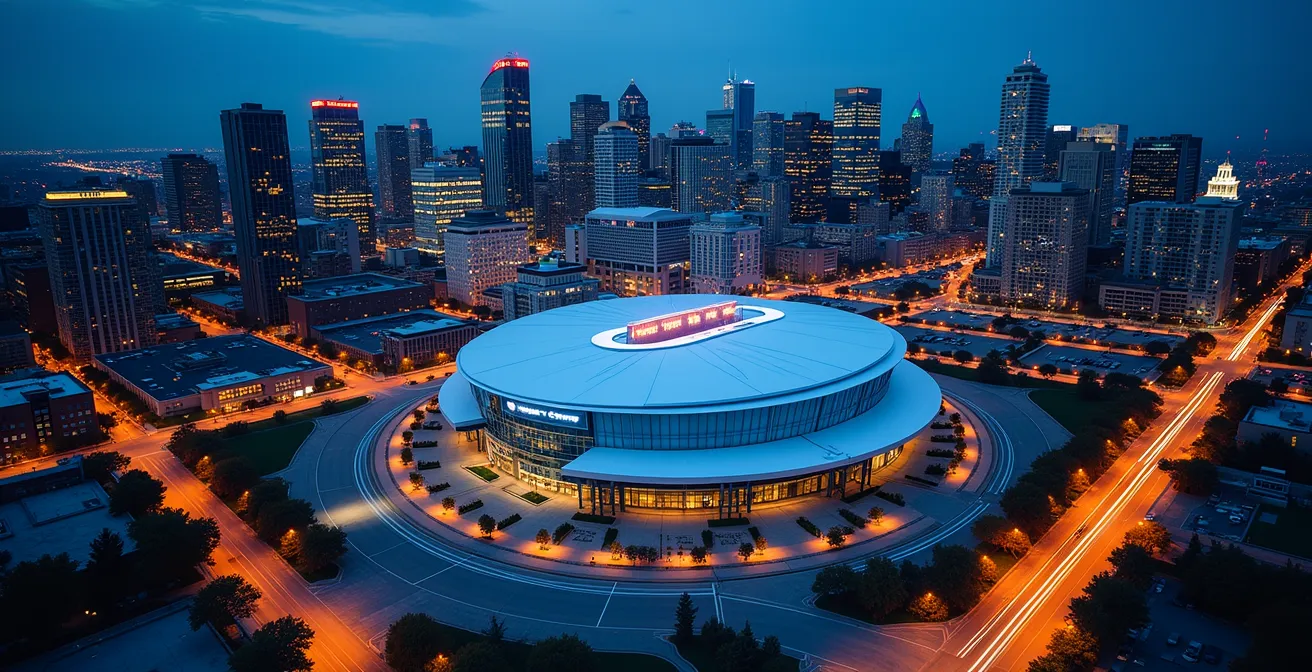
As the map above illustrates, being within this radius means you are back in your room while thousands of others are still waiting for a subway or stuck in traffic. If securing a room inside this zone is impossible, the next best alternative is not a random downtown hotel, but one strategically located near a GO Transit station on the Lakeshore West or East line. GO trains offer a far more civilized and less crowded alternative to the TTC for escaping the downtown core after a major event. A hotel in Port Credit or Pickering, connected by GO Transit, can be a more efficient choice than a poorly located downtown hotel that forces you into the TTC bottleneck at Union Station.
Airbnb vs. Hotel: Which Is Safer for Solo Travelers in Toronto?
For a solo traveler, the choice between an Airbnb and a hotel is not just about cost or “living like a local”—it’s a critical security decision. While Airbnbs can offer great value, they introduce logistical variables that hotels mitigate. Hotels in Toronto’s downtown core are typically clustered in well-lit, high-traffic areas and offer a controlled environment with 24/7 front desk staff, key card access to all floors, and on-site security. An Airbnb, particularly in a residential condo building or a walk-up apartment, may lack these features, leaving the traveler to manage their own security protocol.
The location of an Airbnb can also present a challenge. While a listing might be in a safe neighborhood, it could be a 10-15 minute walk from the nearest subway station down poorly lit residential streets. This “last mile” journey can be a point of vulnerability, especially late at night. Hotels, by contrast, are often situated directly on main thoroughfares and within a 5-minute walk of a major transit station. It’s also important to verify the legality of any short-term rental. As one local expert on a Toronto travel forum noted:
Short Term Rentals are licensed by the City of Toronto and each B&B must display their licence on their ad, or disclose it when asked
– Toronto Forum Community Member, TripAdvisor Toronto Forum Discussion
This verification adds an extra logistical step for the booker. For a solo traveler prioritizing safety and predictability, a hotel often presents a more robust and streamlined security framework. The following table breaks down the key differences in a typical Toronto context.
| Safety Factor | Downtown Hotels | Airbnb Listings |
|---|---|---|
| 24/7 Security Presence | Concierge and front desk staff available | Varies; modern condos may have concierge |
| Building Access Control | Key card systems, secured entrances | Depends on building type (walk-ups less secure) |
| Proximity to TTC Stations | Most within 5-10 min walk to major stations | Can be 10-15 min walk on unlit side streets |
| Late Night Environment | Well-lit hotel zones with foot traffic | Residential areas may be isolated after 11 PM |
| Emergency Response | Direct hotel security and quick staff assistance | Self-managed; depends on host availability |
The “Destination Fee” Shock on Your Final Hotel Bill
An efficiency-obsessed planner knows that the booked room rate is rarely the final price. Toronto hotels are subject to a variety of taxes and fees that can significantly inflate your bill, and understanding them is key to accurate budget forecasting. Beyond the Harmonized Sales Tax (HST), the most significant mandatory charge is the Municipal Accommodation Tax (MAT). It is a percentage levied on the room cost, and it’s crucial to budget for it. As of June 2025, the City of Toronto will require hotels to collect an 8.5% MAT on all stays, an increase from the previous rate.
However, the most common source of “bill shock” comes from a different, often non-mandatory charge: the Destination Marketing Fee (DMF) or Tourism Fee. This is typically a 3-4% fee that some hotels add to fund local tourism marketing efforts. Unlike the MAT, the DMF is often voluntary. Many travelers are unaware of this and pay it without question. As a strategic planner, you should always scrutinize your bill for this fee and be prepared to challenge it.

Being able to distinguish between mandatory taxes and optional fees is a simple yet effective cost-saving tactic. It requires diligence at check-out but can reduce your final bill by a noticeable margin. It is a matter of knowing your rights as a consumer and politely but firmly requesting the removal of any non-compulsory charges.
Action Plan: How to Challenge Voluntary Hotel Fees in Toronto
- Identify the Fee: On your preliminary bill, locate a “Destination Marketing Fee (DMF),” “Tourism Fee,” or similar charge, separate from the mandatory MAT and HST.
- Inquire at the Front Desk: Politely ask the staff to clarify if this specific fee is mandatory or voluntary. State that you understand the MAT is required, but you wish to opt-out of the DMF.
- State Your Position: Clearly articulate that you are requesting the removal of the voluntary marketing fee, not the government-mandated taxes.
- Escalate if Necessary: If the front desk staff are unable or unwilling to remove the charge, ask to speak with a hotel manager to discuss the property’s policy on voluntary fees.
- Document and Decide: Note the hotel’s response. For future trips, prioritize booking with hotel chains that have transparent pricing or are known to waive these fees upon request.
When to Book Your Summer Stay to Lock in Winter Rates?
In Toronto, hotel pricing operates on a dynamic, highly seasonal model. The difference between booking at the right time and the wrong time can be hundreds of dollars. The common advice to “book in advance” is too generic to be useful. A logistics expert needs a more precise formula. The key is to understand Toronto’s unique demand cycle. The city’s low season is from January to March, when cold weather deters leisure travel. This is the period when hotels are most desperate to fill rooms, and it presents a strategic booking window.
To secure summer rates (for June-August travel) that are closer to winter pricing, the optimal booking window is typically 4 to 6 months in advance. This means you should be finalizing your summer hotel plans between late January and early March. During this period, hotels have released their summer inventory, but the peak booking rush has not yet begun. This allows you to lock in a rate before the wave of summer tourists, festival-goers (like those for Pride or Caribana), and conference attendees drives prices up dramatically.
Conversely, booking last-minute in the summer is a recipe for budget disaster. Unlike some destinations that may offer last-minute deals, Toronto’s high summer demand means prices only escalate as the date approaches. The only exception might be a sudden cancellation, but relying on this is a poor strategy. The principle is simple: buy when demand is lowest. By aligning your booking schedule with Toronto’s off-season, you are essentially purchasing your summer accommodation at a “winter” price point, a classic arbitrage that any efficiency-focused planner should exploit.
How to Calculate Your True Commute Time Including Subway Transfers?
Relying solely on Google Maps for TTC travel times is a rookie mistake in Toronto. The app provides a best-case scenario that ignores the crucial ground-level variables that define the real-world transit experience. To build an efficient itinerary, you must calculate your “true commute time” by applying a realistic “transit penalty” to any estimate. A good baseline is to add a 15-20% buffer to any app-based time. An estimated 30-minute trip should be budgeted as 35-40 minutes.
This buffer accounts for common, un-tracked delays: station overcrowding that causes you to miss the first train, “short turns” where a streetcar or subway unexpectedly goes out of service mid-route, and the simple time it takes to navigate a complex station. The most significant penalty, however, comes from transfers. You should budget a minimum of 7 minutes per transfer. A cross-platform transfer (like moving between Line 1 and Line 2 at Bloor-Yonge station) might be quicker, but a multi-level transfer involving long walks and escalators (like at Spadina station) can easily exceed this.
Therefore, the formula for your true commute time is: (Google Maps Estimate x 1.2) + (Number of Transfers x 7 minutes) + (First/Last Mile Walking Time). This equation transforms an optimistic digital guess into a reliable logistical metric. For example, a trip from a hotel near Don Mills station to the CN Tower might look like this: 25 min (Maps estimate) x 1.2 = 30 min. Add one transfer at Bloor-Yonge (7 min) and a 10-minute walk from the station to the hotel. The true commute time is closer to 47 minutes, not 25. This calculation is the most critical tool in your planning arsenal.
Key Takeaways
- Geographical proximity on a map is misleading; calculate the “transit penalty” of transfers and walking time.
- For major events, prioritize a hotel within a 30-minute walking radius of the venue to bypass all transit congestion.
- Scrutinize your hotel bill for the voluntary Destination Marketing Fee (DMF) and request its removal to reduce costs.
When to Abort the Downtown Plan and Stay in the Airport Zone?
The default plan for most Toronto visitors is to stay downtown. However, a strategic planner must know when to abort this plan. Staying in the airport zone near Toronto Pearson (YYZ) is not a concession; it’s a calculated logistical move that can be superior in specific scenarios. The viability of this strategy hinges on one critical piece of infrastructure: the UP Express train. This dedicated line connects Pearson Airport to Union Station in the heart of downtown, and its efficiency changes the entire accommodation equation.
According to its schedule, the UP Express makes the journey in just 25 minutes, with trains running every 15 minutes during peak hours. This reliable, traffic-immune connection means that a hotel in the airport zone is, in terms of time, often “closer” to downtown than a hotel in an outer borough like Scarborough that relies on slower, multi-transfer TTC routes. The key scenarios for choosing an airport hotel are: an early morning departure, a late-night arrival, a very short (1-2 day) business trip, or a trip during severe winter weather when road and TTC travel can be crippled.
This strategy provides a powerful hedge against unforeseen disruptions, as a traveler’s testimonial about a stay at an airport hotel during a major storm confirms:
We have stayed in the Alt Toronto Airport a number of times. The location is very good with the Link train right next door to get you to Terminal 1 or 3 within a few minutes. During a major storm last winter, staying at the airport saved us from missing our flight when downtown transit was crippled.
– TripAdvisor User Review
This real-world example demonstrates the strategic value of the airport zone. It offers a predictable, weather-resilient connection to both your flight and the city core, making it an excellent logistical hub for certain itineraries. The cost of the UP Express fare must be factored in, but for time-sensitive travelers, the certainty it provides is often worth the price.
Getting Around Toronto: How to Choose Between TTC, Uber, and Walking?
Once your logistical hub (hotel) is established, the final layer of optimization is choosing the right mode of transport for each journey. The decision between the TTC, Uber/Lyft, and walking is a constant cost-benefit analysis of time versus money. Walking is free but only viable for short distances; a “walkable” city core is deceptive, as traversing from the Distillery District to Queen West on foot is a significant time investment. Uber offers door-to-door service but is subject to Toronto’s notorious traffic and surge pricing, making it both time-inefficient and expensive during peak hours or events.
The TTC is generally the most efficient backbone for any itinerary. The cost-benefit analysis is simple: if you plan to take more than four single trips in one day, a TTC Day Pass ($13.50) is more economical than paying the $3.35 single fare each time with cash or a PRESTO card. However, the most significant recent development in Toronto transit logistics is the “One Fare Program.”
Case Study: The 2024 One Fare Program Integration
The February 2024 launch of the One Fare Program, as detailed by resources like Prepare for Canada, fundamentally altered transit strategy in the Greater Toronto Area. It allows for free transfers between the TTC and regional transit systems like GO Transit when using a PRESTO card. This is a game-changer. Previously, combining GO Transit with the TTC meant paying two separate fares, making it a costly option. Now, a traveler can take a GO Train from an outer suburb like Pickering to Union Station and then transfer to the TTC subway for a single fare. This makes strategically located hotels near GO stations outside the city core financially viable and logistically competitive for the first time.
This program requires a PRESTO card to use, but it opens up a new hybrid transit model. You can use the faster, more comfortable GO Train for the long-haul portion of your journey and switch to the TTC for the “last mile” distribution within the downtown core. For a logistics-minded traveler, this new variable must be factored into both accommodation choice and daily itinerary planning, as it can unlock significant time and cost savings.
Frequently Asked Questions About Toronto Transit and Accommodation
Should I trust Google Maps transit times for Toronto?
You should use Google Maps as a baseline but always add a 15-20% buffer to its estimates. The app often fails to account for real-world factors like station overcrowding, service delays known as “short turns,” or the time it takes to navigate complex, multi-level stations like Bloor-Yonge.
How much time do transfers really add?
A safe and realistic calculation is to add 7 minutes for every transfer in your journey. While a simple cross-platform transfer (e.g., between Line 1 and Line 2 at Bloor-Yonge) can be faster, a transfer that involves changing multiple levels or long walks (e.g., at Spadina or St. George stations) can easily take longer.
What are peak hours to avoid on the TTC?
The busiest rush hours on the TTC are on weekdays from 7:00 AM to 9:00 AM and from 4:00 PM to 6:00 PM. Travel during these times will involve more crowding and potential for delays. For late-night travel, the Blue Night Network operates most major routes from approximately 1:30 AM to 5:00 AM, but service is less frequent, often with 30-minute intervals between vehicles.
Ultimately, a successful Toronto trip is built on a foundation of sound logistics. By shifting your mindset from finding a “nice hotel” to establishing an “efficient operational base,” you reclaim your most valuable asset: time. Start by analyzing your itinerary and using these strategic principles to build your accommodation plan from the ground up.