
The secret to surviving a Toronto summer isn’t wearing ‘breathable’ cotton; it’s mastering moisture-wicking fabrics and using the city’s unique layout to your advantage.
- Cotton acts like a sponge in high humidity, trapping sweat and making you feel hotter and stickier.
- Strategic navigation through shaded streets and the PATH system is more effective than just dressing light.
Recommendation: Ditch your cotton t-shirts for technical fabrics like polyester or merino wool and plan your sightseeing around the city’s built-in cooling corridors.
That familiar feeling hits you the moment you step outside in Toronto between July and August: a wall of humid, heavy air that makes your clothes stick to your skin before you’ve even reached the corner. The city’s unique combination of lakeside humidity and urban heat creates a summer experience that can feel oppressive. Many will tell you to reach for light, breathable cotton, a classic piece of summer advice that has been passed down for generations. It feels intuitive, simple, and is the go-to for most people looking to beat the heat.
But what if that common wisdom is actually making your sweltering walk to the subway station worse? The key to not just surviving but thriving during a Toronto heatwave isn’t about following old rules; it’s about understanding the science of fabric and the art of urban navigation. It’s about realizing that the city itself, with its glass towers and underground tunnels, offers a strategic playbook for staying cool. Forget everything you thought you knew about summer dressing. The real solution lies in choosing materials that manage moisture, not just breathe, and in seeing the city’s architecture as your ally against the sun.
This guide will deconstruct the myths around summer fabrics and provide a practical, comfort-focused strategy for your Toronto visit. We will explore why your favorite cotton shirt is your enemy, how to pack for both scorching days and air-conditioned evenings, and the specific urban hacks that will keep you cool, comfortable, and stylish from the first heat warning to the last summer storm.
Summary: Your Strategic Guide to Toronto’s Summer Heat
- Why Cotton Is Your Enemy on a Humid Toronto Day?
- How to Pack Light Clothes That Still Work for Fancy Dinners?
- Handheld Fan vs. Cooling Towel: Which Saves You on the Subway?
- The Walking Mistake That Ruins Your Day of Sightseeing
- When to Schedule Your Walk to Avoid Peak UV Exposure?
- The Hydration Mistake That Causes Heatstroke at the Parade
- The Booking Mistake That Ruins Tours on Rainy Days
- Toronto Weather Planning: How to Pack for a City with Four Distinct Seasons?
Why Cotton Is Your Enemy on a Humid Toronto Day?
It’s the first thing we reach for when the temperature climbs: a soft, light cotton t-shirt. It feels natural, breathable, and cool… for the first five minutes. The moment you start to sweat in Toronto’s oppressive humidity, that comfortable feeling vanishes. The fundamental problem with cotton is its relationship with water. As a natural cellulosic fiber, it’s incredibly absorbent. In fact, research shows that cotton can absorb up to 27 times its own weight in water. In the context of a humid day, “water” means your sweat.
Instead of wicking moisture away from your skin to let it evaporate, cotton acts like a sponge, holding that sweat against your body. This creates a damp, clingy layer that prevents air from circulating, effectively trapping heat and humidity. The “breathability” you thought you had is gone, replaced by a personal micro-climate of sogginess. This is the core of moisture management failure, and it’s why you feel sticky and overheated far more quickly in a cotton shirt than you would expect.
Furthermore, this moisture retention has another unpleasant side effect. A fascinating study from the University of Alberta looked into why certain fabrics get smellier than others. Researchers found that while polyester repels water, cotton’s water-loving fibers absorb sweat more thoroughly. Paradoxically, polyester ends up smelling worse because it doesn’t absorb the water component, which concentrates odor-causing compounds on the fabric’s surface. However, the sheer volume of sweat held by damp cotton in high humidity creates its own stale, musty environment. For true comfort, you need fabrics like polyester, Tencel, or ultra-light merino wool, which are designed for active moisture-wicking—pulling sweat off your skin and pushing it to the fabric’s surface to evaporate quickly.
How to Pack Light Clothes That Still Work for Fancy Dinners?
Packing for Toronto in the summer presents a unique challenge: how do you dress for sweltering daytime sightseeing and still look put-together for a sophisticated dinner in Yorkville or King West without bringing your entire wardrobe? The answer lies in strategic layering and choosing versatile, high-performance fabrics that transition seamlessly from day to night. Forget bulky changes of clothes; think of your outfit as a modular system.
The hero piece of this system is often a dress or a pair of trousers made from a fabric like a silk-blend, Tencel, or high-quality viscose. These materials drape beautifully, resist wrinkling in a suitcase, and feel cool against the skin. For a day of exploring, you can style a simple slip dress with comfortable yet stylish leather sandals and perhaps a lightweight denim or linen-blend jacket for those moments when you duck into a heavily air-conditioned museum or cafe. This look is practical, comfortable, and chic enough for wandering through the Distillery District or Queen West.
The magic happens when you need to elevate this base outfit for the evening. The transformation doesn’t require a whole new look, just a few key accessory swaps. This is where you can see the power of a well-planned travel capsule wardrobe in action.

As this image beautifully illustrates, the same base garment can be completely transformed. By swapping the denim jacket for a structured blazer, the sandals for a pair of elegant block heels, and adding a piece of statement jewelry, the casual daytime outfit becomes instantly dinner-ready. This approach not only saves precious luggage space but also saves you time, eliminating the need to return to your hotel for a full costume change. The key is choosing a foundational garment that is simple in silhouette but luxurious in fabric, providing the perfect canvas for any occasion.
Handheld Fan vs. Cooling Towel: Which Saves You on the Subway?
When you’re standing on a packed subway platform at Bloor-Yonge station during rush hour, the air thick and stagnant, you’ll do anything for a moment of relief. Two popular weapons in the fight against urban heat are the handheld fan and the evaporative cooling towel. But in the specific microclimates of Toronto’s transit system, one is a clear winner. While a fan feels great in open air, its effectiveness plummets in confined, crowded spaces where there’s no room to operate it and no cool air to circulate.
The cooling towel, on the other hand, works through evaporation directly on your skin. It’s discreet, requires no batteries, and can be draped around your neck even when you’re shoulder-to-shoulder with other commuters on the TTC. This makes it far more practical for the most intense heat zones you’ll encounter while traveling through the city. Of course, the handheld fan has its moments—it’s a lifesaver when you’re waiting on an exposed streetcar platform in the sun. The key is understanding which tool to deploy for which specific Toronto scenario.
This is especially critical during an official heat wave. In a recent statement, Toronto Mayor Olivia Chow highlighted the city’s proactive measures, noting, “We’re opening over 500 cooling spaces citywide, libraries, community centres, seniors homes.” While these are excellent resources, they aren’t available when you’re in transit. Your personal cooling strategy is your first line of defense.
To help you decide which gear to pack, this table breaks down the effectiveness of each device in common Toronto transit situations, based on real-world conditions. This analysis from the City of Toronto’s heat relief advice underscores the need for a situational approach.
| Scenario | Handheld Fan | Cooling Towel | Winner |
|---|---|---|---|
| Packed subway car (Line 1 rush hour) | Ineffective – no space to use | Effective – works in tight spaces | Cooling Towel |
| Open-air platform waiting | Very effective – creates air circulation | Moderate – requires re-wetting | Handheld Fan |
| PATH system walking | Good – portable cooling while moving | Excellent – continuous cooling | Cooling Towel |
| Streetcar delay in sun | Effective if battery charged | Limited – dries quickly in direct sun | Handheld Fan |
The Walking Mistake That Ruins Your Day of Sightseeing
You’ve got your moisture-wicking clothes and a bottle of cold water. You feel prepared. But an hour into your sightseeing walk, you’re exhausted, your feet are aching, and you feel ten degrees hotter than the forecast predicted. The mistake wasn’t your gear; it was your route. Toronto is a prime example of the urban heat island effect, where concrete and asphalt absorb and radiate solar energy, making dense commercial areas significantly hotter than green spaces. You chose to walk along the sun-baked sidewalks of a major commercial street instead of cutting through a nearby park.
The temperature difference can be staggering. Specific research on Toronto’s heat island effect shows a differential of several degrees, with surface temperatures hitting 29.1°C in commercial areas compared to a much more tolerable 25.1°C in parks. That four-degree difference is the gap between a pleasant stroll and a draining ordeal. The mistake is assuming all walking routes are created equal. A strategic urban navigator will always choose the path with more tree cover and less concrete, even if it adds a few extra minutes to the journey.
This intense ground heat also creates another problem: foot misery. Your feet swell in the heat, and the radiant energy from the pavement can make your shoes feel like tiny ovens. Blisters and chafing become a near certainty, cutting your day of exploration short. Proper foot care is non-negotiable in a Toronto summer and requires a proactive approach that goes beyond just wearing comfortable shoes.
Your Action Plan: Proactive Foot Care for Humid City Walking
- Choose footwear: Opt for shoes with adjustable straps to accommodate the inevitable foot swelling that occurs throughout a hot day.
- Size for expansion: Purchase walking shoes a half-size larger than your usual size specifically to account for humidity-induced expansion.
- Prevent blisters: Wear ultra-thin, moisture-wicking merino wool socks, even with sandals, to create a barrier and manage sweat.
- Mitigate friction: Apply an anti-chafing balm to known pressure points on your feet (like heels and pinky toes) before you even leave your hotel.
- Schedule breaks: Plan strategic rest stops in air-conditioned spaces like cafes or shops every 45-60 minutes to give your feet a chance to cool down and reduce swelling.
When to Schedule Your Walk to Avoid Peak UV Exposure?
In a summer heatwave, the sun is not your friend. Avoiding its most intense rays is crucial not only for comfort but for your health. Most people know to avoid being outdoors around midday, but in a city like Toronto, the “when” is just as important as the “where.” The period of peak UV exposure typically occurs between 11 a.m. and 3 p.m. During an official heatwave, this is the time to be indoors—exploring the Royal Ontario Museum, browsing shops in the Eaton Centre, or enjoying a long lunch.
Environment Canada issues formal heat warnings for the city when certain thresholds are met. According to the city’s strategy, heat warnings for Toronto are triggered when temperatures reach 31°C or higher during the day, combined with nighttime lows of 20°C or more for at least two consecutive days. When you see this warning, it’s a non-negotiable signal to reschedule any extensive outdoor plans. Instead, plan your long walks and sightseeing for the early morning (before 10 a.m.) or the late afternoon and early evening (after 4 p.m.). The golden hour before sunset is often a beautiful and much more comfortable time to explore Toronto’s neighbourhoods.
Beyond timing, you can also use the city’s geography to your advantage. The “concrete canyon” effect of the downtown core, particularly in the Financial District, creates predictable and long shadows. This creates natural cooling corridors you can use to navigate the city.
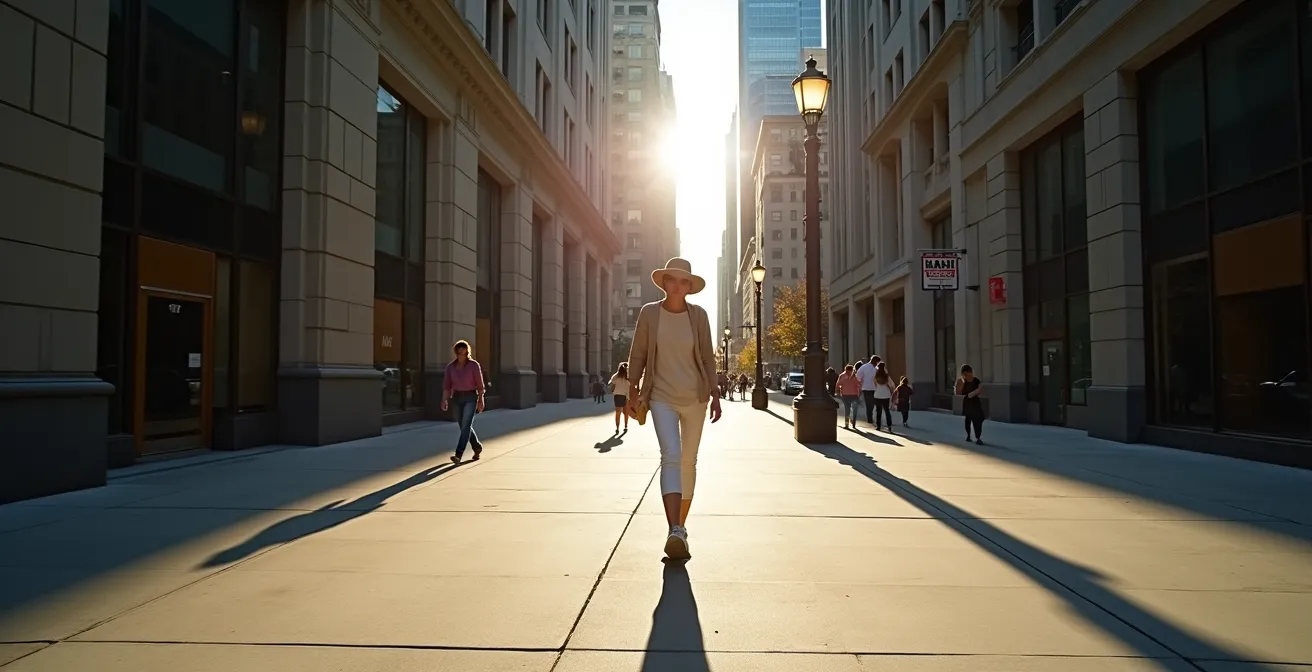
As you can see, by planning your route strategically, you can spend a significant portion of your walk in the shade cast by towering buildings. In the morning, walk on the west side of north-south streets. In the afternoon, stick to the east side. This simple act of “shadow walking” can make a world of difference, allowing you to stay dramatically cooler and more comfortable as you move through the city’s core.
The Hydration Mistake That Causes Heatstroke at the Parade
You’re heading to one of Toronto’s vibrant summer parades, like Pride or Caribana. You’ve packed a single bottle of water, assuming you’ll be able to refill it or buy more along the route. This is a critical and potentially dangerous mistake. While Toronto is generally well-equipped with public amenities, the long, crowded corridors of major parade routes often become what city officials have termed “hydration deserts.”
During the intense June 2025 heatwave, when humidex values soared to 45°C, the city activated its full Heat Relief Strategy. This included opening outdoor pools early and extending hours for its network of over 500 cooling centres. However, an analysis of these events revealed a major gap in infrastructure. Reports noted that major parade routes, such as Yonge Street for the Pride Parade and Lake Shore Boulevard for the Caribana Parade, are surprisingly devoid of public water fountains. The sheer density of the crowds also makes it nearly impossible to leave the area to find a store.
The common hydration mistake is underestimating your needs and overestimating access. Standing for hours in direct sun, surrounded by tens of thousands of people, your body loses water much faster than you realize. A single bottle is simply not enough. The correct strategy is to “pre-hydrate” by drinking plenty of water before you even leave, and to carry at least two liters of water per person with you. Don’t rely on the availability of vendors, who may run out or be inaccessible. Adding an electrolyte powder or tablet to one of your bottles is also a wise move to replenish the salts you lose through sweat, which is a key factor in preventing heat exhaustion and heatstroke.
The Booking Mistake That Ruins Tours on Rainy Days
Toronto’s summer weather isn’t just about heat; it’s also prone to sudden, dramatic thunderstorms that can appear with little warning. A common booking mistake is to plan an itinerary that is entirely dependent on outdoor activities without a solid, pre-planned backup. A “rain or shine” ticket policy for an outdoor attraction is small comfort when you’re caught in a torrential downpour with zero visibility.
A prime example is a trip to the Toronto Islands. As one local visitor shared, the experience can turn sour quickly: “The Toronto Islands, normally a perfect escape, become challenging during summer storms. Ferry services continue in ‘rain or shine’ conditions, but visibility drops to near zero during thunderstorms, and the 15-minute ride becomes uncomfortable with no shelter from wind and rain on the outdoor decks.” Your perfect island picnic day is now a soggy, miserable ferry ride. The mistake was not having a “pivot plan.”
A smart Toronto itinerary is built with weather flexibility in mind. This means booking refundable tickets whenever possible for weather-dependent attractions during the volatile summer months. Even more importantly, it means understanding and leveraging Toronto’s most valuable all-weather asset: the PATH system. This vast underground network of pedestrian tunnels connects major downtown attractions, shopping centres, and transit hubs. By creating a backup itinerary that links indoor spots via the PATH, you can salvage a rainy day and turn it into a new adventure. For instance, a day could easily include visits to the Hockey Hall of Fame, shopping at the Eaton Centre, and a meal at Assembly Chef’s Hall without ever stepping outside.
Before booking any tours, always build in a contingency plan. A weather-proof strategy includes:
- Mapping out PATH system connections between your desired attractions before you book.
- Choosing a hotel with or near a PATH access point for ultimate weather-proof exploration.
- Booking refundable tickets for outdoor attractions, and checking cancellation policies for “thunderstorm” provisions, not just generic “rain.”
- Creating a specific backup itinerary of indoor activities that you’re genuinely excited about.
Key Takeaways
- Cotton is a poor choice for Toronto’s humidity as it absorbs sweat and traps heat; opt for moisture-wicking synthetics or merino wool instead.
- Master strategic urban navigation by using the PATH system on rainy days and walking in the shade of buildings to avoid the worst of the urban heat island effect.
- Pack versatile clothing that can be layered and accessorized to transition from casual daytime sightseeing to more formal evening events without a full outfit change.
Toronto Weather Planning: How to Pack for a City with Four Distinct Seasons?
Packing for Toronto can feel like preparing for four seasons at once, even in the middle of summer. The city’s climate is a “roller coaster,” as weather specialists from Malau Boutique aptly describe it. You can experience a sweltering, humid afternoon followed by a cool, breezy evening, and then a sudden thunderstorm. This variability is the city’s defining characteristic, and a successful packing strategy is one that anticipates these swings rather than being surprised by them.
The urban heat island effect plays a major role in these temperature shifts, especially between day and night. While the sun beats down on concrete during the day, that same concrete radiates heat back out long after sunset, keeping the city core warm. In fact, research shows Toronto experiences the highest nighttime UHI intensity in Canada at a 4.36°C increase. This means that while it might cool down in the suburbs, the downtown area can remain uncomfortably warm and muggy well into the night.
So, how do you pack for this? The key is to think in flexible layers. Your core outfits should be based on high-performance, moisture-wicking fabrics to handle the peak heat and humidity. But you must always include a “third piece”—a lightweight merino wool cardigan, a packable windbreaker, or a linen-blend blazer. This piece is your utility player. It can be thrown on when you enter a frigid, air-conditioned restaurant, provide a bit of warmth if the temperature drops in the evening, or offer some protection from an unexpected drizzle. Your packing list should prioritize versatility: items that can be mixed, matched, and layered to create multiple outfits suitable for a 15-degree temperature swing.
Now that you’re equipped with the right strategies for fabrics, navigation, and planning, you can approach a Toronto summer with confidence, ensuring your visit is remembered for its amazing experiences, not for how uncomfortable you felt.