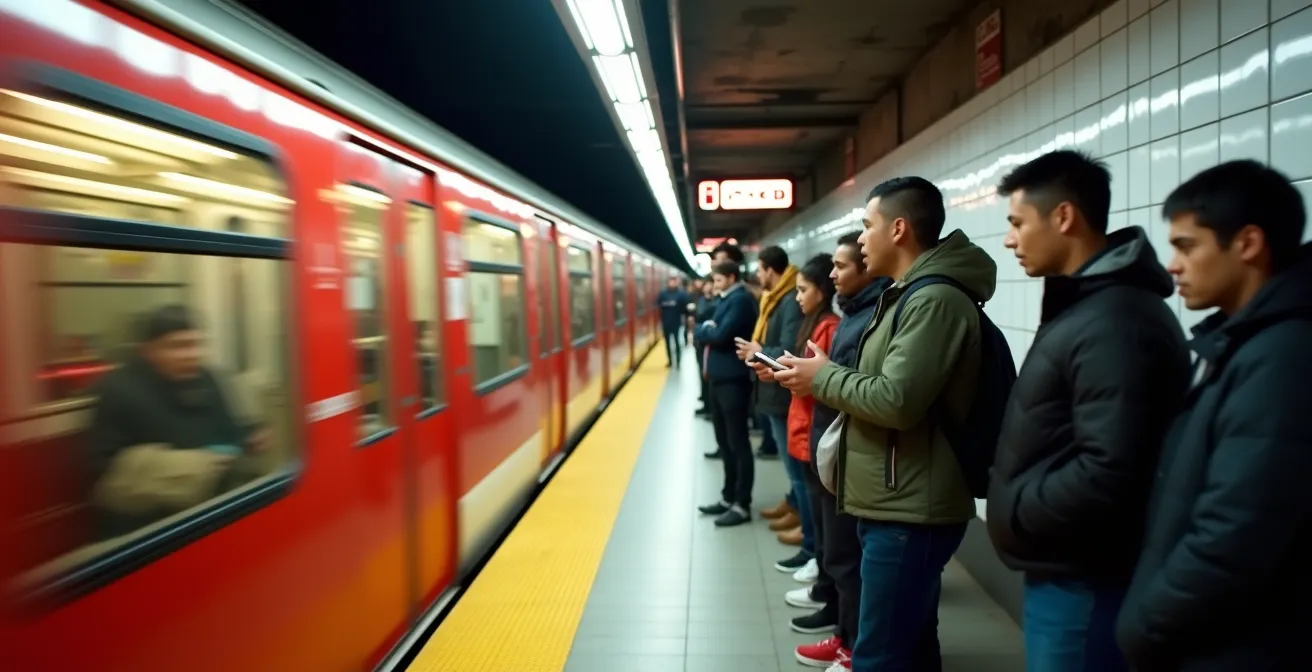
In summary:
- Anticipate “predictable failures” like signal problems and weekend closures instead of just reacting to them.
- Use low-tech solutions like SMS bus alerts and screenshotting routes to survive data-free dead zones.
- Understand the unwritten rules of commuter etiquette, especially regarding personal space and boarding procedures.
- Calculate your “true” commute time by adding a 10-15 minute buffer for transfers at major stations like Bloor-Yonge and Union.
- Maximize the value of your fare by strategically using the 2-hour PRESTO transfer window for errands.
There’s the TTC experience you see in tourist brochures, and then there’s the reality. The daily grind of navigating Toronto’s transit system is a skill honed through patience, frustration, and a deep understanding of its quirks. Many guides will tell you to buy a PRESTO card and download an app. They’ll show you a map of the subway lines and tell you to stand clear of the closing doors. But this is entry-level advice for a system that operates on a much deeper, more complex level.
The hard truth is that mastering the TTC isn’t about knowing the map; it’s about understanding the system’s pulse. It’s about learning to anticipate its predictable failures, from the infamous “signal problems” to the weekend shutdowns that can derail your plans. This isn’t just about getting from A to B. It’s about performing a daily commuter’s calculus, factoring in the chaos of rush hour, the real-world time it takes to transfer between lines, and the unwritten rules of conduct that separate a flustered visitor from a seasoned Torontonian.
Forget the surface-level tips. What if the key to a stress-free commute wasn’t just having the right app, but knowing when to distrust it? What if you could navigate the network with the gritty, hard-won knowledge of a veteran? This guide will take you beyond the basics. We’ll explore the reasons behind the delays, the practical strategies for when technology fails, the nuances of choosing your ride, the unspoken social contract of commuting, and how to plan your journey with the system’s real-world performance in mind. This is how you learn to ride the Red Rocket like you were born to it.
To truly conquer the Toronto Transit Commission, this guide breaks down the essential insider knowledge you’ll need. Below, you’ll find a detailed look at everything from decoding delays to mastering the city’s main subway arteries.
Summary: A Veteran’s Guide to the Toronto Transit Commission
- Why “Signal Problems” Can Stall Your Commute for 30 Minutes?
- How to Text for Next Bus Arrivals When You Have No Data?
- New Streetcar vs. Old Bus: Which Offers a Smoother Ride?
- The Backpack Mistake That Enrages Other Commuters
- When to Check for Subway Closures Before Your Weekend Trip?
- How to Calculate Your True Commute Time Including Subway Transfers?
- TTC Day Pass vs. City Sightseeing: Which Wins on Value?
- Toronto Subway Guide: How to Master the “U” and the “Green Line”?
Why “Signal Problems” Can Stall Your Commute for 30 Minutes?
Every seasoned TTC rider has heard the dreaded, disembodied voice announce service delays due to “signal problems.” It’s a frustratingly vague explanation for why you’re suddenly stationary in a tunnel between stations. But this isn’t random chaos; it’s a predictable failure of an aging system. The TTC’s core signal system on Line 1 is decades old, relying on fixed-block technology that is prone to malfunction. Think of it like a series of traffic lights for trains; when one fails, it creates a massive backup that can take 30 minutes or more to clear.
While the TTC is slowly upgrading to a modern Communications-Based Train Control (CBTC) system, the rollout is a long-term project. Until then, these delays are a fact of life. The scale of the issue is staggering; an analysis of public data revealed that TTC subway delays can be extensive. For a daily commuter, this means “signal problems” aren’t an exception but a variable to be factored into your travel time. Assuming your journey will be seamless is a rookie mistake. A veteran rider always adds a buffer, knowing that the system’s fragility is part of the daily commute.
The impact of these incidents is significant. One analysis found that in a single year, the system accumulated 1,090 hours (or 45 days) of delays. This isn’t just an inconvenience; it’s a systemic issue that defines the commuter experience. Understanding this helps you shift from frustration to strategic planning. The delay isn’t a surprise; it’s a calculated risk you take every time you tap your PRESTO card. So, the next time you hear that announcement, don’t be surprised. Be prepared.
How to Text for Next Bus Arrivals When You Have No Data?
You’re standing at a bus stop, it’s freezing, and your transit app is useless because you’ve hit a data dead zone or your plan has run out. This is a classic Toronto commuter dilemma. While everyone relies on apps like Transit or Google Maps, a true veteran knows the low-tech backup plan that never fails: the TTC’s SMS service. It’s an old-school but incredibly reliable tool that works on any phone that can send a text message, no data required.
The process is simple. Every bus and streetcar stop pole has a unique 4 or 5-digit stop number printed on it. You just need to text this number to 898882 (TXTTTC). Within seconds, you’ll receive a text back with the estimated arrival times for the next several vehicles on that route. It’s not fancy, but it’s effective and can be a lifesaver when you’re disconnected. This is a prime example of insider knowledge that separates the prepared from the stranded.
Before you go underground, it’s also wise to prepare for the inevitable loss of signal. While the TTC does offer TCONNECT Wi-Fi in all subway stations, it doesn’t work in the tunnels between them. A pro-tip is to screenshot your directions or the route map before you descend. If you’re using multiple apps and they show conflicting arrival times, always trust the more pessimistic estimate. The system is more likely to be late than early. This defensive mindset is key to navigating the TTC without stress.
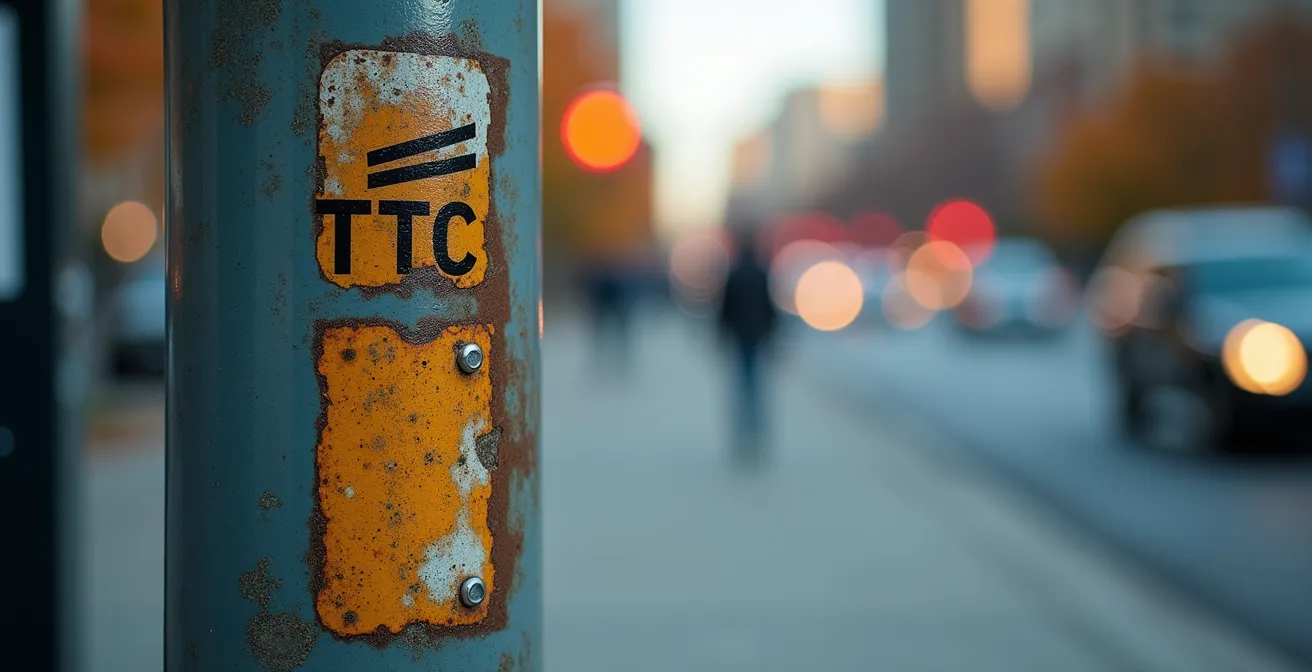
As you can see, the stop number is a critical piece of information often overlooked by those glued to their apps. Learning to spot and use it is a fundamental skill for any TTC rider. It’s your analog key to a digital system, ensuring you always have a way to find out when your ride is *actually* coming.
New Streetcar vs. Old Bus: Which Offers a Smoother Ride?
Choosing between a new Flexity streetcar and a standard city bus isn’t just a matter of which one arrives first; it’s a strategic decision based on your destination, your tolerance for bumps, and the time of day. The “commuter’s calculus” involves weighing the pros and cons of each vehicle type. On paper, the new, low-floor streetcars seem superior: they’re more accessible, have a much higher capacity, and offer a smoother ride thanks to being on rails.
However, reality is more complicated. A streetcar, especially when not in a dedicated right-of-way, is a prisoner to the traffic around it. A single illegally parked car or a left-turning vehicle can bring an entire line to a halt, causing the infamous “streetcar bunching” where three or four arrive at once after a long wait. Buses, while subject to the same traffic, are more maneuverable and can often navigate around obstacles. This is reflected in their on-time performance, which often surpasses that of streetcars in mixed traffic.
A prime example is the contrast between the 504 King streetcar and the 29 Dufferin bus. On King Street, a dedicated right-of-way with transit priority signals allows the 504 to move with relative efficiency, with data showing it improved travel times by 25%. Meanwhile, the notoriously slow 29 Dufferin bus is constantly bogged down in heavy traffic with no priority lanes. This real-world comparison shows that the vehicle’s environment matters more than the vehicle itself. A streetcar in a dedicated lane is a dream; a streetcar in mixed traffic can be a nightmare.
This comparative data, often analyzed by transit advocacy groups, provides a clearer picture than a simple route map. As shown in a comprehensive performance matrix, the choice is never simple.
| Factor | New Flexity Streetcar | Standard Bus |
|---|---|---|
| Ride Smoothness | Rails provide smoother ride | Subject to road conditions |
| Accessibility | Low-floor, wheelchair friendly | Ramp required, less space |
| On-Time Performance | 69% (affected by traffic) | 83% average |
| Capacity | 251 passengers | 55-85 passengers |
| Speed in Mixed Traffic | Slower (blocked by parked cars) | More maneuverable |
| Dedicated Lanes | King St, St. Clair success | Limited bus lanes |
The Backpack Mistake That Enrages Other Commuters
Riding the TTC during rush hour is a masterclass in shared space and unspoken social contracts. Tourists and new riders often break these rules unknowingly, but no transgression is more universally loathed than the “backpack mistake.” Wearing a backpack on your back in a crowded subway car or bus is the ultimate sin of TTC etiquette. It creates a bulky, unaware extension of your body that swings around, bumps into people, and takes up the space of an entire person. It’s the quickest way to earn the silent, seething rage of every other commuter.
The rule is simple and non-negotiable: if the vehicle is crowded, take your backpack off. Hold it by your side, place it at your feet, or keep it on your lap if you’re seated. This simple act of awareness instantly signals that you are a considerate, seasoned rider who understands the spatial dynamics of a packed commute. It’s a small gesture that makes a huge difference in the collective comfort of everyone on board. This is a core tenet of “platform strategy”—minding your personal footprint.
This is just one of many unwritten rules. Others include standing to the right and walking on the left on all escalators (a rule many Torontonians fiercely defend), having your PRESTO card ready *before* you get to the fare gates to avoid holding up the line, and moving to the center of the vehicle to let others board. You should also always let passengers exit the train or bus before you even attempt to get on. Mastering these small rituals is what truly elevates you from a visitor to a local.
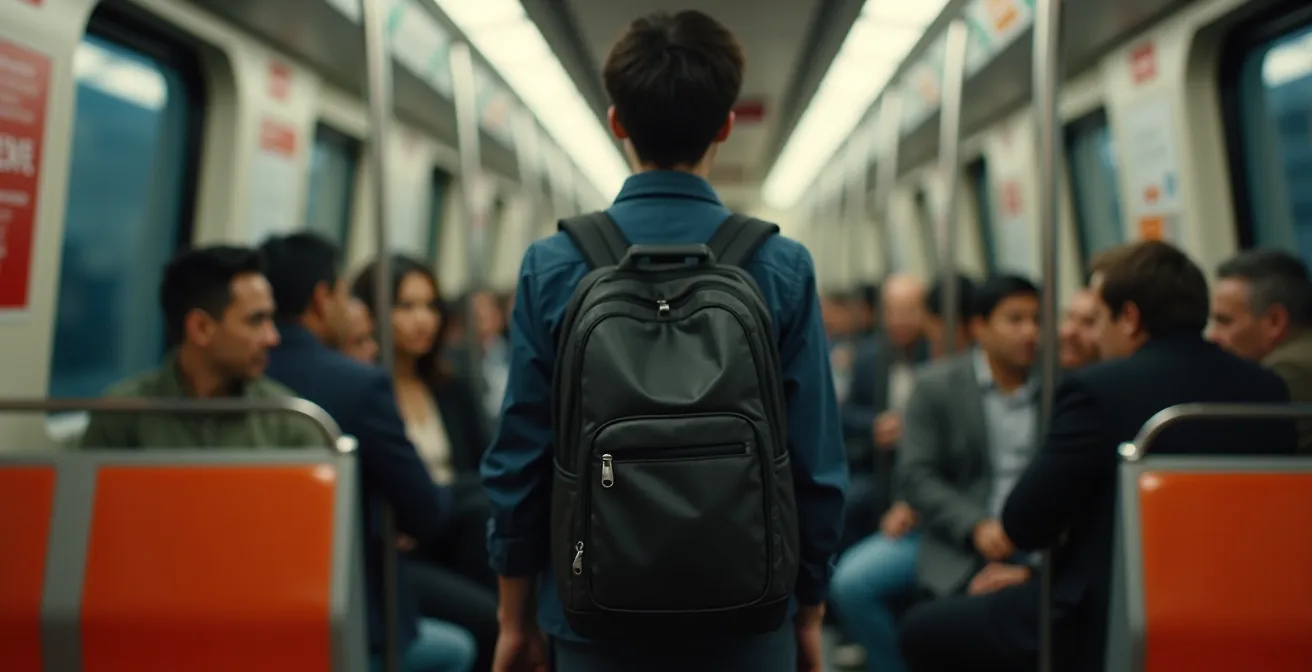
Observing and adopting these behaviours is crucial. It’s not just about politeness; it’s about efficiency. When everyone follows the code, the entire system moves more smoothly. The considerate commuter holding their backpack low, as shown above, is a hero of the morning rush.
Your Action Plan: The TTC Commuter’s Code of Conduct
- Personal Space: During rush hour, always remove your backpack and hold it at your feet or by your side to create more room.
- Flow of Traffic: Adhere strictly to the “stand right, walk left” rule on all station escalators to maintain passenger flow.
- Gate Readiness: Have your PRESTO card or payment ready in your hand before you reach the fare gates to avoid causing a bottleneck.
- Strategic Boarding: Let all passengers exit a vehicle before you attempt to board, and move to the center of the car to clear the doorway area.
- Priority Seating: Be aware of the designated priority seating and offer your seat to seniors, pregnant individuals, or anyone who may need it more.
When to Check for Subway Closures Before Your Weekend Trip?
One of the TTC’s most “predictable failures” is the weekend subway closure. These are essential for system maintenance and upgrades—particularly the ongoing ATC signal system installation on Line 1—but they can completely ruin your weekend plans if you’re not prepared. The TTC usually announces these closures well in advance, but many riders only discover them when they arrive at a station to find the gates locked and a crowd of confused people waiting for a shuttle bus.
A veteran commuter knows the rhythm of these closures. The key is to start checking for alerts on a Wednesday or Thursday for the upcoming weekend. The TTC website’s “Service Alerts” section and its official Twitter account are the primary sources. These closures most commonly affect stretches of Line 1 (Yonge-University), often between St. Clair and Finch. Don’t rely on Google Maps to be instantly updated; cross-reference with the official TTC source. During major city events like Caribana, the Toronto Marathon, or Nuit Blanche, assume there will be significant diversions and plan an entirely different route if possible.
The shuttle buses that replace the subway are notoriously slow, often getting stuck in the very traffic the subway was built to avoid. On a bad day, a 20-minute subway ride can become a 90-minute ordeal on a packed shuttle. A pro-tip is to use the GO Transit rail lines as an alternative. For example, if the subway is closed north of Union, the Lakeshore East and West GO lines can often be a much faster way to travel parallel to the closure. These disruptions are frequent; TTC delay data analysis reveals that major incidents are a regular occurrence. Being proactive is your only defense.
How to Calculate Your True Commute Time Including Subway Transfers?
Google Maps might tell you your trip will take 28 minutes, but a seasoned Torontonian knows to laugh at that optimistic estimate. The “commuter’s calculus” requires you to factor in one of the biggest hidden time sinks: subway transfers. The time it takes to navigate between lines at major interchange stations is almost never accurately reflected in trip-planning apps. This is where lived experience trumps algorithms.
Data analysis of TTC performance confirms what every local feels in their bones. Transferring at Bloor-Yonge, the system’s busiest station, is a 3-5 minute affair during off-peak times, but can easily stretch to 7-10 minutes during rush hour as you navigate a sea of people. The transfer at Spadina involves a famously long tunnel walk with a moving sidewalk that’s often out of service, consistently taking 5-7 minutes. Union Station becomes a chaotic mess during events or rush hour, while St. George generally offers the smoothest connection. A conservative rule of thumb is to add a minimum 10-15 minute buffer to any trip that involves a transfer at a major downtown station.
Beyond buffer time, a true master of the TTC knows how to maximize the value of every fare. When you tap your PRESTO card, you activate a 2-hour transfer window. This allows for unlimited travel in any direction, on any vehicle type (bus, streetcar, or subway) within that period. This isn’t just for getting from A to B; it’s a strategic tool. You can hop off the subway, run a quick errand, and hop back on without paying a second fare. You can also plan multi-stop trips within this window to get the most value out of a single $3.35 charge. Remember, this flexibility only applies to PRESTO; paying with cash will get you a paper transfer with far more restrictive rules.
TTC Day Pass vs. City Sightseeing: Which Wins on Value?
For visitors to Toronto, the bright red hop-on-hop-off tour buses seem like an obvious choice. They promise a convenient way to see the city’s main attractions. However, any local will tell you that for a fraction of the price, you can create a far more authentic and comprehensive tour yourself using a TTC Day Pass. At around $60, the tourist bus covers a limited, pre-determined loop. A TTC Day Pass, costing just $13.50, gives you unlimited 24-hour access to the entire network of subways, streetcars, and buses.
The value proposition is unbeatable if you’re willing to do a little planning. The break-even point is just four single rides. You can craft a DIY tour that is not only cheaper but also takes you through the real neighbourhoods of Toronto. Start your day with a scenic ride on the 509 Harbourfront streetcar for stunning views of the skyline and CN Tower. Transfer at Union Station to the subway and head up to Museum Station to visit the Royal Ontario Museum. Then, hop on the 506 Carlton streetcar for a journey through the historic, leafy streets of Cabbagetown. Finish your day by exploring the trendy Distillery District, easily accessible via the 504 King streetcar.
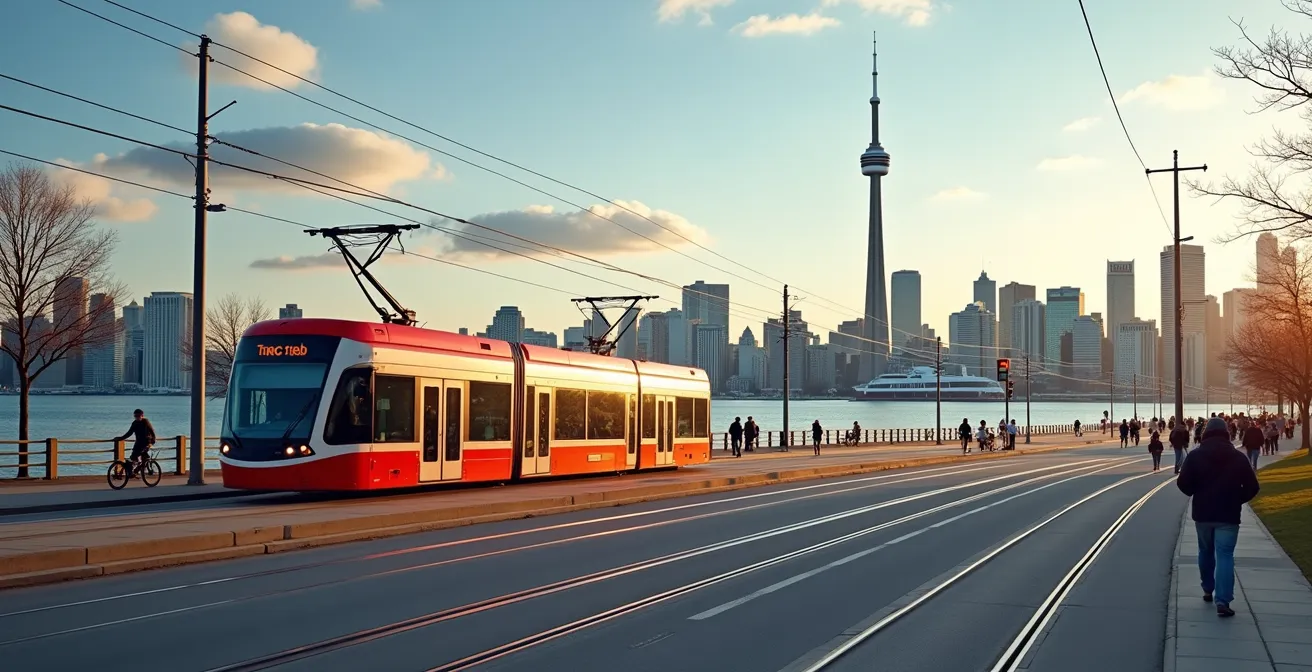
This approach transforms a tourist checklist into a genuine urban exploration. You’re not just seeing the sights; you’re experiencing the city’s pulse, riding alongside locals and discovering the connective tissue between major landmarks. The cost difference is stark, as this analysis from Destination Toronto highlights.
| Option | Cost | Coverage | Break-Even |
|---|---|---|---|
| TTC Day Pass | $13.50 | All TTC routes | After 4 rides |
| Hop-On-Hop-Off | ~$60 | Tourist routes only | N/A – fixed cost |
| Single TTC Fare | $3.35 | 2-hour transfer | Best for 1-2 trips |
| Weekly Pass | $50.00 | Unlimited weekly | After 15 rides |
Key takeaways
- Embrace Predictable Failures: Always add a 15-minute buffer to your commute for signal problems and transfer times, especially at Bloor-Yonge.
- Master Low-Tech Backups: Know your bus stop number for SMS alerts and screenshot your route before going underground to combat data dead zones.
- Respect the Commuter Code: Take your backpack off in crowded cars, stand right on escalators, and let people exit before you board.
Toronto Subway Guide: How to Master the “U” and the “Green Line”?
At the heart of the TTC network are two critical arteries: Line 1 (Yonge-University), the “U,” and Line 2 (Bloor-Danforth), the “Green Line.” Understanding their distinct personalities and how they interact is the final step in mastering Toronto transit. These two lines are the backbone of a system that, according to the TTC subway system serves over 1,079,700 weekday riders, and navigating them efficiently requires a specific platform strategy.
Line 1 Yonge-University forms a massive ‘U’ shape that serves as the city’s primary north-south and financial district connector. The eastern arm (Yonge) is the original subway line, running through the city’s commercial spine. The western arm (University/Spadina) serves the university, cultural institutions, and increasingly, the northwest suburbs. Its base at Union Station is the city’s main transit hub, connecting to GO Transit and the national rail network. During rush hour, trains on Line 1 run every 2-3 minutes, but they are intensely crowded, especially between Bloor-Yonge and Union.
Line 2 Bloor-Danforth is the city’s east-west soul. It cuts across dozens of diverse, vibrant neighbourhoods, from the bungalows of Etobicoke to the Greek restaurants of the Danforth. It’s often less crowded than Line 1 outside of rush hour and provides a crucial link between the city’s extremities. The magic happens where these two lines intersect: Bloor-Yonge and St. George stations. Knowing which side of the platform to stand on at these interchange points to be closest to the exit or the next train’s doors is an art form. At Bloor-Yonge, for instance, standing at the very north or south end of the platform can often put you in a less crowded car.
Now that you’re armed with this insider knowledge, your next trip on the TTC should be less about hope and more about strategy. The final step is to apply this commuter’s calculus to your own daily routes and travel plans.