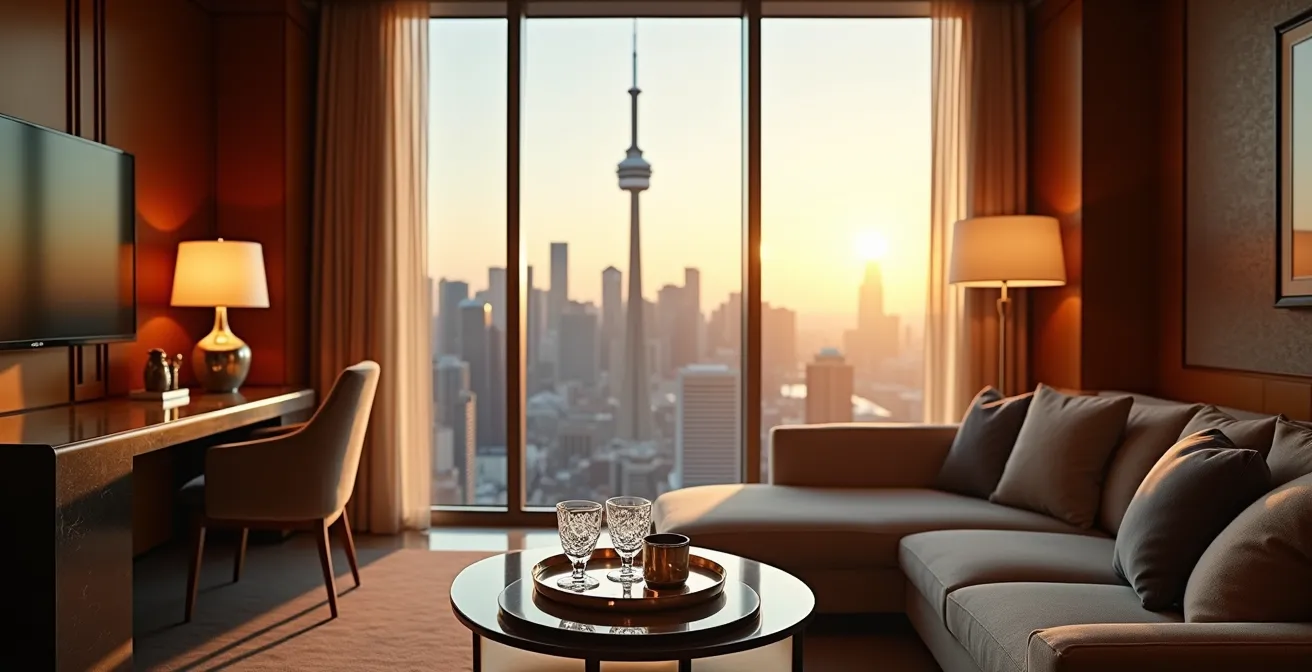
True Toronto luxury is not defined by ostentatious displays but by a quiet, anticipatory intelligence and an insider’s understanding of the city’s unique urban pressures.
- A hotel’s 5-star rating is merely the starting point; Toronto’s elite service culture prioritizes discretion and personalization over overt grandeur.
- Your experience is directly impacted by external factors like the “suit rush” in the PATH, city-wide construction, and major events like TIFF, which require proactive planning.
Recommendation: To secure a truly exceptional stay, you must strategically manage your visit—from pre-booking destination restaurants to vetting your room’s orientation and potential for noise—before you even arrive.
For the discerning executive or seasoned luxury traveler, arriving in a new city presents a familiar challenge: deciphering the true meaning of a five-star rating. You see the polished marble, the sweeping skyline views, and the promise of unparalleled service, and you expect a standard benchmarked against global capitals like London or Dubai. In Toronto, however, this assumption is the first mistake. The city’s luxury landscape operates on a different, more subtle frequency, one where the highest level of service is not about grand gestures but about a quiet, almost imperceptible, anticipation of your needs.
Many will guide you toward the obvious markers: a room on a high floor, a celebrated spa, or a well-regarded restaurant. But this is a superficial reading of the environment. The real art of experiencing Toronto’s elite hospitality lies in navigating its specific urban ecosystem. This involves understanding a service culture that values understated discretion, acknowledging the very real-world pressures of a booming metropolis, and knowing that the most coveted amenities are rarely available on a whim. The conventional wisdom about luxury travel is insufficient here; it fails to account for the nuances that separate a merely expensive stay from a truly exceptional one.
But what if the key to unlocking this experience was not in the hotel’s brochure, but in mastering the unspoken rules of the city itself? This guide is not a list of hotels; it is a strategic brief. We will dismantle the generic definition of luxury and provide you with the intelligence required to assess and secure a genuinely top-tier experience. We will explore why a Toronto five-star is a unique designation, how to gain strategic access to exclusive facilities, and how to mitigate the urban factors that can compromise an otherwise perfect stay.
This article provides an insider’s framework for navigating Toronto’s high-end hotel scene. It is structured to move from the philosophical definition of the city’s luxury to the practical strategies required to fully experience it.
Summary: A Discerning Guide to Toronto’s High-Rise Luxury
- Why a 5-Star Rating in Toronto Differs from Dubai or London?
- How to Get Into the Shangri-La Pool Without Being a Guest?
- Lake View vs. City View: Which Room Orientation Justifies the Price?
- The Construction Noise Factor High-Rise Guests Forget to Check
- When to Book the Hotel Restaurant Before You Even Check In?
- Why Yorkville Row Houses Are Among the Most Expensive in Canada?
- When to Walk the PATH to Avoid the “Suit Rush” at 8:Dinosaur Hunting at the ROM: Which Fossil Exhibits Will Impress Your Kids the Most?
- Yorkville Shopping: How to Experience Luxury in Restored Victorian Homes?
Why a 5-Star Rating in Toronto Differs from Dubai or London?
A Forbes Five-Star rating is the universal benchmark for elite hospitality, yet its manifestation is intensely local. In Toronto, this distinction is not about opulence but about restraint and intelligence. While a luxury property in Dubai might prioritize demonstrative hospitality—grand, visible gestures of service—Toronto’s top-tier hotels practice a more subtle art. Here, the ultimate luxury is anticipatory service: a butler who acts with such discretion that needs are met before they are even fully formed. This is the core difference. It’s a shift from being served to being understood.
This standard of excellence is exceedingly rare; a fact confirmed by Forbes Travel Guide’s 2024 awards, which show that only 5 Toronto hotels achieved a Five-Star rating for the hotel itself. The St. Regis Toronto, for instance, exemplifies this Canadian interpretation of luxury. Its renowned butler service is defined not by ostentation but by profound personalization—fulfilling a request to have a specific Build-a-Bear ready for a child’s arrival or having your preferred morning beverage delivered at a precise moment without a call. It is a service predicated on quiet observation and seamless execution.
As Hiren Prabhakar, General Manager at The St. Regis Toronto, explains, this philosophy is what creates the distinction:
Our commitment to bespoke service at every level is what sets The St. Regis Toronto apart and earns us the distinction of being a top luxury hotel in Canada.
– Hiren Prabhakar, General Manager, The St. Regis Toronto
Therefore, a discerning traveler must look beyond the star rating and inquire about the *philosophy* of service. Is it reactive or anticipatory? Is it designed for show or for genuine, personalized comfort? In Toronto, the latter is the only metric that truly matters.
How to Get Into the Shangri-La Pool Without Being a Guest?
In Toronto’s luxury ecosystem, the most desirable amenities are often shielded from the public, and access requires strategic planning, not just a willingness to pay. The 20-metre indoor pool at the Shangri-La Hotel, with its cascading water features and private cabanas, is a prime example. It is a sanctuary reserved for hotel guests, making direct, non-guest access impossible. However, for the well-informed, a discreet side door exists: the Miraj Hammam Spa.

By booking a spa treatment of 60 minutes or longer (excluding manicures and pedicures), an individual gains complimentary access to the hotel’s entire Health Club, including the coveted pool. This is not simply a transaction but a tactical maneuver. To maximize the experience, one must understand the rhythm of the hotel. Arriving a full hour before a scheduled appointment during an off-peak window—a Tuesday morning, for example—transforms the experience from a simple swim into a private, exclusive retreat. The following steps are not merely a guide; they are a protocol for orchestrating this access:
- Book a spa treatment of 60 minutes or more at the Miraj Hammam Spa, ensuring it’s not a manicure or pedicure.
- Schedule your arrival 60 minutes prior to your treatment time to make full use of the Health Club facilities.
- For the most serene and exclusive experience, aim for a weekday morning booking, with Tuesday around 10 AM often being the quietest period.
This method illustrates a core principle of Toronto luxury: the best experiences are not openly advertised but are available to those who possess the right information and execute with precision.
Lake View vs. City View: Which Room Orientation Justifies the Price?
In a high-rise hotel, your room’s orientation is not a minor detail; it is a fundamental component of the experience you are purchasing. In Toronto, the choice between a Lake Ontario view and a city skyline view is a significant financial and experiential decision. A common mistake is to assume one is universally superior. The reality is that the value of each is highly conditional, dependent on the season, time of day, and the specific hotel’s positioning. For instance, suites like the Astor at The St. Regis Toronto, which offer an expansive 1,675 to 2,035 square feet of space, make this choice even more impactful.
The following table breaks down the strategic considerations for this choice, demonstrating that the “best” view is a matter of calculated preference, not a simple hierarchy.
| Feature | Lake View | City View |
|---|---|---|
| Best Season | May-September (sailboats, island activity) | November-January (holiday lights) |
| Premium View | Ritz-Carlton south-facing (sunrise over Lake Ontario) | Rooms with direct CN Tower view |
| Best Time | Morning (sunrise reflections) | Evening (city lights) |
| Price Premium | +15-20% over standard | +20-25% for CN Tower view |
As the data indicates, a view directly facing the CN Tower often commands the highest premium, reflecting a demand for the iconic city-centric shot. However, the serene, expansive vista of Lake Ontario, particularly during the active summer months or at sunrise, offers a different kind of luxury—one of tranquility and scale. The choice is not about which is “better,” but which experience aligns with your specific desires for the stay. A winter visit might be enhanced by the festive city lights, while a summer stay is arguably incomplete without witnessing the morning sun over the lake.
The Construction Noise Factor High-Rise Guests Forget to Check
Toronto is a city in a state of perpetual vertical growth. For the high-rise hotel guest, this presents a significant, often overlooked, threat to tranquility: construction noise. Nothing undermines a luxury experience more effectively than the pre-dawn chorus of heavy machinery. While hotels invest heavily in soundproofing, proximity to a major development can defeat even the best engineering. Therefore, a pre-booking audit of the hotel’s immediate surroundings is not an optional step; it is an absolute necessity for ensuring a peaceful stay.
Merely asking for a “quiet room” is insufficient. The request must be specific, informed, and demonstrate that you have done your due diligence. This signals to the front desk that you are a discerning guest with high expectations. The goal is to be placed on the side of the building furthest from any active work sites, a detail that can only be secured with precise information. This is a critical component of managing your environment proactively.
Your Pre-Booking Noise Audit Checklist: Securing a Tranquil Stay
- Intelligence Gathering: Before booking, consult the forums on UrbanToronto.ca. This resource provides real-time, ground-level intelligence on active and upcoming construction projects across the city. Identify any developments near your target hotel.
- The Specific Request: During the booking process (ideally by phone), make a direct request for “a room on the quiet side, located as far as possible from any construction activity.”
- Demonstrate Your Research: Add credibility to your request by referencing specific projects or intersections. For example: “I would like to request a room away from the Yonge and Bloor development,” or note your awareness of major projects like The One tower near the Yorkville area.
- Confirm at Check-In: Upon arrival, politely re-confirm that your room assignment adheres to your “quiet side” request. A final check can prevent a disruptive surprise.
This proactive approach transforms you from a passive guest hoping for the best into an active participant curating your own serene environment.
When to Book the Hotel Restaurant Before You Even Check In?
A common misconception among travelers is that a hotel’s signature restaurant is a convenient amenity primarily for its guests. In Toronto, this could not be further from the truth. The city’s top hotel restaurants—like LOUIX LOUIS at The St. Regis or Daniel Boulud’s café at the Four Seasons—are destination establishments in their own right. They are culinary hotspots that attract a discerning local clientele, meaning they operate with the same booking pressures as any other top independent restaurant in the city.
Assuming you can secure a table upon arrival is a critical error, especially during key periods. The city’s cultural calendar dictates restaurant accessibility. The most dramatic example is the Toronto International Film Festival (TIFF) in September. During this period, securing a reservation at a top hotel restaurant requires one to two months of advance booking. Waiting until you check in is not an option; by then, every prime-time table will have been long secured by film executives, celebrities, and well-connected locals.
Case Study: The LOUIX LOUIS Challenge
The 31st-floor restaurant at The St. Regis, LOUIX LOUIS, perfectly illustrates this dynamic. As a Forbes Recommended Restaurant known for its American cuisine with a French twist and one of North America’s largest dark spirits collections, it is a major draw. Its popularity means that even outside of major city events, weekend reservations must be made weeks in advance. It operates as a standalone culinary destination that happens to be located within a hotel, not as a mere hotel amenity.
The rule is simple: if dining at a hotel’s flagship restaurant is part of your plan, your booking timeline for the restaurant must be independent of your hotel reservation. Research the restaurant’s booking window and treat it with the same urgency as you would any other critical part of your itinerary. Merely being a guest offers no special priority.
Why Yorkville Row Houses Are Among the Most Expensive in Canada?
The Yorkville neighbourhood presents a paradox: quaint, historic Victorian row houses standing at the epicentre of Canada’s most expensive real estate. The value of these properties is not just in their brick-and-mortar charm or prime location; it’s in the hyper-exclusive economic ecosystem they support. This area is the undisputed capital of luxury in Toronto, where flagship boutiques and five-star residences create a powerful confluence of wealth and influence. It’s no surprise that, as reported in the 2024 Yorkville luxury market recap, condominiums in adjacent buildings like the Four Seasons Private Residences consistently command the highest price per square foot in the entire city.
The extreme valuation of these properties is directly fueled by a unique phenomenon: the celebrity rental economy, which peaks during the Toronto International Film Festival (TIFF). During this time, the demand for secure, private, and luxurious accommodations skyrockets. Movie studios and A-list celebrities will pay exorbitant weekly rates for furnished luxury units in buildings like The Milan or Festival Tower, which is located conveniently above the TIFF Bell Lightbox complex. These short-term, high-figure rentals establish an incredibly high baseline for property values in the surrounding area.
This creates a feedback loop: the prestige of the address attracts high-profile events and residents, which in turn drives up property and rental values, further cementing the area’s status as the pinnacle of Canadian luxury. The quaint Victorian row house is not just a home; it is an asset whose value is inextricably linked to the global entertainment and luxury industries that converge on its doorstep each year. For the visitor, this translates into an environment of unparalleled exclusivity, where the cost of entry—whether for shopping, dining, or staying—is a reflection of this intense economic concentration.
When to Walk the PATH to Avoid the “Suit Rush” at 8:Dinosaur Hunting at the ROM: Which Fossil Exhibits Will Impress Your Kids the Most?
Mastering a luxury stay in Toronto requires navigating two very different types of jungles: the corporate and the prehistoric. This involves both understanding the underground currents of the Financial District and knowing which colossal skeletons will capture the imagination of the younger members of your party.
Navigating the PATH to Avoid the “Suit Rush”
Toronto’s PATH is a 30-kilometre underground pedestrian network connecting the towers of the Financial District. While it offers a climate-controlled refuge from the elements, it has its own distinct rush hour. Between 8:00 AM and 9:30 AM, the corridors are flooded with a torrent of corporate professionals—the “suit rush.” Navigating this with luggage or children is an exercise in futility. The strategic window for a calm and efficient journey through the PATH is between 10:00 AM and 11:30 AM. During this mid-morning lull, the crowds have dissipated, allowing for a relaxed walk between your hotel and downtown destinations.
Dinosaur Hunting at the Royal Ontario Museum (ROM)
Just west of Yorkville, the ROM offers a world-class collection of fossils. To make the visit impactful, especially with children, it’s best to have a clear target. Instead of aimless wandering, head straight for these two key exhibits:
- “Gordo” the Barosaurus: Go directly to the main hall to witness this massive sauropod. It is one of the few real fossil skeletons of its size on display anywhere in the world, and its sheer scale is guaranteed to impress.
- The Burgess Shale Gallery: For a unique Canadian context, visit this exhibit. It features some of the world’s most important fossils, showcasing the strange and wonderful creatures that lived in what is now Ontario, providing a local connection to deep time.
By applying a strategic approach to both the city’s infrastructure and its cultural institutions, you can transform a potentially chaotic outing into a seamless and memorable experience.
Key Takeaways
- True Toronto luxury is defined by discreet, anticipatory service, not by the overt displays seen in other global capitals.
- Proactive management of your stay is non-negotiable; factors like construction noise and event-driven restaurant demand must be handled before arrival.
- The most exclusive experiences, from accessing a private hotel pool to navigating Yorkville’s unique retail landscape, require insider knowledge and strategic planning.
Yorkville Shopping: How to Experience Luxury in Restored Victorian Homes?
Shopping in Yorkville is an experience that transcends mere commerce. It is an architectural and cultural immersion, where the world’s most prestigious luxury brands have adapted themselves to the neighbourhood’s unique heritage. Unlike the sprawling malls of other cities, luxury retail here is housed within beautifully restored Victorian homes. This creates a “vertical boutique” experience, where flagship stores for Chanel, Hermès, and Louis Vuitton unfold over multiple floors, each with its own distinct atmosphere.
The standard ground-floor showroom is only the beginning. The true luxury of the Yorkville shopping experience is found on the upper levels of these heritage buildings, where private viewing rooms are available by request. These secluded spaces offer a level of privacy, personalization, and service that is impossible to replicate in a conventional retail setting. It is here that you can view collections in absolute tranquility, guided by a dedicated brand ambassador. This is not just shopping; it is a private audience with the world of haute couture and fine jewelry.
To fully embrace this unique environment, one must move beyond the main thoroughfare of Bloor Street West and explore the hidden courtyards and laneways that give Yorkville its character. The following curated route provides a framework for experiencing this multi-layered luxury:
- Begin at the four-floor Holt Renfrew flagship on Bloor Street to get an overview of the luxury landscape.
- Venture into the hidden courtyards behind Yorkville Avenue for peaceful breaks and to discover smaller, independent boutiques.
- Integrate culture with commerce by visiting Ingram Gallery or Gallery Gevik, located amidst the high-fashion houses.
- At a multi-story boutique of your choice, make a specific request to see the upper-level private viewing rooms.
- Conclude your afternoon at The Hazelton Hotel, renowned for its elegant and restorative afternoon tea service.
By approaching Yorkville with this mindset, you transform a simple shopping trip into a curated exploration of fashion, history, and exclusive service.
To truly master the art of the Toronto high-rise stay, the next step is to apply this strategic mindset to your own itinerary. By proactively curating every detail, from restaurant reservations to room selection and daily navigation, you ensure an experience that is not merely luxurious, but exceptionally and intelligently crafted.