The decision to commute in the GTA isn’t a simple choice; it’s a daily logistical puzzle where hidden costs and time-sinks often matter more than the sticker price.
- Taking the GO Train can save over $300 CAD per month, but that time advantage is easily eroded by inefficient transfers and navigation within Union Station.
- Your choice of suburb (Mississauga currently offers better connectivity than Markham) and your travel timing on the 401 are the most significant factors you can control.
Recommendation: Stop thinking like a passenger and start thinking like a logistics manager by calculating your true commute cost in both time and money.
The soul-crushing reality of a Greater Toronto Area commute is a universally shared experience. Whether you’re crawling along the 401 watching brake lights multiply or standing shoulder-to-shoulder on a packed GO train, the daily journey to Union Station often feels like a battle against time, money, and your own sanity. The conventional wisdom presents a simple binary choice: endure the high cost of driving and parking, or embrace the perceived affordability of public transit. This debate, however, misses the point entirely.
Most advice focuses on superficial comparisons of gas versus a PRESTO fare, ignoring the complex web of variables that truly define the commute. The hidden costs of vehicle depreciation, the frustrating “time-sinks” spent navigating the labyrinth of Union Station, and the strategic value of choosing the right suburb are rarely part of the equation. This superficial analysis leads to decisions based on incomplete data, leaving commuters feeling perpetually drained and inefficient.
But what if the key wasn’t simply choosing a mode of transport, but mastering the logistics of the entire journey? The true question isn’t “drive or ride,” but “how do I optimize my personal commute calculus?” This requires a shift in mindset—from a passive passenger to a pragmatic, data-driven strategist who understands every friction point and every opportunity for efficiency. It’s about understanding that your commute is a complex system with levers you can pull.
This guide will deconstruct the GTA commute into its core components. We will dissect the real financial costs, quantify the hidden time losses, compare key suburban transit hubs, and provide actionable strategies to navigate the daily grind—especially when the infamous Toronto winter strikes. It’s time to solve your commute equation.
To help you navigate this complex calculation, we’ve broken down the essential factors into clear, manageable sections. This structured approach will guide you through the financial, temporal, and strategic elements of mastering your daily journey to and from downtown Toronto.
Summary: Deconstructing the GTA Commute to Union Station
- Why Taking the GO Train Can Save You $300 CAD Monthly Compared to Driving?
- How to Calculate Your True Commute Time Including Subway Transfers?
- Mississauga vs. Markham: Which GTA Suburb Offers Better Transit Connectivity?
- The Winter Commute Strategy That Prevents Being Late During Snowstorms
- When to Travel on the 401 Highway to Avoid the Worst Gridlock?
- Subway or Uber: Which Is Faster During Rush Hour?
- Why the Bay and York Concourses Are Separate Ecosystems?
- Mastering the TTC: How to Navigate the “Red Rocket” Network Like a Local?
Why Taking the GO Train Can Save You $300 CAD Monthly Compared to Driving?
The financial case for taking the GO Train seems obvious, but the actual savings are often significantly underestimated. When you move beyond the simple comparison of a daily fare to a tank of gas, the numbers become compelling. The “commute calculus” must include variables like downtown parking, which can easily cost $25-$40 per day, and vehicle depreciation, a silent but substantial expense averaging around $0.20 per kilometer for wear, tear, and maintenance. When combined, these factors can add up to over $800 a month for a daily driver.
In contrast, GO Transit offers a layered approach to affordability. While a single fare might seem notable, regular commuters using PRESTO benefit from significant discounts. For the first 35 rides in a month, you receive a 15.7% discount off the single adult fare. For trips after the 40th ride, the discount becomes even more substantial. Moreover, specific programs dramatically amplify these savings. For instance, the Peel Region’s Affordable Transit Program shows how a Mississauga resident can save over $200 monthly compared to driving, with a 50% reimbursement on GO Transit fares.
Furthermore, the integration with local transit systems via the One Fare program eliminates the cost of transfers to the TTC, MiWay, or York Region Transit. A short trip on the GO Train is also surprisingly affordable; it’s just $3.70 CAD for trips under 10km with a PRESTO card. When all these financial factors are tallied—parking avoidance, depreciation savings, fare discounts, and free transfers—a suburban commuter can realistically save over $300 CAD per month, making the financial argument for the train overwhelmingly strong.
How to Calculate Your True Commute Time Including Subway Transfers?
One of the biggest illusions of the GTA commute is the “advertised” travel time. A 45-minute GO Train ride is never just 45 minutes. The true commute time is a sequence of stages, each a potential “time-sink” that inflates the total duration. The most significant of these hidden delays occurs within the sprawling complex of Union Station itself, particularly during the transfer from your GO platform to the TTC subway. This is where your efficient train journey can quickly unravel.
This journey from platform to platform is a complex ballet of navigating dense crowds, escalators, and winding corridors. During peak hours, what looks like a short walk on a map can become a significant delay. The key is to quantify these micro-journeys to build a realistic timeline.
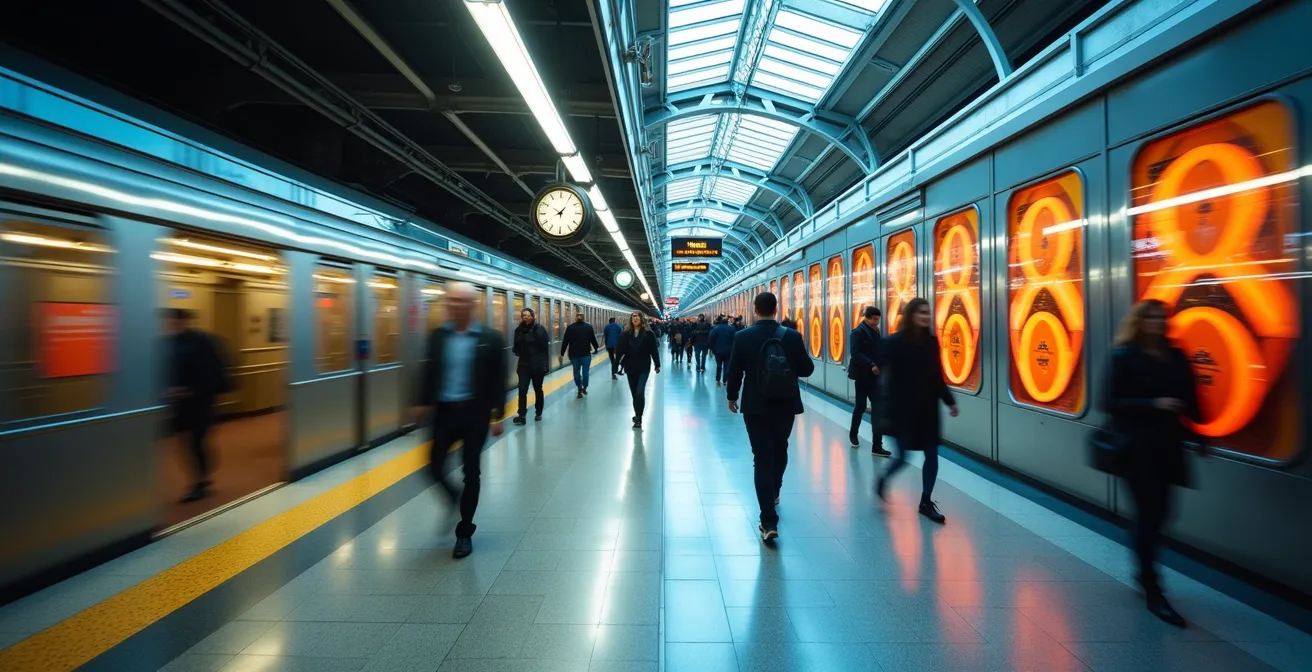
As the visual flow suggests, the path is far from direct. The time it takes to get from your GO train to the Line 1 subway platform can more than double during rush hour. A realistic calculation must factor in these variables, which are often dictated by crowd density and your starting position on the train. An uncharitable truth of commuting is that the time spent walking inside Union Station can often negate the time saved by an express train.
This table illustrates the stark difference between navigating the station during quiet periods versus the morning and evening rush. A simple walk can transform into a frustrating crawl.
| Route | Off-Peak Time | Peak Hour Time | Distance |
|---|---|---|---|
| GO Platform to TTC Line 1 | 3-5 minutes | 7-10 minutes | 200m |
| Bay Concourse to PATH | 2-3 minutes | 5-7 minutes | 150m |
| York Concourse to UP Express | 4-5 minutes | 8-10 minutes | 300m |
| GO Platform to Street Level | 5-6 minutes | 10-12 minutes | 250m |
Mississauga vs. Markham: Which GTA Suburb Offers Better Transit Connectivity?
Not all suburbs are created equal in the GTA’s transit ecosystem. For a commuter heading to Union Station, the choice between living in Mississauga and Markham presents a clear case study in the importance of transit infrastructure. While both are major suburban hubs, Mississauga currently holds a distinct advantage due to the frequency and integration of its services, primarily centered around the Lakeshore West GO line.
The Lakeshore West line is the workhorse of the GO network, offering all-day service with trains running every 15-30 minutes during peak periods and maintaining frequent service throughout the day and on weekends. This provides a level of flexibility that is simply not available on the Stouffville line, which serves Markham. While the Stouffville line is expanding, its service is less frequent, particularly during off-peak hours, forcing commuters into a more rigid schedule.
Case Study: The One Fare Program’s Impact
Ontario’s One Fare Program amplifies Mississauga’s advantage. A resident using their PRESTO card can transfer from a MiWay bus to the GO Train and then to the TTC subway, all while only paying the single highest portion of the fare (the GO Train leg). This seamless integration removes financial penalties for multi-modal journeys. While Markham’s YRT is also part of the program, the superior frequency of the Lakeshore West line means Mississauga residents can leverage these benefits of the One Fare Program more effectively and with greater flexibility throughout the day.
This isn’t to say Markham is a poor choice, but from a purely logistical standpoint, the robustness of the Lakeshore West corridor gives Mississauga commuters more options and a more resilient connection to the downtown core. For anyone prioritizing a flexible and frequent transit link to Union Station, the current infrastructure heavily favors the western suburbs over their northern counterparts.
The Winter Commute Strategy That Prevents Being Late During Snowstorms
A Toronto winter adds an entirely new layer of chaos to the daily commute. Snow, ice, and extreme cold are not just inconveniences; they are systemic threats to the transit network’s reliability. Frozen switches on the GO lines, “signal problems” on the TTC, and weather-related delays can quickly turn a routine journey into a multi-hour ordeal. A passive commuter is a victim of the weather; a strategic commuter has a plan.
Surviving the winter commute requires proactive measures, not reactive panic. The most critical element is information. On days with significant snowfall, your commute planning must begin before you even leave the house. This means actively monitoring service alerts and having a pre-defined set of backup options. Waiting until you’re on a delayed train to figure out your next move is a recipe for failure. Your winter strategy must be built on redundancy and a healthy dose of pessimism.
Having the right gear is also part of the strategy. A dead phone means no access to service updates or rideshare apps. Cold hands and feet make an unexpected platform wait unbearable. A simple preparedness kit can be the difference between a minor annoyance and a miserable experience.

The following checklist isn’t just a list of tips; it’s a standard operating procedure for any day with a winter weather advisory. Following these steps systematically will dramatically reduce your chances of being late and mitigate the stress of weather-related disruptions.
Your Action Plan: Winter GO Transit Survival Guide
- Monitor service alerts starting at 5 AM on snow days via GO Transit Twitter and website.
- Build in a 30-minute buffer time for potential frozen switch delays.
- Identify alternative bus routes—GO buses often replace trains during major disruptions.
- Download offline content and charge all devices in preparation for extended platform waits.
- Know your Plan B stations—stations like Kipling, Kennedy, and Main Street offer crucial connections to the TTC subway network if the train line is compromised.
When to Travel on the 401 Highway to Avoid the Worst Gridlock?
For those who must drive, Highway 401 is less a road and more a daily test of human patience. It’s a system that operates on the brink of collapse, where a single incident can create kilometers of gridlock. While avoiding traffic entirely is impossible, understanding its patterns allows for strategic timing that can save you significant time and stress. The key is to accept a brutal truth: the “rush hour” window is wider than most people think, and traveling at the edges of this window yields the greatest benefit.
The data on traffic flow is unforgiving. Traveling eastbound towards Toronto, the breaking point is around 6:30 AM. Leave before this, and you might experience something resembling normal highway speeds. Leave after, and you join a slow-moving parking lot where average speeds can drop below 40 km/h. The evening commute westbound is even more compressed and vicious, with severe congestion starting as early as 3:30 PM.
| Time Window | Direction | Traffic Level | Average Speed |
|---|---|---|---|
| 5:30-6:30 AM | Eastbound | Light | 90-100 km/h |
| 6:30-9:00 AM | Eastbound | Heavy | 30-50 km/h |
| 3:30-7:00 PM | Westbound | Heavy | 20-40 km/h |
| After 7:30 PM | Both | Moderate | 80-90 km/h |
| Game Nights | Near Gardiner | Severe | 10-20 km/h |
For drivers with some flexibility, the 407 ETR represents a form of “transit arbitrage”—a high-cost escape route. While daily use is prohibitively expensive for most, its strategic value in an emergency or for a time-critical appointment cannot be overstated. Using the 407 to bypass a major 401 closure can save 45-60 minutes, a trade-off that is sometimes worth the steep toll. It’s a necessary evil in the driver’s toolkit, best reserved for when time is truly more valuable than money.
Subway or Uber: Which Is Faster During Rush Hour?
Once you’ve arrived at Union Station, the final leg of your journey into the downtown core presents another logistical choice: the steadfast predictability of the TTC subway versus the door-to-door convenience of an Uber. During rush hour, this decision is less about comfort and more about a cold calculation of time and cost. The answer is rarely straightforward and depends heavily on your final destination.
For any destination directly along the Yonge-University subway line (Line 1), such as the financial district around King and Bay, the subway is almost always the smarter choice. While an Uber might seem faster on a map, it is slave to the same gridlock that paralyzes all surface-level traffic. The subway, operating in its own dedicated tunnel, is immune to this congestion. An Uber might get stuck at a single traffic light for the same amount of time it takes a subway train to travel two stops. During peak rush hour, underground mobility trumps surface-level comfort.
However, the calculation changes for destinations that are not easily accessible from a subway station. Areas like Liberty Village or the Distillery District require an additional transfer to a streetcar or bus from the subway, adding another potential point of delay. In these specific scenarios, an Uber can sometimes be faster, shaving a few crucial minutes off the total trip by providing a direct route. The cost difference, however, remains significant, especially with rush hour surge pricing.
| Journey Type | TTC Cost | Uber Cost (Rush) | Time Difference |
|---|---|---|---|
| Union to King/Bay | $3.35 | $12-18 | TTC +2 min |
| Union to Liberty Village | $3.35 | $15-22 | Uber -5 min |
| Union to Distillery | $3.35 | $14-20 | Similar |
| Group of 3 (short trip) | $10.05 | $12-15 | Uber -8 min |
Why the Bay and York Concourses Are Separate Ecosystems?
To the casual observer, Union Station’s Bay and York Concourses might seem like two redundant, confusingly similar hallways. To the strategic commuter, they are distinct ecosystems, each with a specific purpose. Understanding their separation is not just trivia; it’s a critical piece of “strategic positioning” that can save you precious minutes and considerable frustration every single day. The division was a deliberate design choice to manage the immense flow of people.
Case Study: Managing 200,000 Daily Passengers
As Canada’s busiest transportation hub, Union Station handles a staggering 65 million passengers annually. A deep analysis of passenger movement revealed that separating traffic flows was essential to prevent catastrophic congestion. The design channels GO Transit commuters, who account for the vast majority of traffic, primarily through the Bay Concourse. The York Concourse, conversely, serves as the main artery to the UP Express and the sprawling PATH network. According to station management analysis, this separation reduces congestion by 30% during peak hours compared to what a single-concourse design would face.
This functional separation means you should choose your concourse based on your ultimate destination. Using the wrong concourse is a rookie mistake that adds unnecessary walking and crowd-jostling to your commute. If your office is connected to the PATH system, or you’re heading to an event at Scotiabank Arena, the York Concourse is your target. If you need to connect to the GO Bus terminal or the Yonge side of the subway line, the Bay Concourse is the more efficient route.
This logic extends to how you board your train in the morning. By positioning yourself in the train car that will arrive closest to your destination concourse, you can be among the first to disembark and get a head start on the crowd. It’s a micro-optimization that, compounded over a year, saves hours of time. The Bay and York concourses aren’t just places; they are tools to be used strategically.
Key Takeaways
- The true cost of a GTA commute must include hidden variables like parking, vehicle depreciation, and the significant time lost in transfers and station navigation.
- Your choice of suburb (based on transit line frequency and integration) and your daily travel timing (to avoid peak gridlock) have a greater impact than your mode of transport alone.
- Mastering the commute requires a shift in mindset: actively manage your journey with strategic choices, from which concourse to use to having a robust winter backup plan.
Mastering the TTC: How to Navigate the “Red Rocket” Network Like a Local?
The Toronto Transit Commission (TTC) is the final, crucial link in the chain for most GTA commuters. With nearly 72 million passengers passing through Union subway station annually, navigating the “Red Rocket” network efficiently requires more than just knowing the map; it demands an understanding of its quirks and unwritten rules. Mastering the TTC is about leveraging its systems to your advantage, turning you from a simple rider into a savvy local.
The first and most powerful tool is the PRESTO card’s transfer policy. Tapping your card begins a two-hour window during which you can take unlimited trips across the TTC network—subway, streetcar, or bus—in any direction. This transforms a simple fare into a two-hour pass, allowing you to run a quick errand on your way home without paying again. Furthermore, under the One Fare Program, this TTC portion of your trip becomes completely free when you transfer from a GO Train or bus, making the integration seamless and cost-effective.
Beyond fares, physical positioning is key. During peak hours, subway cars are least crowded at the very front and very back. By walking to the ends of the platform, you can often find a more comfortable space. On streetcars, being aware of “short turns”—where a vehicle turns back before the end of the line to fix scheduling gaps—is crucial. Real-time transit apps will alert you to these, saving you from being unexpectedly offloaded halfway to your destination. Finally, don’t underestimate the 900-series Express buses. These routes make limited stops and can save 15-20 minutes on longer crosstown journeys compared to their local counterparts.
Start by calculating your own true commute cost for one week, factoring in every dollar and every minute. The data you gather is the first and most powerful step to reclaiming your time, your money, and your sanity.