
True solitude on the Toronto Islands is an art, not simply a location; it’s achieved through a mindful approach rather than just avoiding crowds.
- The car-free environment creates a unique soundscape perfect for mental decompression, a quality you can leverage by mastering timing and choosing lesser-known paths.
- Embracing seasonal shifts, especially the quiet of winter, unlocks a completely different, more profound level of tranquility.
Recommendation: To begin, book the very first ferry of the day to Ward’s Island, put your phone away, and simply walk the boardwalk, focusing on the sounds of the water and wind.
The constant hum of downtown Toronto—the rumble of the streetcar, the distant sirens, the chorus of a thousand conversations—can wear down even the most resilient urban soul. For those craving a genuine escape, a moment to read, meditate, or simply hear their own thoughts, the Toronto Islands loom as a nearby promise of peace. Many believe the solution is as simple as hopping on a ferry. They might suggest renting a bike to “see it all” or heading to the popular beaches, believing that leaving the mainland is enough.
But true solitude is a more delicate creature. It can be elusive even on a car-free island, especially during the peak of summer when crowds flock to the same well-trodden spots. The secret to unlocking the Islands’ profound tranquility isn’t just about finding a place without people; it’s about cultivating a state of mind. What if the key wasn’t simply escaping the city’s noise, but actively attuning your senses to a different, more natural frequency?
This guide is built on that principle. We will move beyond the obvious and explore the art of finding deep, restorative solitude on the Toronto Islands. We will delve into how the absence of cars shapes a unique acoustic environment, guide you along the quietest paths, and reveal how timing and seasons can transform a popular park into your personal sanctuary. This is your map not just to a quiet place, but to a quieter self.
To help you navigate this journey toward tranquility, this article is structured to guide you from the foundational principles of the Islands’ peace to the practical steps for experiencing it firsthand. Discover how to transform this urban oasis into your personal retreat.
Summary: Escaping Downtown Noise: How to Find Solitude on the Toronto Islands?
- Why Cars Are Banned on the Islands and What It Means for You?
- How to Walk to Hanlan’s Point for Maximum Privacy?
- Walking vs. Biking: Which Is Best for Exploring the Boardwalk?
- The Coyote Awareness You Need When Exploring Remote Island Paths
- When to Visit the Islands for a Winter Walking Experience?
- How to Reach Polson Pier Without a Car for the Night View?
- Why Cars Are Banned on King Street and How It Speeds You Up?
- Centre Island Day Trip: How to Maximize Fun for a Family of Four Under $100?
Why Cars Are Banned on the Islands and What It Means for You?
The fundamental reason the Toronto Islands feel like another world is the absence of private vehicles. This isn’t just a park rule; it’s the defining characteristic of a living community. In fact, the Toronto Islands community represents North America’s largest urban car-free enclave, home to hundreds of residents. This deliberate choice to prioritize pedestrians and cyclists over automobiles is the foundation of the Islands’ unique tranquility, and understanding this allows you to appreciate its effects more deeply.
For a visitor seeking solitude, this car-free status translates into a profound sensory shift. The dominant urban soundscape of engines, horns, and tire-rumble is replaced by a more natural auditory texture. It’s an invitation to actively listen. On your walk, you can start to distinguish the chatter of Red-winged Blackbirds in the marshes, the lapping of Lake Ontario against the shore, and the rustle of leaves in the ancient cottonwood trees. It’s not silence—it’s a rich, calming soundscape that allows the mind to decompress.
To fully embrace this, try visiting during the off-season when the park is described as ‘eerily quiet’. Take the Ward’s Island ferry, the only one running in winter, and walk the 1.5km boardwalk on the south side. The absence of both cars and crowds creates an acoustic refuge, offering uninterrupted lake views and a mental reset that is simply unattainable on the mainland. The ban on cars isn’t about restriction; it’s about the creation of a space where nature’s voice can be heard.
How to Walk to Hanlan’s Point for Maximum Privacy?
Hanlan’s Point is known for its beach, but its western edges hold some of the island’s best-kept secrets for solitude seekers. Attaining this privacy is an active pursuit—a rewarding “off-path journey” for those willing to walk a little further. The key is to leverage timing and choose paths that most day-trippers overlook. The most effective strategy is to become an early riser.
By booking the very first ferry of the day to Hanlan’s Point, you arrive before the crowds. Upon disembarking, resist the urge to follow the main paved path. Instead, head immediately west, past the fence of the Billy Bishop Airport. Here you will find a lesser-known dirt path that winds along the western shoreline. This is where your mindful walk begins. The path is narrow, the grasses are tall, and the only sounds are the lake and the birds. This is the perfect setting for meditation or quiet reflection.
This path leads toward the historic Gibraltar Point Lighthouse, and by arriving early, you’ll have it almost to yourself. This journey epitomizes the trade-off for true quiet, as a local wanderer describes their favourite spot:
Case Study: The Allure of Gibraltar Point Beach
One local describes Gibraltar Point Beach as their ultimate spot for solitude precisely because it’s the furthest walk from any ferry dock and lacks facilities like washrooms. They note it’s a place “most people ignore,” which transforms its inconvenience into its greatest asset. For those seeking privacy, trading convenience for a guarantee of peace is a worthwhile exchange, proving that the most rewarding spots are often the ones you have to work for.
This hidden trail is more than a shortcut; it’s a deliberate choice to step away from the flow of traffic and create your own quiet experience.
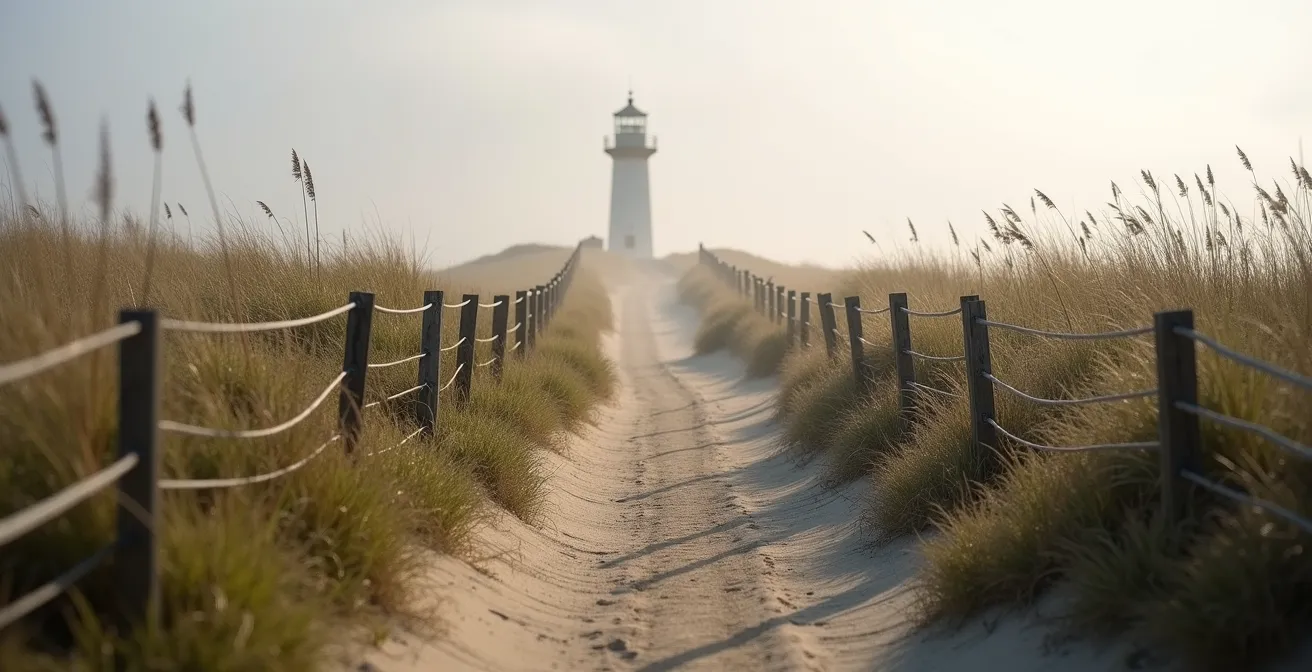
As you can see, the journey itself becomes the destination. The winding path invites you to slow down and observe, transforming a simple walk into a meditative experience. By the time you reach the westernmost tip overlooking the open lake, you’ll have found a level of isolation that feels miles away from the city.
Walking vs. Biking: Which Is Best for Exploring the Boardwalk?
Once on the Islands, you face a fundamental choice: explore on two feet or two wheels? Both are excellent, car-free options, but they offer vastly different experiences for someone seeking solitude. The best choice depends on your specific goal. Is it to cover ground and find a remote outpost, or is it to immerse yourself in the immediate environment? The entire 5 kilometers of interconnected trails can be walked in about an hour, but the experience changes dramatically with your mode of transport.
Walking is an act of mindful observation. It allows you to move slowly, to notice the small details: the texture of the boardwalk, the patterns of light through the trees, the subtle sounds of the island’s wildlife. It’s the superior choice for exploring the charming residential paths of Ward’s Island or the full length of the boardwalk, as your pace is perfectly aligned with the tranquil rhythm of the island. In peak season, staying on the quieter Ward’s Island section allows you to feel secluded even when Centre Island is bustling.
Biking, on the other hand, is a tool for achieving temporal solitude. It allows you to quickly escape the crowded areas near the ferry docks and reach the far ends of the island network, like the eastern tip of Ward’s Island or the western side of Hanlan’s. If you arrive on a busy afternoon, a bike can be your ticket to finding a quiet spot in minutes. The 20km of paved pathways are ideal for a ride after 6 p.m., when the day-trippers begin their exodus and a golden-hour calm descends upon the island.
The following table summarizes the strategic advantages of each approach to help you decide which better suits your quest for peace.
| Factor | Walking | Biking |
|---|---|---|
| Coverage | 5km takes 1 hour point-to-point | Can cover entire island network in 30 minutes |
| Best For Solitude | Ward’s Island residential paths and boardwalk | Quick escape to far ends away from ferry docks |
| Peak Time Strategy | Stay on Ward’s Island section (quieter) | Bike entire length after 6pm when crowds leave |
| Cost | Free | Free if bring own bike on ferry, rentals available Centre Island |
| Accessibility | All paths pedestrian-friendly | 20km of paved pathways throughout |
The Coyote Awareness You Need When Exploring Remote Island Paths
As you venture down the quieter paths and desire trails in search of solitude, you are entering a more natural, less-manicured ecosystem. One of the most beautiful signs that you’ve successfully left the crowds behind is the potential to encounter wildlife, including the island’s resident coyotes. Seeing a coyote should not be a cause for alarm, but rather a moment of mindful awareness—a reminder that you are a guest in a thriving natural environment.
The City of Toronto Parks Department emphasizes this perspective, viewing their presence as a positive indicator. As they state in their official guidelines, “Coyotes are a natural part of Toronto’s wildlife and their presence on the islands indicates a thriving environment.” This reframes the encounter from a threat to a connection with the wilder side of the city. To ensure these encounters remain peaceful for both you and the animals, it’s crucial to understand and respect the protocols for coexistence.
Running is the worst possible reaction, as it can trigger a chase instinct. Instead, the goal is to be calm, assertive, and large. Keep your dog on a leash at all times as per island regulations, and never, ever feed wildlife. This includes leaving food scraps behind at picnic areas, as it habituates them to humans and can lead to negative interactions down the line. Reporting any unusually bold or aggressive behavior helps the city manage the wildlife population responsibly.
Your Action Plan: Peaceful Coexistence with Island Wildlife
- Project Presence: If you encounter a coyote, make yourself appear large by raising your arms or opening your jacket. Stand your ground.
- Maintain Contact: Keep eye contact with the animal and back away slowly and calmly. Never turn your back or run.
- Create Noise: Make assertive noise by clapping your hands firmly or yelling “Go away coyote!” in a strong, deep voice.
- Secure Pets and Food: Always keep dogs on a leash and never leave food or scraps unattended. Feeding wildlife is the primary cause of conflict.
- Report Concerns: If a coyote acts aggressively or seems unafraid, report the encounter to City of Toronto Animal Services (311) with the time and location.
When to Visit the Islands for a Winter Walking Experience?
For the truest devotee of silence, the Toronto Islands in winter are an unparalleled sanctuary. When the summer crowds have vanished and a blanket of snow muffles the world, the island transforms into a place of profound quiet and stark beauty. This isn’t an accidental peace; it’s structurally enforced. As a winter guide notes, during winter months, ferry service is reduced to only one route—the one to Ward’s Island. This naturally limits the number of visitors, guaranteeing an almost private experience for those willing to brave the cold.
Walking the islands in winter is a unique sensory journey. The familiar landscape is rendered new by ice and snow. The boardwalks can be slick, so wearing ice cleats or microspikes is essential for a safe and confident stride. The wind off the frozen lake is biting, making layered clothing with a waterproof outer shell non-negotiable. With most facilities closed, preparation is key. Only three public washrooms remain open, so packing a thermos with a hot beverage is not just a comfort, it’s a necessity.
This is the time for cross-country skiing or snowshoeing across the vast, empty fields of Olympic Island, with no rental shops open, you must bring your own gear. It’s also the time to find warmth at the Island Riviera Café, a cozy outpost that remains open for the few who make the journey. A winter visit requires more planning, but the reward is a level of solitude and quiet that is simply impossible to find during any other season.

The visual starkness of the frozen landscape, with the distant city skyline hazy and remote, enhances the feeling of being in a world apart. The intricate frost on the boardwalk and the untouched snow create a pristine environment, perfect for a walking meditation where the crunch of your footsteps is the only sound.
How to Reach Polson Pier Without a Car for the Night View?
While the Islands offer daytime solitude, one of Toronto’s most iconic and peaceful night views is found looking back at the city from Polson Pier. Reaching this spot without a car is not a chore, but an opportunity for a “decompression zone”—a gradual transition from the city’s core to the water’s quiet edge. The journey itself becomes part of the calming experience, especially when you choose the right path.
The Martin Goodman Trail provides a scenic cycling or walking route along the waterfront. Starting from the bustling Harbourfront, you move eastward, and with each step, the sounds of downtown begin to fade, replaced by the gentle clinking of boat masts and the call of gulls. If you’re cycling, Bike Share Toronto stations along Queens Quay make it an easy and breezy 15-20 minute ride from Union Station. This approach allows you to physically and mentally distance yourself from the urban intensity before you even arrive at the pier.
Public transit is also a viable option, though it requires a short walk at the end. The key is to see this final leg not as an inconvenience but as the final stage of your transition into tranquility. Each option offers a different rhythm and timeframe for your urban pilgrimage to one of the city’s best spots for quiet contemplation of the skyline.
To help you plan your car-free journey, here are the most effective transit options to reach the peace of Polson Pier.
| Option | Route | Time | Best For |
|---|---|---|---|
| 72B Pape Bus | From Pape Station to Commissioners St | 25 min + 10 min walk | Direct public transit |
| Bike Share Toronto | From Union Station along Queens Quay | 15-20 minutes | Fastest option, scenic route |
| Walking | From Union via Harbourfront | 40-45 minutes | Gradual noise escape |
| Streetcar + Walk | 509/510 to Queens Quay then walk east | 30 minutes total | Partial transit option |
Why Cars Are Banned on King Street and How It Speeds You Up?
To fully appreciate the radical peace of the Toronto Islands, it helps to understand its philosophical counterpart on the mainland: the King Street Transit Priority Corridor. While not a nature retreat, the near-ban of cars on this critical downtown artery stems from the same urbanist principle: prioritizing people and flow over private vehicles. For a stressed urbanite, this project isn’t just about a faster streetcar ride; it’s a sign that the city is actively working to reduce the very congestion and noise you seek to escape.
The project, which began as a pilot and was made permanent, fundamentally changed the rhythm of one of Toronto’s busiest streets. By restricting through-traffic for cars, the streetcar was given precedence, transforming a slow, frustrating crawl into a model of transit efficiency. This philosophy directly benefits you, even when your goal is to get away from it all. A faster, more reliable trip through the core means less time spent in stressful traffic and more time available for your retreat to the Islands or other quiet city corners.
The success of this initiative provides a powerful context for the Islands’ car-free status, showing it’s not an isolated anomaly but part of a broader, successful vision for a more livable city. Mayor Olivia Chow recently reaffirmed this commitment, stating her willingness to ensure transit moves smoothly and people are not “stuck in traffic.”
Case Study: The King Street Pilot Success Story
The King Street Transit Priority Corridor is a powerful example of re-prioritizing urban space. According to a study on the project’s success, the corridor saw weekday ridership increase by 11% within six months of its pilot launch. Today, it serves 72,000 daily riders, with 85% of streetcars arriving within four minutes during the morning commute. It’s a tangible demonstration of how reducing car dominance can lead to a more efficient and less frustrating urban experience for everyone.
Key takeaways
- True solitude on the Islands is an active practice, not a passive discovery. It relies on timing, path selection, and a mindful approach.
- The car-free environment creates a unique “soundscape.” Tune into the sounds of nature, not just the absence of traffic, for deep mental decompression.
- Winter offers an unparalleled level of quiet due to limited ferry service and fewer visitors, rewarding those who prepare for the cold.
- Even mainland spots like Polson Pier and urban corridors like King Street reflect Toronto’s growing philosophy of prioritizing people over cars, enhancing the city’s overall livability.
Centre Island Day Trip: How to Maximize Fun for a Family of Four Under $100?
Sometimes, the quest for personal solitude must coexist with family obligations. A day trip to Centre Island with children can feel like the antithesis of a quiet retreat, but it doesn’t have to be. By applying the same principles of mindful navigation and strategic timing, you can carve out pockets of peace for yourself while still ensuring the family has a fantastic and affordable day.
The first step is managing the budget, which automatically guides you away from the most crowded and commercialized zones. A return ferry trip for a family of four is affordable, costing approximately $28. The real savings—and the first step toward tranquility—comes from packing your own picnic and bringing your own bikes. This simple act saves you from the pricey concessions and expensive rentals at Centreville, and frees you to find a quieter spot for your lunch. Arrive early to claim one of the free BBQ pits with your own charcoal for a memorable meal.
Instead of making the bustling Centreville amusement park your destination, frame the day as a nature adventure. Steer the family towards the quieter lawns of Olympic Island, which offer stunning city views and more space to run around than the main park. For swimming, guide them to the less-crowded Ward’s Island Beach. You can create a free nature scavenger hunt—spotting cormorants, monarch butterflies, and massive cottonwood trees—which engages the kids in the natural environment and subtly leads them along the less-traveled paths you secretly crave. Even the return journey can be a moment of shared calm if you time it for sunset, providing free and spectacular entertainment.
Your personal sanctuary is just a ferry ride away. By embracing these strategies, you can transform the Toronto Islands from a popular tourist spot into a reliable refuge for your mind. The next step is simple: check the ferry schedule, pick a day, and begin your own off-path journey to tranquility.