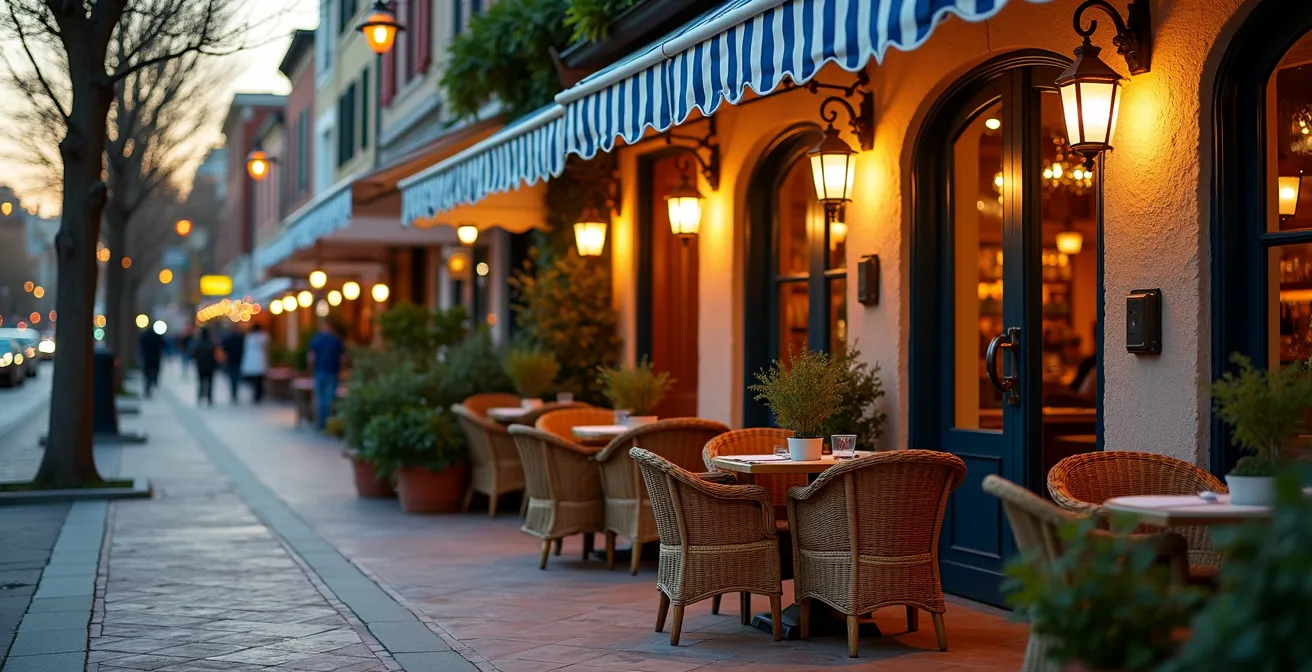
Finding authentic Greek culture on Toronto’s Danforth isn’t about locating the busiest souvlaki spot; it’s about learning to read the neighborhood’s subtle cultural cues.
- True authenticity is revealed in late-night dining rhythms, a tradition brought over from Greece.
- Locals know to look for specific menu clues—like whole fish specials and Greek olive oil on the table—to distinguish a real taverna from a tourist trap.
- The Danforth’s identity is a living blend, where understanding the Greek experience also means knowing when to pivot to the vibrant Ethiopian culture that shares its streets.
Recommendation: Use this guide not just to find a great meal, but to explore the Danforth with a culinary anthropologist’s eye, appreciating the deep layers of history and community that season every dish.
The moment you step out of Broadview or Pape station, the air on Danforth Avenue changes. It’s thick with the scent of charcoal, oregano, and sizzling meat—a siren song for anyone with an appetite. This is Greektown, Toronto’s vibrant Hellenic heart, a neighborhood that proudly announces its identity on bilingual street signs and blue-and-white lampposts. For many, the experience begins and ends with a satisfying plate of souvlaki or a gyro wrapped in warm pita. It’s a delicious, essential part of the story, but it’s only the first chapter.
The common advice is to simply wander and follow the crowds, especially during the massive Taste of the Danforth festival. But this approach often leads to the most visible, tourist-facing establishments, where the menu is predictable and the experience, while pleasant, can lack the deeper soul of the community. What if the key to unlocking authentic Greek culture wasn’t about finding the most popular restaurant, but about understanding the rhythms, rituals, and sensory clues that locals instinctively recognize? What if the real flavour of the Danforth is found in the details: the time of night you eat, the type of cheese in your salad, or even the language on the menu?
This guide is for the food lover who wants to go beyond the surface. We won’t just list restaurants; we’ll teach you how to see the Danforth as a culinary anthropologist would. We’ll explore the clues that separate a genuine taverna from a tourist trap, delve into the legendary rivalry between two iconic bakeries, and uncover the neighborhood’s layered history. We’ll even discuss when the most authentic move is to pivot and explore the vibrant Ethiopian community that has become an integral part of the Danforth’s modern identity. Prepare to experience Greektown not just as a destination, but as a living, breathing cultural landscape.
This article will guide you through the subtle signs and hidden stories that define the real Danforth. Below is a summary of the cultural deep dive that awaits, helping you navigate the neighborhood’s rich heritage with confidence and a hungry curiosity.
Summary: Dining on The Danforth: A Deeper Cultural Guide
- Why Taste of the Danforth Is Impossible to Navigate by Car?
- How to Find Full Meals After 2 AM on the Danforth?
- Athens Pastries vs. Serano Bakery: Who Has the Flakiest Baklava?
- The Menu Clue That Reveals a Tourist Trap vs. a Local Taverna
- When to Pivot to Ethiopian Food in East Danforth?
- Why Little Italy Moved Westward Over the Decades?
- Riverdale Park or Humber Bay: Which Offers the Best Skyline Panorama?
- Toronto’s Cultural History: How Immigration Waves Shaped Current Neighborhood Identities?
Why Taste of the Danforth Is Impossible to Navigate by Car?
The short answer is scale. The Krinos Taste of the Danforth isn’t just a local food fair; it’s a monumental event. As Canada’s largest street festival, it attracts over 1.6 million visitors over a single weekend in August. Imagine the entire population of Calgary descending on a few city blocks. Danforth Avenue, from Broadview to Donlands, transforms from a bustling thoroughfare into a pedestrian-only sea of humanity. To even think about bringing a car into this joyful chaos is to misunderstand the very nature of the festival. It’s an experience designed for walking, for spontaneous stops at vendor stalls, and for navigating shoulder-to-shoulder with fellow food lovers.
Driving is not only impractical due to road closures that extend for kilometres, but it’s also culturally missing the point. The true way to navigate the festival, and Greektown in general, is by using the city’s veins: the TTC. The Bloor-Danforth subway line runs directly beneath the action, with multiple stations acting as strategic entry points. Choosing your station is the first insider move. Arriving at Pape station deposits you into the absolute densest part of the crowd, an exhilarating but overwhelming plunge. For a more measured approach, exiting at Broadview on the west or Donlands on the east allows for a gradual immersion, letting you explore the festival’s edges before diving into its heart. This is how Torontonians do it—by treating the subway not just as transport, but as a tactical tool for a better experience.
Ultimately, leaving the car at home is an act of surrendering to the festival’s rhythm. It’s about embracing the flow of the crowd, the freedom of walking with a skewer of lamb in one hand and a loukoumades in the other, and the shared community feeling that can only happen when the streets belong to the people, not to vehicles. The impossibility of driving is, in fact, the event’s greatest feature.
How to Find Full Meals After 2 AM on the Danforth?
In most of Toronto, finding a full, sit-down meal after midnight is a challenge. But on the Danforth, the night is just getting started. This isn’t about greasy spoons or last-call slices; it’s about a deeply ingrained cultural practice known as “late-night dining rhythm.” In Greece, dinner often begins well after 10 p.m., an experience that blends food with vibrant social life. This tradition is alive and well in Greektown, where many tavernas don’t just stay open late—they come alive late. The key is to look for establishments that aren’t just serving food, but are fostering a social scene.
A prime example is Soulas Modern Greek Cuisine, which transforms on weekend evenings. While many restaurants are winding down, Soulas is just hitting its stride, serving full plates of charbroiled lamb and fresh seafood as live music fills the air. This is a crucial sensory clue: the sound of a live bouzouki or singers after 10 p.m. is a strong indicator of an authentic late-night experience, not just a kitchen that happens to still be open. It signals a place where dining is the main event, no matter the hour. Christina’s on the Danforth perfectly captures this spirit, inviting patrons to enjoy a complete cultural immersion.
Dine and dance to the beautiful sounds of a live Greek band (Friday and Saturday evenings)
– Christina’s on the Danforth, Christina’s Restaurant Official Website
So, the quest for a late meal isn’t about finding a 24-hour sign. It’s about seeking out the warm glow and lively music spilling from a taverna long after others have closed. It’s about shifting your internal clock to a Mediterranean rhythm, where a meal at 11 p.m. isn’t late; it’s right on time. Look for the places where families and groups of friends are just settling in for their main courses, and you’ll have found the heart of the Danforth’s nightlife.
Athens Pastries vs. Serano Bakery: Who Has the Flakiest Baklava?
The debate between Athens Pastries and Serano Bakery is more than a simple question of dessert; it’s a friendly but fierce neighbourhood rivalry that speaks to the heart of Greektown’s identity. Asking a local to choose between them is like asking them to pick a favourite child. Both are more than just bakeries; they are cultural anchors, beloved institutions that have stood firm against the pressures of rising rents and changing demographics. Their endurance is a testament to their commitment to traditional recipes and methods, a quality that has earned them unwavering loyalty.
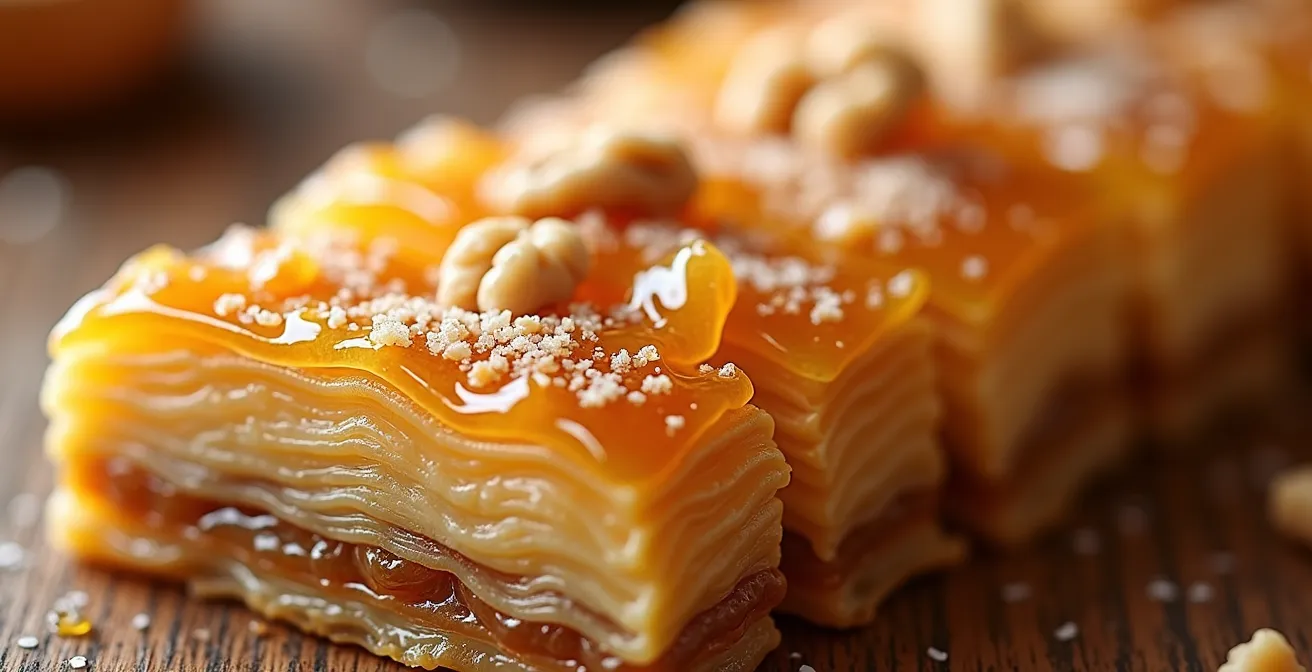
Athens Pastries, often lauded for its dizzying variety of sweets and savoury pies, is a whirlwind of activity. Their baklava is known for being utterly drenched in honey-lemon syrup, a sweet, dense, and powerfully flavourful experience. It’s a bold statement piece. Serano Bakery, just a few doors down, presents a slightly different philosophy. Their baklava often has a more pronounced nuttiness, with many finding the phyllo layers to be exceptionally crisp and flaky, holding their structure even under the weight of the syrup. The difference is subtle but significant—a matter of textural preference that divides households.
As one local vendor on the Danforth explained, the community’s fierce loyalty to these spots is about preservation. In a neighbourhood where many businesses have been forced out by high rents, Athens and Serano are cherished for their authenticity. They are living museums of flavour, connecting a new generation to the tastes of the old country. So, who has the flakiest baklava? The only real answer is to try both. Start at one, grab a piece, then walk to the other and do the same. It’s a delicious pilgrimage, and participating in the debate is the most authentic part of the experience.
The Menu Clue That Reveals a Tourist Trap vs. a Local Taverna
With one of the highest concentrations of restaurants per kilometre in the world, the Danforth presents a paradox of choice. Amidst the dozens of eateries, how do you distinguish a genuine, family-run taverna from a place designed to cater to undiscerning tourists? The secret isn’t in the decor or the size of the restaurant, but hidden in plain sight on the menu. A few key “sensory clues” on the page can tell you everything you need to know before you even order.
First, look at the fish selection. A tourist-focused spot will often have a single, generic “fried calamari” option. An authentic taverna, however, treats fish with the reverence it deserves. Look for daily specials listed by species, such as striped bass (lavraki), porgy (sinagrida), or red mullet (barbounia), often imported from Greece or Portugal. The preparation is another clue: authentic places will offer fish grilled whole with simple seasonings like ladolemono (lemon and oil), salt, and oregano, rather than hiding it under heavy batter. Second, check the language. A menu that uses the proper Greek terms—’Kalamarakia Tiganita’ or ‘Htapodi sti Skhara’—with English descriptions beneath shows respect for the cuisine’s origins. A menu with English-only, simplified descriptions may be a red flag.
Finally, observe the table itself. A bottle of high-quality Greek olive oil for liberal drizzling is a hallmark of a place that values authentic flavour. The absence of olive oil, or the presence of a generic vegetable oil blend, suggests a kitchen cutting corners. Similarly, a true horiatiki (village salad) will feature a solid block of feta on top, not the pre-crumbled, often drier version found in many North American Greek restaurants. These small details collectively paint a picture of a restaurant’s philosophy. The table below summarizes these key indicators.
| Menu Feature | Authentic Taverna | Tourist Trap |
|---|---|---|
| Fish Selection | Daily specials: striped bass, porgy, red mullet from Greece/Portugal | Generic ‘fried calamari’ only |
| Menu Language | Greek terms used: ‘Kalamarakia Tiganita’, ‘Htapodi sti Skhara’ | English descriptions only |
| Preparation Methods | Fish grilled whole with oregano and salt, 2-day marinated meats | Everything deep-fried or basic grilled |
| Table Setting | Quality Greek olive oil bottle present for liberal use | No olive oil or generic vegetable oil |
| Feta Presentation | Served as a solid block in horiatiki salad | Pre-crumbled feta |
When to Pivot to Ethiopian Food in East Danforth?
A true culinary exploration of the Danforth involves knowing not just where to find the best Greek food, but also recognizing where the Hellenic narrative gracefully gives way to another. As you walk east past Pape Avenue, the blue and white flags begin to mingle with the green, yellow, and red of Ethiopia. This is “Little Ethiopia,” a vibrant, five-minute stretch of the Danforth that represents a more recent, but equally significant, wave of immigration. The pivot from Greek to Ethiopian cuisine is a journey of just a few blocks, but it’s a profound shift in flavour, culture, and history.
The emergence of this community began in 2001 with the opening of Rendez-Vous, the first Ethiopian restaurant in the area. It was a pioneering move that transformed a relatively barren stretch of Danforth East into a new cultural hub. Establishments like Blue Nile and Wazema soon followed, creating a concentrated cluster of authentic dining experiences. As the Blue Nile restaurant proudly states on its website, it is an authentic Ethiopian restaurant located in the world’s famous city Toronto, cementing its place within the Danforth’s multicultural fabric. The pivot point is both geographic and sensory. You’ll know you’re there when the smell of grilling lamb is replaced by the complex, spicy aroma of berbere and the earthy scent of roasting coffee beans.

The “when” to pivot is a matter of curiosity. After you’ve had your fill of saganaki and baklava, a walk east offers a completely different, yet complementary, experience. It’s a chance to trade pita for injera, and ouzo for traditional Ethiopian honey wine (tej). What makes this cross-cultural dialogue so unique is the shared heritage between the two communities, particularly their Orthodox Christian faith, which leads to unique cross-cultural Easter festivities. To truly understand the modern Danforth is to appreciate this “neighborhood palimpsest,” where one culture doesn’t erase the other, but instead adds a rich new layer.
Why Little Italy Moved Westward Over the Decades?
To understand the resilience of Greektown, it’s insightful to look at the story of another of Toronto’s iconic ethnic enclaves: Little Italy. Over the decades, the heart of Italian culture on College Street has gradually shifted westward, its original core becoming more of a multicultural strip with a strong Italian flavour than a dense, residential community. While still a beloved neighbourhood, its demographic centre of gravity has migrated. Greektown, however, has largely resisted this same geographic diffusion. The question isn’t just why Little Italy moved, but why Greektown stayed put.
The answer lies in the establishment of powerful “cultural anchors.” Unlike Little Italy, the Danforth’s Greek community, with the support of the city, took concrete steps to formalize its identity. In 1993, the area was officially renamed “GreekTown on the Danforth” by the local Business Improvement Area (BIA). This wasn’t just a marketing slogan; it was a declaration. It was followed by the installation of bilingual street signs and the iconic blue-and-white decor that physically branded the neighbourhood. These visual cues serve as constant, public affirmations of Hellenic identity.
Furthermore, the annual Taste of the Danforth festival acts as a massive, recurring anchor, drawing millions of people and reinforcing the area’s reputation as the epicentre of Greek culture in North America. These institutional efforts created a powerful sense of place that has helped the community weather the pressures of gentrification and demographic shifts. While the neighbourhood is now more diverse—a 2021 census showed that Greeks still constitute a significant ethnic group at 4.5% of the ward’s population—the cultural identity remains firmly rooted, anchored by institutions that Little Italy, for various reasons, did not develop in the same way.
Riverdale Park or Humber Bay: Which Offers the Best Skyline Panorama?
While Humber Bay Arch Bridge offers a stunning, wide-angle view of the Toronto skyline from the west, for anyone on the Danforth, the answer is unequivocally Riverdale Park East. It’s not just a matter of convenience; it’s about context. The view from Riverdale Park isn’t just a picture of the city; it’s a view *from* the East End, with the Don Valley creating a lush, green foreground that separates the downtown core from the vibrant neighbourhoods on the other side. It’s the perfect overture to a Greektown evening, a moment of panoramic beauty before diving into the sensory delights of the Danforth.
The park’s main lookout point, at the crest of the hill, is famous for a reason. At sunset, the sky ignites behind the CN Tower, offering a postcard-perfect moment that feels both epic and intimate. This vista has become a cultural icon in its own right; it’s no surprise that, as noted by historians, several scenes in the quintessential Toronto-Greek film My Big Fat Greek Wedding were shot in the neighbourhood, cementing its connection to the Hellenic-Canadian identity. But for those seeking a slightly more secluded experience, a local secret is the Chester Hill Lookout, a smaller, more romantic perch just off the Prince Edward Viaduct, offering a similar view with a fraction of the crowds.
The best way to incorporate this view is to treat it as the first course of your Danforth meal. By following a simple walking route, you can seamlessly transition from natural beauty to culinary indulgence.
Your Pre-Dinner Skyline Viewing Plan: Riverdale Park East
- Start at the Riverdale Park East lookout, a brief 10-minute uphill walk from Broadview Station, to catch the main event.
- Capture your sunset photos of the downtown skyline from the famous hill’s crest, a quintessential Toronto moment.
- Descend via Broadview Avenue, a 7-minute walk that takes you directly towards the western entrance of Greektown.
- Enter the Danforth at its western edge, allowing for a gradual and pleasant immersion into the neighbourhood’s atmosphere.
- For a crowd-free alternative, seek out the Chester Hill Lookout off the Prince Edward Viaduct for a more intimate and romantic viewing spot.
Key Takeaways
- Authenticity on the Danforth is found in the details—whole fish, Greek on the menu, a block of feta—not just in the crowds or famous names.
- The Danforth’s culture is a living, layered story, where the deep-rooted Greek heritage now exists in a vibrant dialogue with the Ethiopian community to its east.
- A complete Greektown experience extends beyond the plate, incorporating the stunning city views from Riverdale Park and an appreciation for the neighbourhood’s unique history of immigration.
Toronto’s Cultural History: How Immigration Waves Shaped Current Neighborhood Identities?
The Danforth of today is a “neighbourhood palimpsest”—a place where layers of history are visible, with traces of past inhabitants showing through the present landscape. To walk its length is to walk through time, observing the story of Toronto’s immigration patterns written on the very buildings themselves. Before it was Greektown, this was a predominantly Anglo-Protestant area. The first major transformation came with the waves of Greek immigration, particularly in the post-war era of the 1950s and 60s. This influx was dramatic; Toronto’s Greek population grew from a modest 3,000 before WWII to a staggering 65,000 by 1976, with the Danforth as its undeniable heart.
This second wave didn’t just bring people; it brought a complete cultural overlay. The neighbourhood was physically transformed. Businesses put up new facades with Greek columns, signs appeared in a new alphabet, and the city itself eventually installed the blue and white lampposts that define the street today. These are not just decorations; they are physical artifacts of cultural transformation, a public declaration of a new identity that solidified the Danforth as North America’s largest Greektown. This deep-rooted identity, built over decades, is the foundation upon which everything else now rests.
The most recent layer in this palimpsest is the arrival of the Ethiopian and Eritrean communities, starting around 2001. This third wave has created Little Ethiopia on the eastern stretch, adding another rich dimension to the neighbourhood’s identity. As of 2021, while the Greek identity remains strong, the area is home to a diverse population, including a significant number of residents who identify as Black, many from these East African communities. Understanding this three-act story—from Anglo Toronto to Greektown to a multicultural hub with a Hellenic heart—is the key to truly appreciating the Danforth. It allows you to see the neighbourhood not as a static theme park, but as a living document of Toronto’s ongoing history of immigration and cultural dialogue.
Now, armed with an anthropologist’s eye for cultural cues and historical layers, you are ready to explore. Go beyond the main strip, look for the subtle signs of authenticity, and savour the rich, complex flavour of the real Danforth.