The key to navigating Toronto isn’t just knowing the transit options, but mastering the “Transit Decision Matrix” to choose the right mode based on cost, time, and context.
- A PRESTO card becomes cheaper than cash or credit taps after just a few days due to fare capping and offers exclusive discounts.
- The subway is almost always faster than an Uber during rush hour, while the GO Train offers significant savings over driving from the suburbs.
Recommendation: Before choosing where to live, use Google Maps’ “arrive by” feature for a weekday morning to test the real commute time, not just the distance to downtown.
Welcome to Toronto. You’ve likely noticed that getting around this sprawling city is more complex than it first appears. It’s a confusing landscape of red TTC rockets, green and white GO trains, and a sea of Ubers, all with different rules and costs. Many newcomers fall into the trap of either over-relying on expensive rideshares or sticking to a single transit method, failing to see the interconnected system that locals have learned to leverage.
The standard advice is often too simple: “buy a PRESTO card” or “the subway is fast.” But this ignores the critical questions. When does that PRESTO card actually start saving you money? Is the subway really faster than an Uber from Etobicoke during rush hour? And how do you travel to a suburb like Mississauga without paying two separate fares? The real challenge isn’t knowing that the TTC, GO Transit, and UP Express exist; it’s understanding their boundaries, fare structures, and reliability quirks.
This guide moves beyond a simple list of options. It provides you with the “Transit Decision Matrix”—a mental framework to make the smartest, most cost-effective choice for every trip. We’ll break down the hidden economics of fare capping, the strategic use of transfer windows, and the time-value calculation of choosing a subway over a car. By understanding *why* a local makes a certain choice, you’ll stop feeling like a confused visitor and start navigating the city with confidence.
This article will provide you with a comprehensive framework for making intelligent transit decisions in Toronto. We’ll explore everything from the financial benefits of the PRESTO and GO systems to the practical realities of rush hour travel and late-night safety, ensuring you’re equipped with the knowledge to navigate the city efficiently.
Summary: A Newcomer’s Guide to Toronto Transit: Navigating TTC, Uber, and GO Like a Local
- Why Buying a PRESTO Card Saves You Money After 4 Days?
- How to Travel Between Toronto and Suburbs Without Double Fares?
- Subway or Uber: Which Is Faster During Rush Hour?
- The Late Night Transit Route You Should Avoid Solo
- When to Use the 2-Hour Transfer Window for a Free Return Trip?
- Why Taking the GO Train Can Save You $300 CAD Monthly Compared to Driving?
- Why “Near Downtown” Listings in Etobicoke Are Misleading?
- Mastering the TTC: How to Navigate the “Red Rocket” Network Like a Local?
Why Buying a PRESTO Card Saves You Money After 4 Days?
For any newcomer, the first transit question is usually about payment. While you can tap a credit or debit card for a single ride, the PRESTO card is the key to unlocking significant savings, but only if you understand its economic tipping point. The card itself costs $6, an initial investment that can feel unnecessary. However, its value lies in the weekly fare-capping system and exclusive discounts. After 11 paid TTC rides in a single week (Monday to Sunday), every subsequent ride for the rest of that week is free. This means if you use transit twice a day, you start riding for free by Friday morning.
This “fare arbitrage” is where the card’s power lies. A tourist visiting for a long weekend or a resident commuting daily will quickly surpass the break-even point. Beyond the fare cap, the card offers other financial incentives. For instance, an often-overlooked benefit is that PRESTO cardholders save up to 20% discount at major attractions like the Royal Ontario Museum and the Toronto Zoo. This transforms the card from a simple payment tool into a city-wide discount pass.
The system is designed to reward frequent users. While a short-term visitor might be fine with contactless payment, anyone staying more than four days or planning to explore the city extensively will find the PRESTO card to be the most cost-effective option. Setting up autoload via the PRESTO app further simplifies the process, ensuring you’re always ready to tap and go without worrying about reloading funds at a station.
Ultimately, the $6 fee is not just for a piece of plastic; it’s an entry fee to a system of optimized travel and ancillary benefits that quickly pays for itself.
How to Travel Between Toronto and Suburbs Without Double Fares?
One of the biggest sources of confusion and unexpected costs for newcomers is traveling between Toronto (the 416 area code) and the surrounding suburbs in the 905 region (like Mississauga, Vaughan, or Brampton). Historically, this meant paying a “double fare”: one for the suburban transit system (like MiWay or YRT) and another for the TTC upon crossing the municipal boundary. This penalty made cross-boundary commutes prohibitively expensive. However, a recent and crucial change has completely altered this dynamic.
As of early 2024, the government implemented the One Fare Program, a game-changer for regional commuters. When you use a PRESTO card or a credit/debit card to pay your fare, transfers between the TTC and participating regional transit agencies are now free for a two-hour window. This means a commuter from Brampton can take a Brampton Transit bus to a TTC subway station, tap onto the subway, and pay only one fare for the entire journey. This initiative effectively erases the financial border between Toronto and its suburbs, making regional travel far more affordable and seamless.
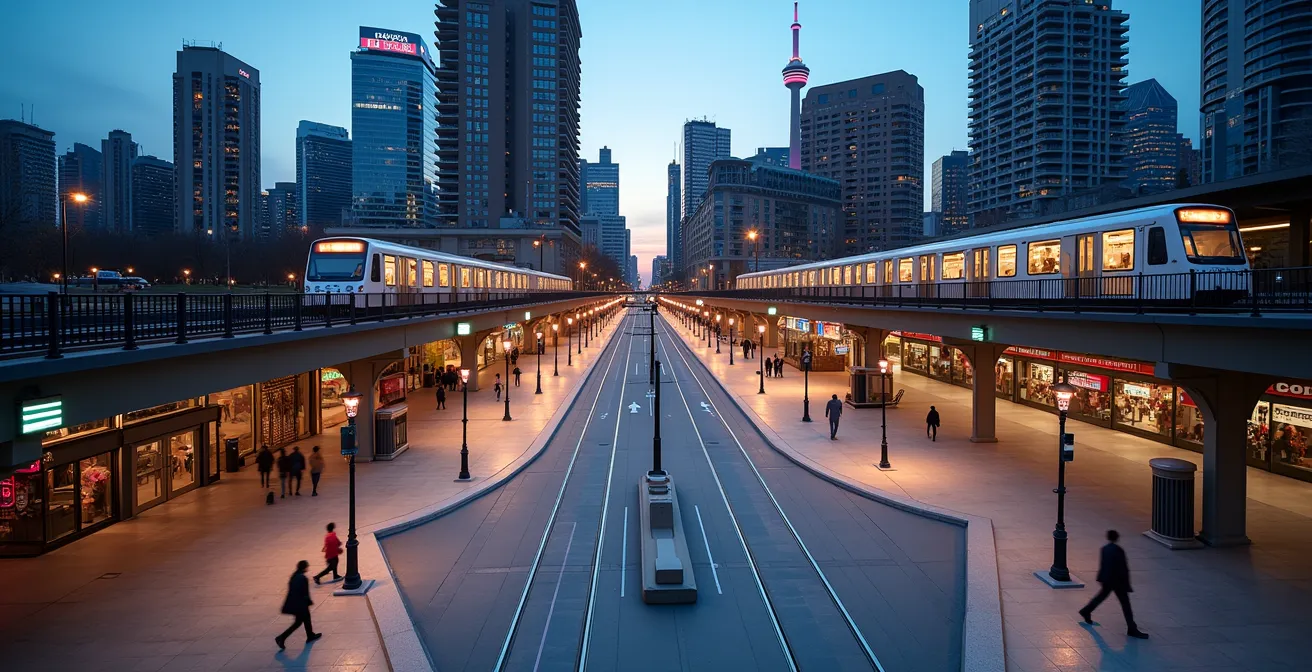
This integration is most powerful when combining GO Transit with the TTC. Under the One Fare Program, your TTC portion of the trip is now free when connecting to or from a GO train or bus. As the table below illustrates, this not only eliminates the double fare but often provides a much faster and more direct route into the downtown core compared to relying solely on the TTC from the outer edges of the city. A trip from Vaughan, for example, becomes significantly quicker by leveraging the GO network.
The introduction of the One Fare Program is a prime example of why staying updated on local transit policies is key. According to information on the program’s implementation, this change removes a long-standing financial barrier for thousands of daily commuters.
| Route | TTC Only (Approx. Time & Cost) | GO+TTC Co-Fare (Approx. Time & Cost) | Benefit |
|---|---|---|---|
| Vaughan to Union | $3.35 (60 min) | GO fare only (35 min) | 25 minutes saved |
| Mississauga to Downtown | Not a direct TTC route | GO fare + $0 TTC fare | Direct, faster route |
| Scarborough to Financial District | $3.35 (45 min) | GO fare + $0 TTC fare | 15 minutes saved |
For any newcomer living in a 905 suburb or considering it, using a PRESTO or credit card is no longer just a convenience—it’s a financial necessity to avoid paying unnecessary fares.
Subway or Uber: Which Is Faster During Rush Hour?
The “Subway vs. Uber” debate is a classic Toronto dilemma, but the answer is heavily dictated by one factor: the time of day. During off-peak hours, an Uber or other rideshare service can offer a direct, comfortable, and relatively quick journey. However, during the city’s notorious rush hours—typically 7 AM to 9 AM and 4 PM to 6 PM—the equation changes dramatically. Toronto’s traffic congestion is not a minor inconvenience; it’s a major disruptor that can easily double or triple travel times on key arteries like the Gardiner Expressway, the Don Valley Parkway, and major streets like Yonge or Bloor.
In this context, the TTC subway becomes the undisputed champion of speed and reliability. While an Uber is stuck in gridlock, the subway travels unimpeded in its dedicated tunnels. A car trip from a midtown neighbourhood like Eglinton to the Financial District could take 45 minutes or more in rush hour traffic, while the same journey on Line 1 of the subway is a consistent 20 minutes. This isn’t just a marginal difference; it’s the difference between arriving on time and being significantly late. The subway’s consistency is its greatest asset when the roads are unpredictable.
The sheer volume of people who rely on this principle is staggering. On an average weekday, the TTC subway system carries approximately 1,079,700 passengers, a huge number of whom are making the strategic choice to avoid the traffic chaos above ground. The “time-value calculation” is simple: the extra cost of an Uber is not justified if it results in a longer and more stressful commute. While the subway can be crowded, it remains the most efficient way to move north-south or east-west across the city’s core during peak periods.
The rule of thumb for any newcomer is clear: if you are traveling during rush hour to, from, or within the downtown core, choose the subway. Save ridesharing for late-night trips, cross-town journeys not well-served by the subway lines, or for when you’re carrying heavy items.
The Late Night Transit Route You Should Avoid Solo
Toronto’s transit system operates 24/7, a feature that provides incredible mobility but also requires situational awareness, especially late at night. After the subway system closes around 1:30 AM, the TTC Blue Night Network takes over. This network of buses and streetcars runs on major routes, ensuring you can always get a ride home. However, the experience on a Blue Night bus is very different from a daytime commute. Service runs every 30 minutes or less, which can mean long, lonely waits at bus stops in the early hours of the morning.
While the network as a whole is a vital service, certain routes pass through industrial or low-density residential areas where stops are isolated and passenger numbers are few. This can create situations that feel unsafe, particularly for someone traveling alone. While no single route is officially “off-limits,” routes that traverse long stretches without much activity require extra vigilance. The key isn’t to avoid the Blue Night Network entirely, but to be strategic about how you use it.
The TTC offers several features to enhance safety during these hours. The most important is the Request Stop program. Between 9 PM and 5 AM, any woman or person feeling vulnerable can ask the bus driver to let them off between regular stops, closer to their destination. This simple but effective policy can significantly reduce the amount of time spent walking alone at night. Additionally, it’s wise to plan your transfers at major, well-lit hubs like Bloor-Yonge or Eglinton Station, even if it means a slightly longer route, rather than at a quieter, less-frequented stop.
Your Action Plan for Safe Late-Night Travel
- Use the Request Stop program between 9 PM and 5 AM to be dropped off closer to your destination.
- Plan your trip to transfer at major, well-lit stations like Bloor-Yonge or St. George instead of quieter ones.
- Be aware of your surroundings and know the location of priority seating areas and the yellow emergency alarm strips.
- Consider using a rideshare app as an alternative if your journey involves traveling through or waiting in isolated areas.
- Share your live trip details with a friend or family member using safety features available in many transit and rideshare apps.
Ultimately, your comfort and safety are paramount. If a particular route feels unsettling, the cost of a rideshare may be a worthwhile investment for peace of mind.
When to Use the 2-Hour Transfer Window for a Free Return Trip?
One of the most underutilized but powerful features of the TTC is the two-hour transfer window. When you pay your fare, you are not just buying a single ride; you are purchasing unlimited travel on the TTC network—in any direction—for the next two hours. A single TTC fare, which costs around $3.35 for 2 hours unlimited transfers, essentially becomes a short-term pass. This opens up a world of “fare arbitrage” for savvy commuters who plan their errands strategically.
The most common application of this rule is for a “free” return trip. If you need to run a quick errand that will take less than two hours from start to finish, you only need to pay one fare. The system is designed for this kind of “trip-chaining.” For example, a resident at Pape Station can take the subway one stop to Chester, do a 45-minute grocery shop at the Foodland on the Danforth, and then take the subway back home, all on a single fare. The PRESTO system automatically tracks the transfer period from your first tap, making the process seamless.
This strategy is perfect for a wide range of short trips: picking up takeout, dropping off a package at the post office, or a quick visit to a friend living nearby. The key is to be mindful of the clock. Your last tap onto a vehicle must be made before the two-hour window expires. It doesn’t matter if the trip itself finishes after the window closes. This feature transforms the way you should think about your fare. Instead of “one ride,” think of it as “a 120-minute travel bubble.”
Before you automatically pay for two separate trips for a short journey, always do a quick mental calculation. If you can complete your round trip within two hours, you can effectively cut your transit cost for that errand in half.
Why Taking the GO Train Can Save You $300 CAD Monthly Compared to Driving?
For newcomers planning to live in the suburbs and commute to downtown Toronto, the choice between driving and public transit has massive financial implications. While the convenience of a personal vehicle is appealing, the true cost of driving into the city center is often drastically underestimated. When you factor in not just gas but also sky-high downtown parking rates, increased insurance premiums, and vehicle maintenance, the monthly expense can easily exceed $800. Parking alone can cost over $400 a month in the Financial District.
This is where the GO Transit network presents a compelling and financially superior alternative. GO trains and buses are designed for regional commuting, offering a direct, reliable, and comfortable link between the suburbs and Union Station in the heart of downtown. A monthly GO Transit pass, while seemingly expensive upfront, consolidates all your commuting costs into a single, predictable payment. As the mobility experts at Prepare for Canada note in their guide, traffic makes driving difficult, and public transit is a cost-effective alternative.
Traffic congestion can make it difficult to travel by car. If you plan to live in Toronto, public transit is a fast and cost-effective way to get around.
– Prepare for Canada, Public Transit in Toronto Guide
The savings are not theoretical; they are substantial. As an analysis of monthly commuting costs demonstrates, the financial argument is overwhelmingly in favor of GO Transit. The comparison below shows that even after accounting for the GO pass, the savings are significant.
| Expense Category | Driving to Downtown | GO Monthly Pass (e.g., Oakville-Union) |
|---|---|---|
| Monthly Pass/Gas | $200+ | $327 |
| Parking | $400+ | $0 |
| Insurance Premium | $150 | $0 |
| Maintenance | $50 | $0 |
| Total Monthly Cost | $800+ | $327 |
| Monthly Savings | – | $473+ |
Beyond the direct financial savings, taking the GO train also allows you to reclaim your commute time. Instead of battling stress-inducing traffic, you can read, work, or relax, arriving downtown more refreshed and with significantly more money in your pocket each month.
Why “Near Downtown” Listings in Etobicoke Are Misleading?
When searching for a place to live, newcomers are often lured by rental listings in neighborhoods like Etobicoke or Scarborough that are advertised as being “near downtown” or a “short drive to the city.” Geographically, these statements might seem plausible on a map. However, in the context of a daily commute, they are deeply misleading. The single most important factor for accessibility in Toronto is not the physical distance to the CN Tower, but the proximity to a subway station on a main line.
The transit reality of Toronto is that accessibility varies dramatically from one block to the next. An apartment in the High Park neighborhood, for instance, offers a quick 15-minute subway ride to the downtown core via Line 2. In contrast, a condo in parts of Etobicoke, while appearing similarly distant on a map, might require a 20-minute bus ride just to reach the subway, followed by a 45-minute subway journey, turning the total commute into well over an hour. This “geographic reality-check” is a crucial piece of local knowledge that can save you from signing a lease for a location with a grueling daily commute.
Relying on driving distance is equally flawed due to the rush hour traffic we’ve discussed. That “20-minute drive” advertised can easily become a 60-minute crawl. The subway system, particularly Line 1 (Yonge-University) and Line 2 (Bloor-Danforth), forms the true backbone of the city’s mobility. Living within a 10-minute walk of a station on one of these lines is the gold standard for an efficient commute. Anything requiring a bus transfer to get to the subway will add significant and often unpredictable time to your journey, especially in winter when buses face delays due to weather.
Your 5-Point Checklist to Verify True Transit Times
- Check the exact walking distance from the property to the nearest subway station, not just the distance to a landmark.
- Use Google Maps Transit directions and set the “Arrive by” time to Monday at 8:30 AM for a realistic rush-hour commute estimate.
- Verify if the journey requires a bus connection to reach the subway, as this adds a significant variable.
- Research which subway line serves the area; direct access on Line 1 or 2 is far more convenient than lines requiring multiple transfers to get downtown.
- Consider the total “door-to-door” time, including walking, waiting for buses, and transfers, not just the in-vehicle time.
Before you commit to a lease, always perform your due diligence on the commute. What looks good on a map may be a daily transit nightmare in reality.
Key Takeaways
- Master Fare Arbitrage: Use the 2-hour transfer for free return trips and leverage the weekly PRESTO fare cap to get free rides after your 11th trip.
- Perform a Time-Value Calculation: During rush hour, the subway’s reliability almost always outweighs the perceived comfort of an Uber, saving you significant time.
- Conduct a Geographic Reality-Check: Prioritize proximity to a Line 1 or 2 subway station over geographic distance to downtown when choosing a place to live.
Mastering the TTC: How to Navigate the “Red Rocket” Network Like a Local?
Moving beyond the high-level strategic choices, mastering daily navigation of the TTC network involves a few key pieces of local knowledge. The first step is to arm yourself with the right digital tools. While Google Maps is good for planning, real-time tracking apps like Transit or Rocketman are essential. They show you exactly where your bus or streetcar is, helping you decide whether to wait or start walking. This is crucial in winter when vehicles can be delayed or “bunching” (several arriving at once after a long gap).
Next is understanding the subway’s directional language. Locals don’t just say “take the subway”; they know the line number and the final destination that indicates direction. For example, on Line 1 (the yellow U-shaped line), a northbound train will say “Vaughan” or “Finch” on the front, depending on which branch it’s on. Knowing your final destination’s direction is fundamental to getting on the right train, especially at interchange stations like Bloor-Yonge or St. George.
Finally, embrace the city’s “secret” network: the PATH. This is a massive underground walkway system that connects many of downtown’s office towers, shopping centers, and subway stations. The official Toronto’s PATH underground walkway spans over 30 kilometers, allowing you to walk from Union Station to King, St. Andrew, and even as far as the Eaton Centre without ever stepping outside. On a freezing winter day or during a summer downpour, the PATH is not just a convenience; it’s a critical piece of transit infrastructure that locals use to navigate the downtown core in comfort.
By combining real-time apps, understanding the system’s directional logic, and leveraging the PATH, you transition from someone who simply uses the TTC to someone who navigates it with the efficiency and confidence of a seasoned Torontonian.