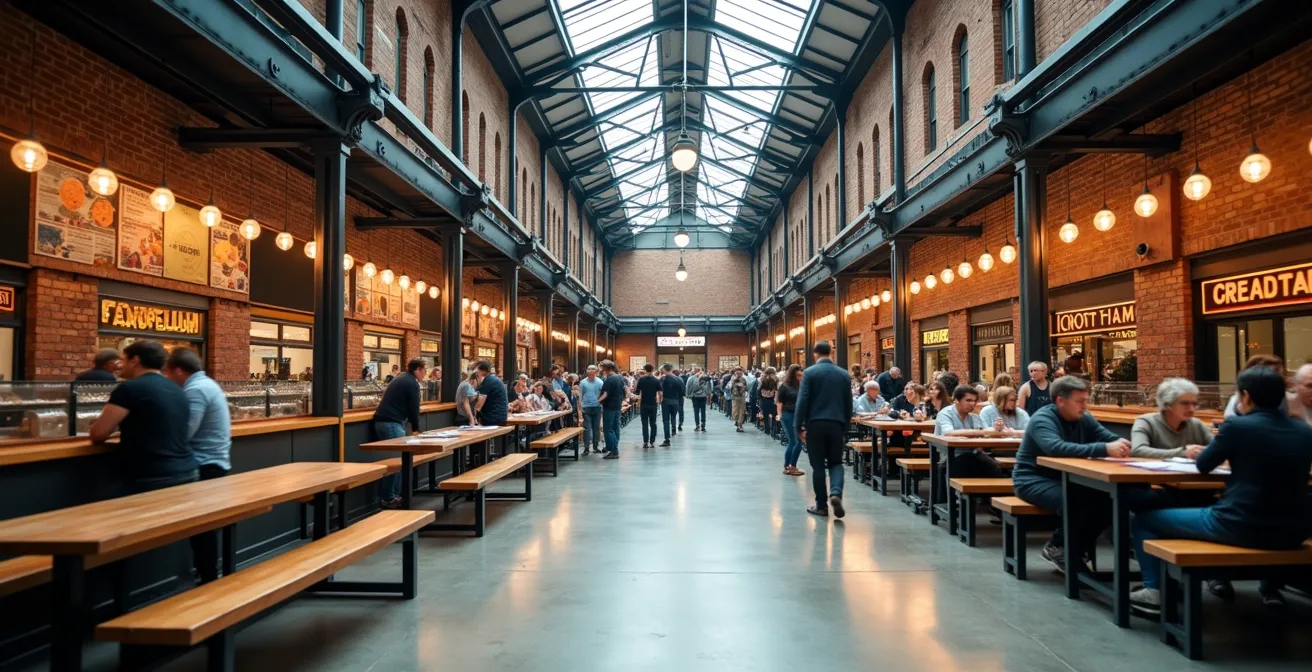
Toronto’s food halls offer incredible variety, but their chaotic nature often leads to decision fatigue and budget overruns for groups.
- The key is to treat them as “culinary ecosystems” that require a logistical plan, not just a destination.
- Success hinges on pre-visit strategy for seating, ordering, and sharing to maximize both taste and value.
Recommendation: Adopt the “Food Hall Draft” strategy—where each person in your group is responsible for acquiring one dish from a different vendor—to systematically explore multiple cuisines in a single visit.
Trying to get a group of colleagues or friends to agree on a lunch spot in downtown Toronto can feel like a diplomatic mission destined to fail. Someone wants tacos, another craves pasta, and a third is just looking for a good salad. The modern food hall, with its dazzling array of high-end vendors under one roof, presents itself as the perfect solution. This is no longer the era of greasy spoons in a drab food court; these are vibrant, architecturally stunning spaces serving restaurant-quality dishes.
But this solution creates a new set of challenges, or “friction points.” The sheer number of choices can be paralyzing. Navigating the lunchtime crowds to find a table for four feels like a competitive sport. And the “market price” reality means that a casual lunch can quickly become an expensive affair. While most guides simply list Toronto’s top food halls, they fail to address the fundamental question: how do you actually *conquer* them?
This is not a directory; it’s a logistical playbook. Forget aimless wandering. The secret to a successful food hall experience lies in strategy. We’ll move beyond the ‘what’ and dive deep into the ‘how’. This guide will equip you with a food hunter’s mindset, providing actionable tactics to secure a table during the busiest rush, manage your budget without sacrificing flavour, and devise a sharing system that allows your group to sample the world in a single hour.
To fully master Toronto’s new dining landscape, you need a plan. This article breaks down the essential strategies, from understanding the forces driving this trend to executing a flawless visit at iconic locations like St. Lawrence Market. Let’s explore the blueprint for your next culinary expedition.
Summary: A Strategic Guide to Toronto’s Food Hall Scene
- Why Food Halls Are Replacing Traditional Food Courts in Condos?
- How to Secure a Table at Chef’s Hall During Lunch Rush?
- Waterworks vs. The Well: Which Food Hall Has Better Gastronomy?
- The “Market Price” Trap That Makes Food Hall Lunches Expensive
- How to Find Gluten-Free Options in a Shared Kitchen Environment?
- How to Share Portions to Try 5 Different Countries’ Food?
- How to Find the Best Cheap Lunch in the Financial District Tunnels?
- St. Lawrence Market: How to Find the Best Peameal Bacon Sandwich on a Saturday?
Why Food Halls Are Replacing Traditional Food Courts in Condos?
The explosion of high-end food halls across Toronto isn’t a random culinary trend; it’s a direct response to the city’s shifting real estate landscape. The traditional, fluorescent-lit food court is being replaced by sophisticated “culinary ecosystems” because they serve a crucial role in modern urban development. In a city where there are now over 9,951 condominiums available for sale, developers need more than just a gym to attract buyers. Food halls have become powerful “amenity anchors.”
For developers, integrating a vibrant food hall into a mixed-use project justifies premium condo prices and creates a built-in community hub. It transforms a residential building into a destination, offering residents a dynamic social space right at their doorstep. This strategy is a win-win. It provides a lifestyle amenity for residents and a constant stream of customers for the vendors.
For chefs and aspiring restaurateurs, food halls offer a lifeline in Toronto’s notoriously expensive commercial real estate market. Opening a standalone restaurant can be a multi-million dollar gamble. In contrast, a food hall stall presents a lower barrier to entry and reduced financial risk. This model allows for culinary experimentation and gives diverse, independent chefs a platform to showcase their talent without the crushing overhead of a full-scale operation. This diversity, in turn, appeals directly to the multicultural demographics of young professionals who populate these new high-density developments, creating a self-sustaining cycle of supply and demand.
How to Secure a Table at Chef’s Hall During Lunch Rush?
Chef’s Hall, located in the heart of the Financial District, is the epicentre of the corporate lunch rush. Between 12:00 PM and 1:00 PM, the space transforms into a sea of suits, and finding a single empty seat, let alone a table for your group, seems impossible. However, with a logistical approach, you can navigate the chaos. The key is to think like a local and move against the primary flow of traffic.
The most effective method is the “Scout & Occupy” strategy. Before anyone orders food, designate one person from your group as the “scout.” Their sole mission is to secure a table. The best hunting grounds are often near the side or back entrances, away from the main vendor thoroughfare. While the scout claims your group’s territory, the rest of the team can divide and conquer the food queues. This simple division of labour eliminates the stressful juggling act of balancing food trays while searching for a place to sit.
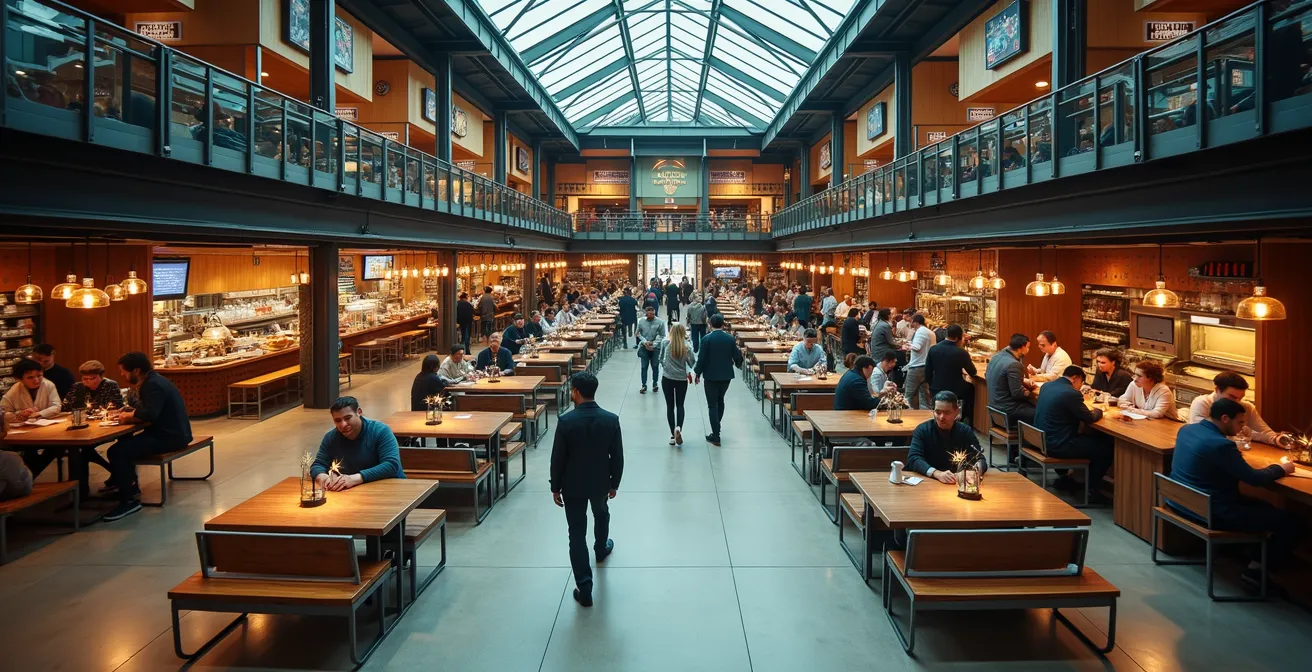
Timing is also critical. The Bay Street rhythm is predictable. To beat the wave, apply the “Bay Street Rhythm Hack”: arrive at 11:40 AM, just before the corporate floodgates open, or wait until after 1:20 PM, when the majority of office workers are heading back to their desks. For a more data-driven approach, use the ‘Popular Times’ feature on Google Maps to monitor real-time crowd levels before you even leave the office. If your schedule is flexible, visiting after 2 PM offers the double advantage of smaller crowds and access to happy hour deals, like the Bar Bites menu at Chef’s Hall, which features items under $10.
Waterworks vs. The Well: Which Food Hall Has Better Gastronomy?
Two of Toronto’s most talked-about destinations, Waterworks and Wellington Market at The Well, represent two different philosophies of the modern food hall. Choosing between them depends entirely on the experience your group is seeking. Waterworks offers curated, European-inspired charm within a historic setting, while The Well provides a high-energy, sprawling market with a vast array of choices. It’s not a question of which is “better,” but which is right for the occasion.
Case Study: Heritage vs. Modern Development
Waterworks Food Hall exemplifies heritage preservation, brilliantly converting a 1930s public utility building into a culinary destination. It retains stunning historic elements like 44-foot ceilings, massive skylights, and original Art Deco gates, creating an atmosphere of timeless elegance. In contrast, The Well’s Wellington Market is the heart of a brand-new, massive mixed-use complex. It represents the pinnacle of modern integration, combining dining, grocery shopping, retail, and entertainment into a single, high-energy urban hub.
The gastronomic focus of each hall reflects its architectural identity. Waterworks is your destination for artisanal quality and a relaxed atmosphere. Think fresh pasta from Piccolo Pasta, gourmet sandwiches, and a European-style daily happy hour. It’s the ideal choice for a more intimate gathering or a sophisticated Sunday brunch. The Well, with over 40 vendors, leans into diversity and high-volume energy. It excels in delivering a wide range of options, from suburban favourites to a strong showing of East Asian cuisines and trendy concepts, making it perfect for large, indecisive groups and lively Friday nights, complete with a market DJ series.
This side-by-side comparison highlights the key differences to help you make a strategic choice.
| Aspect | Waterworks Food Hall | The Well (Wellington Market) |
|---|---|---|
| Size & Scale | 55,000 sq ft heritage building | 70,000 sq ft modern development |
| Number of Vendors | 15+ artisanal food vendors | 40+ food outlets |
| Atmosphere | European-inspired, heritage charm with 44-foot ceilings | Contemporary, high-energy with pet-friendly policy |
| Cuisine Strengths | European fare, artisan sandwiches, fresh pasta | Diverse East Asian options, suburban favorites |
| Unique Features | Historic 1930s building, art deco elements, daily happy hour | Friday night market DJ series, integrated grocery shopping |
| Best For | Relaxed Sunday brunch, intimate gatherings | High-energy Friday nights, large group dining |
The “Market Price” Trap That Makes Food Hall Lunches Expensive
The greatest illusion of the modern food hall is that it offers “street food” prices. The reality is that the high-quality ingredients, chef-driven concepts, and prime real estate costs are passed on to the consumer. These venues are not food courts; they are collections of mini-restaurants, and the pricing reflects that. It’s common for the experience to transform a $10-$15 food court lunch into a $20-$25 culinary experience, especially once a craft beverage is added. This is the “Market Price Trap,” where the casual atmosphere masks restaurant-level costs.
However, being aware of this trap is the first step to avoiding it. Achieving good value density—maximizing the quality and quantity of your experience for the dollars spent—is possible with a few simple strategies. First, always scan for lunch specials, which are often available between 11 AM and 12 PM as vendors try to attract the early crowd. Second, leverage the happy hour. Places like Chef’s Hall offer “Bar Bites” for under $10 after 2 PM, providing a more budget-conscious way to sample their offerings.
The type of food you choose also matters. Vendors serving naturally larger portions, such as noodle or rice bowls, often provide a more filling meal for the price compared to smaller à la carte items like individual tacos or sliders. A simple but effective tactic is to avoid the beverage trap. Most food halls have water stations, so bringing your own reusable water bottle can save you $3-$5 instantly. Finally, for groups, the best value strategy is to share multiple dishes “family-style.” This not only controls costs but also allows everyone to sample a wider variety of cuisines, which is the primary appeal of a food hall in the first place.
How to Find Gluten-Free Options in a Shared Kitchen Environment?
For diners with celiac disease or severe gluten sensitivities, a food hall presents a unique challenge. While the variety is appealing, the shared kitchen environment creates a high risk of cross-contamination. A vendor might offer a “gluten-free” dish, but if they are using the same surfaces, utensils, or deep fryer as gluten-containing items, it’s not truly safe. Navigating this requires clear communication and asking the right questions.
Before ordering, approach the vendor and inquire directly about their process. Don’t just ask, “Is this gluten-free?” Instead, ask specific, operational questions. A cook who understands cross-contamination will be able to answer confidently. When you place your order, politely request that the person preparing your meal uses fresh gloves, clean utensils, and a sanitized preparation surface. This isn’t being difficult; it’s being safe, and reputable vendors will understand and accommodate.
Another strategy is to target cuisines that are naturally low in gluten. Many Vietnamese dishes like pho (with 100% rice noodles) or Mexican stalls focusing on corn-based tortillas can be safer bets than a pizza or sandwich vendor. For community-vetted recommendations, online resources like the “Gluten Free Toronto” Facebook group can be invaluable, offering firsthand accounts of safe and unsafe vendor experiences in specific food halls.
Your Gluten-Free Safety Checklist
- Dedicated Equipment: Ask the vendor directly: ‘Do you use a dedicated fryer and separate cooking surfaces for gluten-free items?’
- Preparation Process: Inquire about their protocol: ‘Can you describe your process for preventing cross-contact with gluten during preparation?’
- Fresh Utensils: When ordering, make a clear request: ‘Could you please use clean utensils and a fresh pair of gloves for my order?’
- Naturally GF Cuisines: Prioritize vendors specializing in cuisines that are inherently gluten-free, such as those centered on rice noodles, corn masa, or grilled meats and vegetables.
- Community Intel: Before you go, check local resources like the ‘Gluten Free Toronto’ Facebook group for recent reviews and vetted vendor recommendations.
How to Share Portions to Try 5 Different Countries’ Food?
The ultimate promise of a food hall is culinary tourism—the ability to travel the world on your lunch break. For a group, the best way to leverage this is through a strategic sharing system. The goal is to maximize variety without over-ordering or creating logistical chaos. The most effective method is what we can call the “Food Hall Draft.”
The draft works in two phases. First, the “Recon Lap.” Your group does a full walkthrough of the entire food hall without buying anything. Everyone identifies potential dishes they’re interested in. This prevents impulsive first-stall purchases. Phase two is “The Draft.” Each person in the group “claims” one dish from a different vendor and is responsible for purchasing it. If you have four people, you get four different dishes from four different cuisines. The group then reconvenes at your secured table to share everything.
To execute this well, you need a “Shareability Score Guide.” Dishes like tacos, dumplings, empanadas, or slices of pizza are ideal for sharing. They are easily divisible and can be eaten with minimal mess. In contrast, large bowls of soup, elaborate plated dishes, or saucy pastas have a low shareability score and can create a logistical nightmare. For a seamless experience, you can plan a route. For example, an “Asian Express Route” could involve one person getting dumplings, another bao buns, and a third sushi rolls. A “Latin American Tour” could feature tacos, arepas, and churros. This targeted approach ensures a cohesive yet diverse tasting menu.
Case Study: The Wellington Market Ecosystem
With its 40+ vendors, Wellington Market at The Well is the perfect arena for the Food Hall Draft. The vendor mix is intentionally diverse, featuring everything from Gus Tacos and East Tea Can (Middle Eastern) to Samosarie and a wide range of Asian options. The fully licensed space also means you can pair a beer from the bar with your tacos and a cocktail with your sushi, creating a truly global experience in a single location.
How to Find the Best Cheap Lunch in the Financial District Tunnels?
While new, glamorous food halls dominate the headlines, Toronto’s original culinary ecosystem, the PATH, remains the undisputed king of the budget-friendly lunch. This sprawling underground network is a maze of corridors connecting office towers, but for those in the know, it hides some of the best cheap eats in the city. The secret is to venture beyond the main, brightly lit food courts and explore the quieter, less obvious offshoots.
Your best tool for discovery is to follow the office workers. At 11:45 AM, watch where the seasoned veterans head; they often lead to hidden gems tucked away in the basements of buildings like Commerce Court or the Richmond-Adelaide Centre. These smaller, often independent vendors rely on repeat business, not foot traffic, and their prices reflect that. For example, Ho Ga Korean at First Canadian Place is a cash-only takeout spot legendary for its generous, affordable meals that cost around $8.
The real jackpot for value hunters is often found in the older food courts. The HSBC Food Court at York & Wellington is a prime example, where you can still find $5-$6 lunch specials from Thai or noodle soup vendors. These deals are a throwback to a different era of downtown dining. Navigating the PATH requires a sense of adventure, but the reward is a satisfying and genuinely cheap lunch that a modern food hall simply cannot match. It’s the ultimate insider’s play for surviving lunch in the Financial District.
Key Takeaways
- Food halls are “amenity anchors” in Toronto’s competitive condo market, offering chefs a lower-risk entry point than standalone restaurants.
- Navigate lunch rush crowds by using a “Scout & Occupy” strategy for seating and arriving before 11:45 AM or after 1:20 PM.
- Maximize variety and control costs with the “Food Hall Draft,” where each person in your group buys one shareable dish from a different vendor.
St. Lawrence Market: How to Find the Best Peameal Bacon Sandwich on a Saturday?
Long before the modern food hall trend, there was St. Lawrence Market—Toronto’s original temple of gastronomy. And on a bustling Saturday morning, there is no greater quest than securing the city’s most iconic dish: the peameal bacon sandwich. The debate over who makes the best one rages between two main contenders: Carousel Bakery and Paddington’s Pump. Choosing your champion depends on your personal taste.
Carousel Bakery, located near the main entrance, is the tourist favourite. They serve their sandwich on a fluffy, airy kaiser roll with thick-cut peameal bacon. It’s a classic for a reason. Paddington’s Pump, tucked away further inside, is often considered the local’s choice. Their version features a denser, chewier bun that holds up better to the juices, and they famously offer a fried egg as an add-on. The queue is often shorter, making it a strategic choice on a crowded day.
This comparison can help you decide which line to join.
| Feature | Carousel Bakery | Paddington’s Pump |
|---|---|---|
| Bun Type | Fluffy kaiser roll | Denser, chewier bun |
| Bacon Thickness | Thicker cut | Medium cut |
| Add-ons | Basic toppings available | Fried egg option |
| Queue Strategy | Main entrance location | Less crowded position |
| Local Preference | Tourist favorite | Local’s choice |
But the sandwich is only part of the mission. The true art is navigating the market itself. The Saturday navigation strategy is to work backwards. Enter through the less-crowded back entrance before 10 AM and head straight for your chosen sandwich stall. By working against the main flow of traffic coming from Front Street, you’ll avoid the worst of the congestion. Once you’ve secured your sandwich, you can complete your market crawl, grabbing a must-have butter tart from a bakery stall and picking up some Kozlik’s mustard to take home.
Armed with this playbook, your group’s next outing is no longer a challenge of logistics and compromise, but a culinary adventure waiting to happen. The city’s food halls are yours to conquer. Start planning your expedition.