In summary:
- GO Transit is split between two concourses: Bay for Lakeshore lines, York for others and arena access. Know which one you need.
- The UP Express is not in the main concourses; it is located at the far west end of the station via the SkyWalk.
- For GO trains, your trip number is more important than the departure time. Track the number to find your platform.
- The Great Hall is an excellent, central meeting point, while the concourses are purely for transit.
- For indoor access from the MTCC, follow the blue “P” PATH signs through the Scotiabank Arena corridor.
Stepping into Toronto’s Union Station for the first time can be an exercise in sensory overload. The sheer scale, the constant flow of people, and the cacophony of announcements can make a simple transfer feel like a monumental challenge. With over 300,000 people passing through daily, it’s a city within a city, and its recent, extensive renovations have created new pathways and new points of confusion for travelers.
Common advice like “follow the signs” or “arrive early” is insufficient. These platitudes fail to address the core of the issue: Union Station is not one single entity, but a collection of distinct, interlocking transportation systems. To navigate it efficiently, you don’t just need directions; you need to understand its operational logic. It’s about knowing the difference between the Bay and York concourses, the specific location of the UP Express, and the critical information on the departure screens that most people miss.
This guide abandons generic tips. Instead, it provides the logistical framework of a station master. We will decode the station’s layout system by system, explaining the ‘why’ behind its design. You will learn not just where to go, but how to think like a regular commuter, anticipating platform changes and moving with purpose. This is your manual for transforming from a lost traveler into a confident navigator of Canada’s busiest transit hub.
This article provides a clear, operational breakdown of the station’s key hubs and transfer points. The following sections offer specific instructions for each leg of your journey, ensuring a smooth and efficient connection.
Summary: A Master Guide to Union Station Navigation
- Why the Bay and York Concourses Are Separate Ecosystems?
- How to Transfer from VIA Rail to UP Express in 10 Minutes?
- Panorama Lounge vs. Great Hall: Where to Wait for Your Train?
- The Screen Mistake That Makes You Miss Your GO Train Boarding
- When to Arrive at Union for a VIA Rail Trip to Montreal?
- How to Use the UP Express to Reach Downtown in 25 Minutes?
- How to Walk from MTCC to Union Station Without Going Outside?
- The Great Hall at Union: How to Use Toronto’s Grandest Room as a Meeting Spot?
Why the Bay and York Concourses Are Separate Ecosystems?
The primary point of confusion for most GO Transit riders is the existence of two separate main concourses: Bay and York. Thinking of them as interchangeable is the first mistake. They are distinct operational ecosystems designed to manage passenger flow. According to City of Toronto data, Union Station connects more than 300,000 passengers daily, and this separation is critical to preventing terminal-wide gridlock.
The Bay Concourse is the legacy hub, primarily serving the high-volume Lakeshore East and Lakeshore West lines. If you are a regular commuter on these routes, you will almost exclusively use this concourse. Its main landmark is the large lower-level food court, known as the Foodie Aisle, located directly below it. It is a functional, high-traffic zone designed for rapid boarding.
The York Concourse, part of the newer revitalization, serves the other GO lines (Milton, Kitchener, Barrie, Stouffville, Richmond Hill). Its strategic purpose extends beyond transit; it provides direct, weather-protected access to the Scotiabank Arena, the PATH network, and major office towers. It feels more like a modern mall, with more retail options and wider walkways. Use the York Concourse if your destination is an event at the arena or an office connected via the PATH.
Therefore, your choice of concourse is not arbitrary. It is determined by your GO train line and your ultimate destination in the downtown core. Always check your line first to determine your starting point within the station.
How to Transfer from VIA Rail to UP Express in 10 Minutes?
The transfer from a VIA Rail arrival to the UP Express departure platform is a common point of friction for travelers heading to Pearson Airport. The key is knowing that the UP Express station is not located within the main body of Union Station. It is a separate entity connected by an elevated, enclosed pedestrian bridge. A 10-minute transfer is achievable, but only if you proceed directly and without hesitation.
Upon disembarking your VIA train, you will emerge into the main station. Ignore the signs for GO Transit concourses. Your objective is the SkyWalk. Look for signs pointing west, often accompanied by icons for the UP Express and the CN Tower. You must head towards the far west end of the Great Hall or follow the main corridor past the GO concourses.
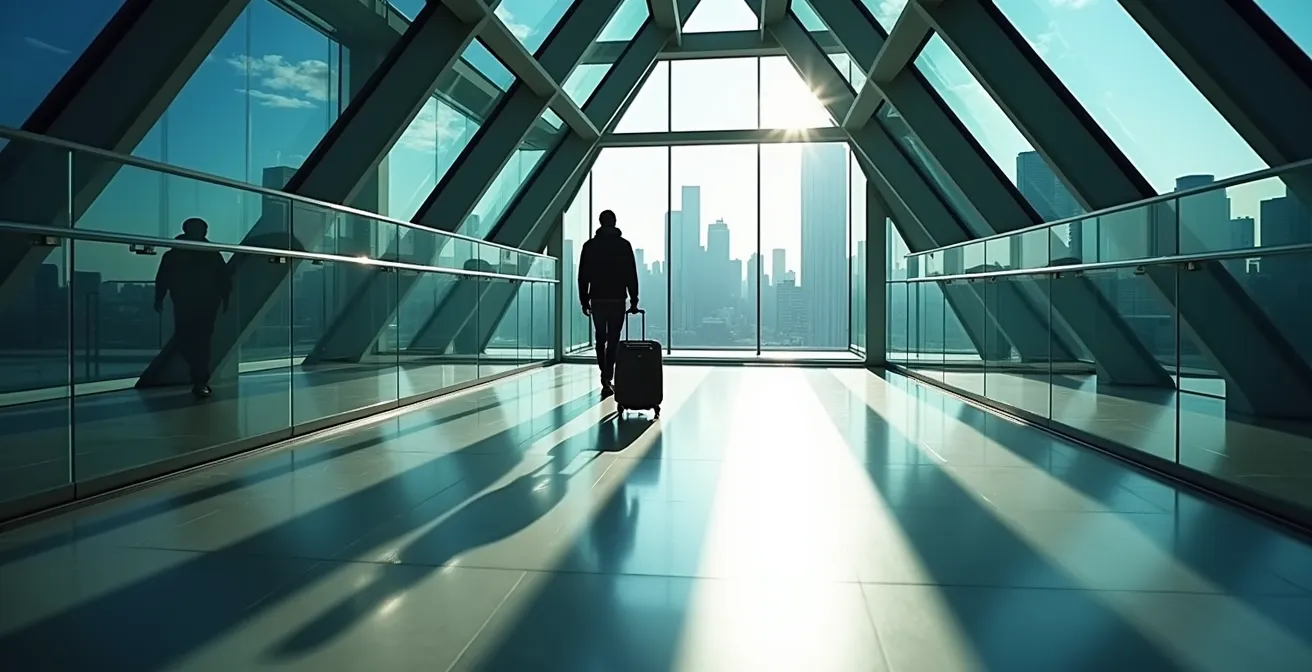
As the image above illustrates, the SkyWalk is a distinct, modern glass corridor. Once you enter it, you are on a direct path. The UP Express station is located inside this walkway. The journey from the VIA arrival gates to the UP platform is a continuous, indoor walk of approximately 5-7 minutes at a steady pace. Once at the UP Express station, trains to the airport are frequent and reliable. The trip to Pearson Airport takes a consistent 25 minutes, with departures every 15 minutes for most of the day.
Do not linger in the Great Hall or get distracted by the food courts. Your mission is singular: get to the west end of the station and enter the SkyWalk. This is the most critical instruction for making this connection efficiently.
Panorama Lounge vs. Great Hall: Where to Wait for Your Train?
Where you wait for your train at Union Station depends entirely on your ticket type, your needs, and the amount of time you have. The station offers three distinct environments: the exclusive Panorama Lounge, the grand public Great Hall, and the functional lower-level food courts. Choosing the right one optimizes your pre-departure experience.
The Panorama Lounge is an exclusive space reserved for VIA Rail Business Class passengers. It offers complimentary beverages, snacks, Wi-Fi, and a quiet environment away from the main station’s crowds. If you hold a business ticket and have more than 30 minutes, this is your best option for a calm and productive wait.
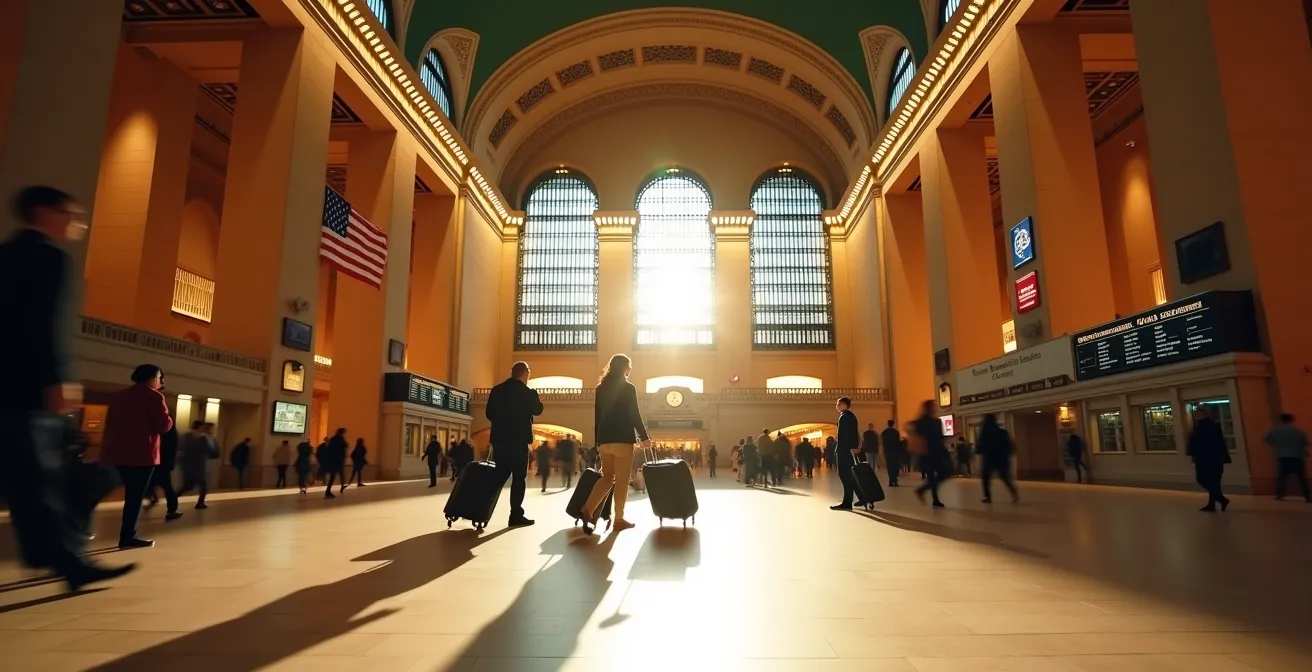
The Great Hall is the historic heart of the station. With its soaring Zumbro limestone walls and vaulted ceiling, it serves as the station’s primary meeting point and a photo opportunity. While seating is limited, its grandeur and central location make it the ideal place for a short wait or to meet others. It provides a sense of place that the purely functional concourses lack.
For longer waits or if you need to eat or work, the lower-level food court beneath the Bay Concourse is the most practical choice. It offers ample seating, tables, power outlets, and a wide variety of food options. This area is built for utility, not ambiance. The following table breaks down the key differences:
| Feature | Panorama Lounge | Great Hall | Food Court Lower Level |
|---|---|---|---|
| Access | VIA Business Class only | Public | Public |
| Hours | 6:00 AM – 8:00 PM | 5:30 AM – 12:45 AM | 5:30 AM – 12:45 AM |
| Amenities | WiFi, complimentary snacks | Historic architecture, LCBO | Power outlets, tables |
| Best For | Business travelers | Photos, meeting point | Working, eating |
As confirmed by VIA Rail’s official station information, each space serves a different function. Choose the Panorama Lounge for exclusivity, the Great Hall for atmosphere, and the food court for practicality.
The Screen Mistake That Makes You Miss Your GO Train Boarding
The single biggest mistake passengers make is focusing only on the departure time on the GO Transit screens. On a busy afternoon, multiple trains to different destinations can be scheduled for the same departure time. Staring at the clock will lead to confusion and potentially a missed train, a significant issue when data shows the vast majority of GO Transit’s 91% of train riders travel to or from Union Station.
The most critical piece of information on the departure board is not the time; it is your trip number. This unique identifier is assigned to your specific train service. Regular commuters know to identify their trip number and watch for it to appear on the screen. When the platform is assigned, it will appear next to this number. This is the signal to proceed to the designated platform stairs or elevator.
Another subtle but crucial cue is observing the crowd. Regular commuters often know which section of the concourse their train typically departs from. When you see a large group of people suddenly start moving with purpose, it is a strong indicator that a platform has just been announced for a major route. Do not follow blindly, but use it as a trigger to double-check the departure screens for your trip number. This “crowd-flow” is an unofficial but highly reliable part of the station’s rhythm.
To avoid this common error, shift your focus from the departure time to the trip number. It is the key to correctly identifying your train and ensuring a stress-free boarding.
Station Master’s Checklist: Securing Your GO Train Boarding
- Identify Trip Number: Locate your unique trip number on your ticket or schedule. This is your primary identifier on the departure board.
- Confirm Your Concourse: Verify if your train departs from Bay (Lakeshore lines) or York (all other lines) and position yourself accordingly.
- Monitor the Boards: Watch the departure screens specifically for your trip number to appear with a platform assignment. Ignore other trains with the same departure time.
- Observe Passenger Flow: Notice when large groups of regulars begin to move towards a platform, as this often signals an imminent departure for a major line. Use this as a cue to re-check the screens.
- Verify Train Type: Once on the platform, confirm if the train is an “Express” or “All Stops” service to ensure it will stop at your destination.
When to Arrive at Union for a VIA Rail Trip to Montreal?
For a VIA Rail trip, especially a long-haul journey like the one to Montreal, your arrival time at Union Station should be budgeted based on your ticket class and personal needs. Unlike a simple commute, inter-city train travel involves more steps. With Union Station handling 2.4 million VIA Rail passengers annually, the concourse can be crowded, and ticketing or baggage lines can form.
Here is the standard time allocation guidance:
- Standard Economy Class: Arrive 45-60 minutes before departure. This provides a comfortable buffer to check the departure board in the Great Hall, locate your gate, and navigate any crowds. If you need to check baggage or print a ticket at a kiosk, err towards the 60-minute mark.
- Business Class: Arrive 30-45 minutes before departure. Your access to the Panorama Lounge and priority boarding queue streamlines the process. This timeframe allows you to enjoy the lounge amenities without rushing.
- Passengers Requiring Assistance: Arrive at least 60 minutes before departure. As per VIA Rail’s policy, travelers with special needs should report to the Great Hall service desk well in advance to ensure staff can provide proper boarding assistance.
The main VIA Rail ticket counter is open from 6:00 AM to 8:00 PM. If your train is outside these hours, you must have your ticket in advance or use a self-service kiosk. Pre-boarding for families and passengers needing assistance typically begins 15-20 minutes before the general boarding call.

Your departure gate will be posted on the large screens in the Great Hall. Do not wait in the GO concourses. The VIA Rail experience is managed entirely from the Great Hall, which serves as the central waiting and information area for all inter-city trains.
How to Use the UP Express to Reach Downtown in 25 Minutes?
For travelers arriving at Toronto Pearson International Airport (YYZ), the UP Express is the most efficient and reliable method to reach downtown Union Station. The service is designed for speed and simplicity, bypassing all road traffic. A complete journey from the airport terminal to the heart of the city takes a predictable 25 minutes.
Follow this procedure upon arrival at Pearson:
- Follow “Train to City” Signage: From baggage claim in either Terminal 1 or Terminal 3, look for the prominent “Train to City” signs. They will guide you directly to the UP Express platform. If arriving at Terminal 3, you will first take the free Terminal Link train to Terminal 1, where the main station is located.
- Purchase Your Ticket: You do not need to buy a ticket in advance. You can tap a PRESTO card, credit card, or debit card directly on a PRESTO reader at the platform entrance. Alternatively, you can use the ticket vending machines. A standard one-way trip from Pearson to Union costs $12.35, or $9.25 with a PRESTO card.
- Board the Train: Trains run every 15 minutes from early morning until after midnight. There is ample space for luggage on dedicated racks. The journey is non-stop from the airport to Bloor Station, and then directly to Union Station.
- Arrive at Union Station: After the 25-minute ride, you will disembark inside the SkyWalk at the west end of Union Station. From here, follow the signs for your connecting service, whether it’s the TTC subway, GO Transit, or the taxi stands on Front Street.
The UP Express is a purpose-built system designed to eliminate the variables of travel time from the airport. By following the clear signage and using a simple tap-on payment, you can ensure a swift and stress-free arrival in downtown Toronto.
How to Walk from MTCC to Union Station Without Going Outside?
Yes, you can walk from the Metro Toronto Convention Centre (MTCC) to Union Station entirely indoors using Toronto’s PATH network. This is especially useful during inclement weather or cold winters. The PATH is a vast underground pedestrian network, and the route to Union Station is one of its main arteries. The walk takes approximately 10-15 minutes at a brisk pace.
The key to navigating this route is to follow the specific PATH signage. The system is color-coded, and for Union Station, you must follow the blue “P” signs. These signs are often accompanied by a small train icon, indicating the direction of the transit hub. The most direct route takes you from the MTCC, through a corridor connected to the base of the CN Tower, and into the SkyWalk.
Your main landmark on this journey will be the Scotiabank Arena. The PATH walkway leads directly through the arena’s public galleria. This section is open to the public even on non-event days and serves as the primary indoor link between the entertainment district and the station. Once you pass through the arena’s galleria, you will be deposited directly into the York Concourse of Union Station.
According to guides on downtown navigation, this PATH route is part of a 28-kilometre pedestrian network. Do not get sidetracked by the numerous retail and food court entrances. Maintain your focus on the blue “P” (PATH) signs and the signs for Scotiabank Arena and Union Station. This disciplined approach will guide you seamlessly from the convention centre to your train without ever stepping outside.
Key takeaways
- Understand the difference: Bay Concourse is for Lakeshore GO lines, while York Concourse serves all other GO lines and provides access to Scotiabank Arena.
- The UP Express platform is not in the main station; it’s a dedicated terminal accessible via the SkyWalk at the station’s west end.
- For GO Transit, always prioritize your trip number over the departure time on the screens to avoid confusion and missed trains.
The Great Hall at Union: How to Use Toronto’s Grandest Room as a Meeting Spot?
Union Station’s Great Hall is more than just a passageway; it is the ceremonial heart of the building and the most effective meeting point for travelers. Designated a National Historic Site of Canada since 1975, its grand scale and distinct architectural features make it an unambiguous landmark, unlike the visually similar concourses.
To use it as a meeting spot effectively, you must be specific. Simply saying “meet me in the Great Hall” is too vague. Instead, use one of these three precise landmarks within the hall:
- Under the Main Clock: The large, classic clock on the west side of the hall is a traditional and easily identifiable meeting point.
- At the East Entrance: The main entrance doors on the east side of the hall, leading towards Bay Street, provide a clear location away from the central flow of traffic.
- Near the VIA Rail Information Desk: The centrally located customer service desk is another highly visible and well-known landmark within the space.
The Great Hall’s function extends beyond transit. It is a cultural venue that frequently hosts art installations, markets, and musical performances through the Union Arts program. This dual purpose means the hall is always open, clean, and well-lit, making it a safe and pleasant environment to wait. Its acoustics can be overwhelming, so it is better for meeting than for quiet conversation. For the latter, you would proceed to a nearby cafe after meeting up. By using a specific landmark within this grand room, you leverage its status as a Toronto icon for a foolproof meeting plan.
Now that you understand the operational logic of Union Station, you are equipped to navigate its concourses and transfer between services with confidence. The next step is to apply this knowledge on your next journey through Canada’s busiest transportation hub.
Frequently Asked Questions on Mastering Union Station: How to Connect Between GO, VIA, and UP Express Seamlessly?
What are the PATH system hours?
Most PATH sections are open during business hours, but main routes like the one connecting the MTCC to Union Station typically remain open later, especially during events at the Scotiabank Arena or the convention centre.
Is the PATH accessible for wheelchairs?
Yes, the PATH network is designed to be accessible. Elevators are available at key points to navigate between levels, though some sections may involve long ramps. It is advisable to allow extra time for accessible routing.
How do I avoid getting lost in the PATH?
To avoid getting lost, focus exclusively on the color-coded directional signs. To get to Union Station, follow the blue ‘P’ signs, which often feature a railway icon, and look for landmarks like the Scotiabank Arena.